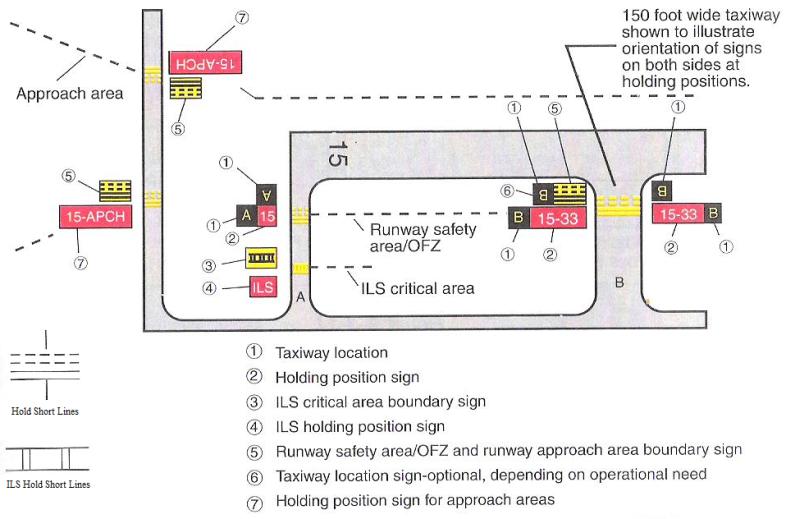
Every year, runway incursions remain one of the most serious safety concerns in aviation. A significant number of these incidents occur because pilots misidentify or misunderstand the painted markings and signs that define where an aircraft must stop before entering an active runway or an ILS critical area. Understanding runway hold short lines and ILS critical area signs is not just a knowledge-test topic — it is a fundamental safety skill that every private pilot must master before ever taxiing at a towered or non-towered airport.
This article covers the two distinct types of hold short markings and their associated signs in depth: the standard runway holding position markings (which protect active runways) and the ILS critical area markings (which protect the electronic signals that guide aircraft flying precision approaches in low visibility). Both look similar at first glance but carry different meanings, and confusing them is a surprisingly common trap on both the FAA knowledge test and in real-world operations.
Runway Holding Position Markings
The most important marking on any airport surface is the runway holding position marking, commonly called the hold short line. This marking is painted on the taxiway pavement at the point where a taxiway meets a runway, and it defines the boundary a pilot must not cross without an explicit ATC clearance at a towered airport, or without ensuring safety at a non-towered airport.
The marking consists of four yellow lines — two solid and two dashed, running perpendicular across the full width of the taxiway. The two solid lines are always on the taxiway side (the side the aircraft is approaching from), and the two dashed lines are always on the runway side. This arrangement is the critical memory hook: solid lines mean stop here. A pilot taxiing toward the runway sees the solid lines first and understands they mark the stopping point. A pilot exiting the runway sees the dashed lines first, indicating they are leaving the protected runway environment.
The individual lines within the runway holding position marking are spaced 6 inches apart, per FAA airport marking standards. The entire pattern is highly visible yellow and is supplemented by a runway holding position sign mounted on the left side of the taxiway (and sometimes both sides at wider taxiways). That sign features a white inscription on a red background showing the runway designation — for example, "15-33" — indicating that the aircraft is holding short of Runway 15-33. Red background signs at airports always indicate mandatory instructions. Crossing without clearance is a violation of 14 CFR Part 91 and can result in a certificate action.
ILS Critical Area Markings and Signs
A separate but visually similar set of markings exists to protect the ILS (Instrument Landing System) critical area. The ILS uses two ground-based radio transmitters — the localizer and the glide slope — to provide lateral and vertical guidance to aircraft flying precision approaches, especially in instrument meteorological conditions (IMC) and low visibility. Large metallic objects such as aircraft or ground vehicles parked or moving inside the ILS critical area can reflect or distort the radio signals, causing the needle indications in the cockpit of an aircraft on approach to fluctuate or deviate. In very low visibility conditions, this distortion could be catastrophically misleading.
The ILS critical area holding position marking consists of a ladder-like pattern of two solid yellow lines with two yellow lines connecting them, forming a series of rectangular segments — often described as looking like a railroad track or ladder pattern painted across the taxiway. This is distinct from the four-line runway hold short marking. The ILS critical area sign accompanying this marking has a white inscription on a red background and reads "ILS", sometimes combined with the runway number (e.g., "ILS 28L"). Like the runway hold short sign, the red background indicates a mandatory instruction.
ATC will instruct pilots to hold outside the ILS critical area when the airport is in a specific low-visibility condition. The instruction "hold short of the ILS critical area" or "do not enter the ILS critical area" means the pilot must stop before the ladder marking. When the approach is not in use or visibility is above certain minimums, ATC may allow aircraft to enter the critical area freely.
Why These Markings Matter
Runway incursions are categorized by the FAA from Category A (most serious, near miss or collision) down to Category D (little or no chance of collision but still a deviation). Many Category B and C incursions involve pilots who crossed a hold short line without authorization, often because they failed to recognize the marking or misread it as a simple taxiway centerline. The consequences range from frightening close calls to fatal mid-runway collisions.
ILS critical area violations are less immediately dramatic but carry real safety risk. When an aircraft holds inside the critical area during an ILS approach in very low visibility, the aircraft on approach may receive false course or glide path deviations. If the pilot trusts those indications, the result could be a controlled flight into terrain or a runway overrun. This is why ATC enforces ILS critical area holds strictly during Category I, II, and III operations.
Key Numbers and Rules
- Four yellow lines (2 solid + 2 dashed): Runway holding position marking. Solid lines face approaching traffic — stop here.
- Ladder/railroad pattern: ILS critical area holding position marking. Also yellow; distinct shape from the runway hold short.
- Red background sign: Always a mandatory instruction. Runway designation signs and ILS critical area signs both use red backgrounds with white text.
- White background sign: Location information (taxiway designator signs use black text on yellow background; direction/destination signs use black text on yellow background; runway distance remaining signs use white text on black background — none of these are mandatory).
- 14 CFR 91.129 and 91.127: Operating rules at towered and non-towered airports. Crossing a hold short line without clearance at a towered airport violates ATC instructions and may constitute careless or reckless operation under 14 CFR 91.13.
- At non-towered airports: Pilots must self-sequence and use radio calls on CTAF to coordinate before crossing hold short lines; there is no controller to provide explicit clearance, so extra vigilance is required.
- Enhanced taxiway centerlines: At some airports, the taxiway centerline stripe is flanked by two parallel dashed yellow lines beginning 150 feet before the runway holding position marking — a visual alert system to warn pilots they are approaching a hold short area.
- Surface painted hold short signs: Some airports also paint the runway designation directly on the taxiway pavement in addition to the vertical signage, offering an additional cue.
Memory Aid
For the runway hold short marking, remember: "Solid Means Stop." The two solid lines are on your side of the boundary when you are taxiing toward the runway. If you see solid lines in front of you, you have not yet crossed into the runway environment — and you must stop there unless cleared. Once you see the dashed lines in front of you, you are exiting the protected runway side. Think of it as the solid lines forming a wall: a solid wall you cannot pass through without permission.
For distinguishing ILS critical area markings from runway hold short markings, remember: "Ladder = Localizer." The ladder-shaped pattern protects the ILS localizer (and glide slope) signals. Runway hold short lines are simple parallel lines; ILS critical area lines look like a ladder or railroad tracks.
Common Test Traps
- Solid vs. dashed side confusion: The FAA loves to ask which side the solid lines face. Remember: solid lines face the taxiing aircraft on the taxiway side. Pilots crossing FROM the runway will see the dashed side first — this does NOT mean it is okay to stop on the dashes.
- ILS vs. runway hold short appearance: Test questions may describe or show a ladder marking and ask what it indicates. Do not confuse it with a standard runway hold short. The ladder pattern is exclusively the ILS critical area.
- Red sign = mandatory: The test often presents scenarios where a pilot ignores a red-background sign. Always know that red background signs are mandatory instructions — not suggestions, not informational.
- Holding inside vs. outside the ILS critical area: The question may ask what a pilot should do when instructed to "hold short of the ILS critical area." The answer is to stop before the ladder marking, not at the runway hold short line. These are two separate boundaries.
- Non-towered airport assumptions: Some students assume hold short lines only apply at towered airports. In fact, the markings exist at all certified airports, and pilots operating at non-towered fields are still expected to hold short and make proper radio calls before crossing onto any runway.
Mastering these markings is not merely about passing your written exam — it is about developing the habit of scanning, recognizing, and correctly interpreting every line and sign on the airport surface before moving. In the cockpit, hesitation or uncertainty about a hold short line should always resolve in one direction: stop, verify, then proceed. The runway will still be there when you have confirmed it is safe and clear to cross.