Every pilot learns to depend on the radio almost instinctively — a quick call to the tower and you receive a crisp clearance to land or taxi. But what happens when that radio fails, or when you are flying a classic aircraft with no radio at all? The FAA has a backup system that predates modern avionics by decades: the light gun signal. Knowing these signals is not just a matter of passing your knowledge test — it is a genuine safety skill that could one day allow you to operate safely in controlled airspace even when the most fundamental piece of cockpit equipment goes dark.
Light gun signals are standardized visual communications issued by an air traffic controller using a device called a light gun, which projects a highly focused, bright beam of red, green, or white light. The controller can aim the beam directly at a specific aircraft on the ground or in the air. Pilots who see the light directed at their aircraft must interpret the color and the pattern (steady or flashing) and respond appropriately. The entire system is defined in the Aeronautical Information Manual (AIM) and referenced in 14 CFR Part 91.
How Light Gun Signals Work
The light gun produces three colors — red, green, and white — and each color can be displayed in one of two modes: steady (a continuous beam) or flashing (a blinking beam). This gives six unique combinations, each carrying a different meaning depending on whether the aircraft is on the ground or airborne. That context — ground versus air — is critical, because the same signal can mean something completely different depending on where the aircraft is when it receives the beam.
The controller directs the beam toward a specific airplane. During daylight hours, pilots acknowledge a light signal by moving the ailerons or rudder (or by rocking the wings if airborne); at night, acknowledgment is made by flashing the landing light or navigation lights. The tower is watching for that acknowledgment before they issue another signal.
The Six Signals — Memorize Both Contexts
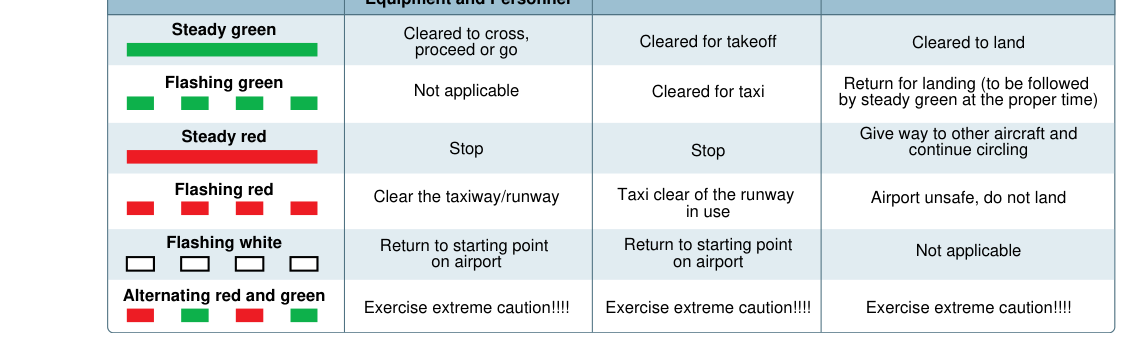
Here is the complete set of light gun signals as published in the AIM. Study the ground and airborne meanings side by side, because the FAA knowledge test will mix them deliberately.
- Steady GREEN — on the ground: Cleared for takeoff. This is the most straightforward signal: green means go, and a steady beam tells you the runway is yours.
- Steady GREEN — airborne: Cleared to land. Again, green means the pilot has a clearance, but now for landing rather than departure.
- Flashing GREEN — on the ground: Cleared to taxi. A flashing (blinking) green light tells a ground-based aircraft it is approved to begin taxiing, but it does NOT mean cleared for takeoff.
- Flashing GREEN — airborne: Return to land. The controller wants the aircraft to come back and land — often used when an aircraft that had departed needs to return, or when a non-radio aircraft in the pattern needs to be sequenced in.
- Steady RED — on the ground: Stop. A continuous red beam directed at a taxiing aircraft means halt immediately and hold your position.
- Steady RED — airborne: Give way to other aircraft and continue circling. The runway or airspace situation is not safe for landing; the pilot must remain in the pattern and wait.
- Flashing RED — on the ground: Taxi clear of the runway in use. This urgent signal tells a pilot on the runway surface to get off immediately.
- Flashing RED — airborne: Airport unsafe — do not land. Something on or near the airport makes landing hazardous. The pilot must not attempt to land until the situation is resolved.
- Flashing WHITE — on the ground: Return to starting point on the airport. This signal is unique to ground operations and means the controller wants the aircraft to go back to where it started — the ramp, the FBO, or the departure end it came from.
- Flashing WHITE — airborne: Not applicable / not assigned a specific meaning for airborne aircraft. (Some sources list this as a general signal; the AIM does not assign a standard airborne meaning to flashing white.)
- Alternating RED and GREEN — on the ground or airborne: Exercise extreme caution. This signal applies in both contexts and means the controller has spotted a hazard or conflict that the pilot may not be aware of. It is a general danger warning.
Why Light Gun Signals Matter
Radio failure at a towered airport is more common than many student pilots realize. An electrical fault, a dead headset, or even a stuck microphone can leave you unable to transmit or receive. When that happens at a controlled airport, the FAA expects you to squawk 7600 on the transponder (the lost-communications code) and look for light gun signals from the tower. Understanding those signals allows you to continue operating safely and legally without disrupting other traffic.
Non-radio-equipped aircraft — antique taildraggers, gliders towed into the pattern, or ultralight-category aircraft operating near a towered field — also rely on light gun procedures. Even if you never fly such an aircraft yourself, you may share the pattern with one, and understanding how that aircraft is being directed by ATC helps you anticipate its behavior.
From a regulatory standpoint, 14 CFR 91.125 specifically addresses ATC light signals and makes clear that pilots operating at towered airports are expected to understand and comply with them. Operating in the traffic pattern while ignoring a light gun signal directed at your aircraft could be considered a violation of this section as well as a potential hazard to other traffic.
Key Numbers and Rules
- Light gun signals are defined in AIM Chapter 4 and referenced in 14 CFR §91.125.
- There are three colors (red, green, white) and two patterns (steady, flashing), yielding six primary combinations, plus the alternating red-and-green signal.
- The meaning of a signal depends on whether the aircraft is on the ground or airborne — never assume one context applies to the other.
- Pilots should acknowledge light signals during daylight hours by moving the ailerons or rudder (or rocking wings if airborne), and at night by flashing the landing or navigation lights.
- In the event of radio failure at a towered airport, squawk 7600 and look for light gun signals from the tower.
- Flashing white is the only signal that applies only to ground operations; the alternating red-and-green signal applies to both ground and airborne aircraft.
Memory Aid
A widely used memory trick for the color logic is to think of them in terms of urgency: Green = Go / Good news, Red = Stop / Risk, White = Wait / Where you were. Within each color, the steady version is the immediate clearance or command (steady green = cleared NOW, steady red = STOP NOW), while the flashing version is more instructional or preparatory (flashing green = get ready to go or come back, flashing red = get out of the way or stay out). The alternating red-and-green signal stands alone as a universal danger flag — whenever you see alternating colors, something unusual and potentially hazardous is happening.
Another approach many instructors use: write out a 2×3 grid on a notecard with columns labeled GROUND and AIR, and rows labeled STEADY GREEN, FLASHING GREEN, STEADY RED, FLASHING RED, FLASHING WHITE, and ALT. RED/GRN. Drill it until you can recite both columns from memory without hesitation.
Common Test Traps
- Ground vs. airborne confusion: The FAA loves to ask what a flashing red signal means, then specify whether the aircraft is landing or taxiing. Flashing red on the ground means leave the runway; flashing red in the air means do not land at all. Mix these up and you will answer wrong — and in real life, you could enter a dangerous situation.
- Flashing green on the ground is NOT a takeoff clearance: Flashing green on the ground means cleared to taxi only. Many students assume any green light means go — but only a steady green grants takeoff clearance. A flashing green means begin taxiing toward the runway.
- Steady green airborne means cleared to LAND, not something else: Students sometimes confuse steady green in the air with a traffic advisory or an instruction to continue. A steady green directed at an airborne aircraft is specifically a landing clearance.
- Alternating red and green applies to BOTH ground and air: Some students think the caution signal only applies in flight. It is valid in either environment — always exercise extreme caution when you see it.
- Flashing white has no standard airborne meaning: If a test question asks what flashing white means to an aircraft in flight, be cautious. The AIM assigns flashing white only to ground operations (return to starting point). If the question specifies an airborne aircraft, the answer may be that it is not a defined signal for that phase of flight.
Light gun signals represent one of aviation's most elegant backup systems — a simple device and a handful of color codes that can keep traffic moving safely even when every radio in the cockpit has gone silent. Commit this table to memory, practice it during your training, and you will be prepared for the knowledge test and for whatever the real world might throw at you in the pattern.