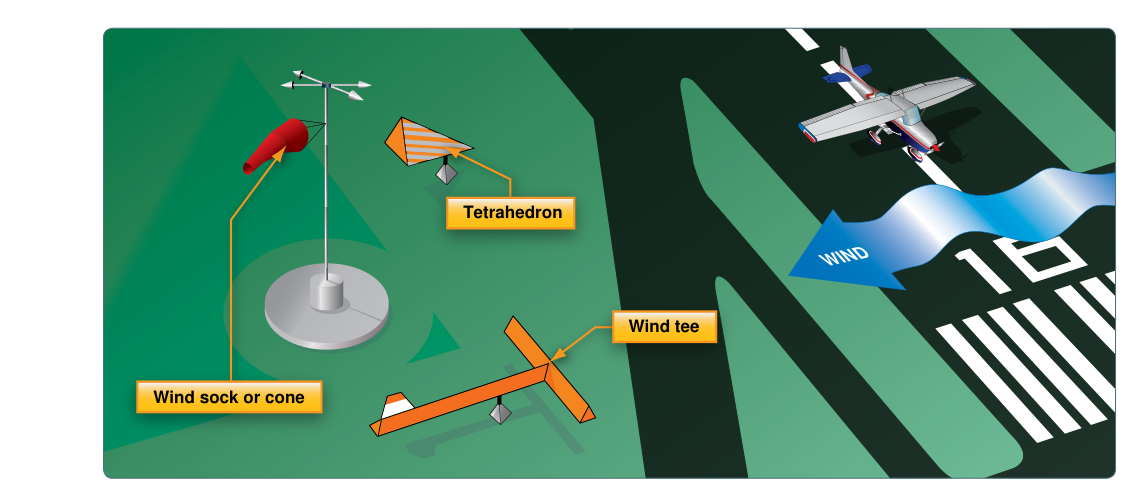
Every time you approach an unfamiliar airport, one of your first tasks is figuring out which runway is in use and what the wind is doing. At towered airports you simply follow ATC instructions, but at the thousands of non-towered airports across the country, the wind indicators on the ground are your primary source of that information. The FAA recognizes three types of visual landing-direction and wind indicators: the windsock, the tetrahedron, and the wind tee. Each tells a slightly different story, and the Private Pilot knowledge test expects you to read all three confidently.
These indicators are normally located in a designated segmented circle near the center of the airport or adjacent to the runway in use. The segmented circle system — described in the Aeronautical Information Manual (AIM) and the Pilot's Handbook of Aeronautical Knowledge (PHAK) — gives pilots a single place to look for traffic pattern information, and the wind indicator sits at its center.
The Windsock
The windsock is the most common and most information-rich of the three indicators. It is a cone-shaped fabric sleeve mounted on a pole so that it swings freely in the wind. Air enters the wide open end and exits through the narrow tapered end, which means the small end always points downwind — away from the direction the wind is coming from. To determine wind direction for landing, you do the opposite: you want to land with the wind coming at you, so you land toward the large open end of the sock.
Beyond direction, the windsock also gives you a rough estimate of wind speed. A fully extended, horizontal windsock indicates a wind of approximately 15 knots or greater. A sock hanging at roughly 30 degrees suggests winds around 6 knots, and a limp, barely-moving sock indicates nearly calm conditions. Some airports install windsocks that are calibrated so that full extension corresponds to exactly 15 knots; these are required at certain airports under FAA standards to give pilots consistent speed cues.
FAA regulations under 14 CFR Part 139 (Airport Certification) require certified airports to maintain windsocks that meet specific standards, including illumination for night operations. Even at small, non-certificated airports you will almost always find a windsock because it is inexpensive, requires no power source to operate, and is universally understood. At night, a lighted windsock is illuminated so that its orientation remains readable on approach.
The Tetrahedron
The tetrahedron looks like a large arrowhead or a three-dimensional kite shape pivoting on a pedestal. Unlike the windsock, the tetrahedron does not primarily indicate wind — it indicates the recommended landing direction. Pilots should land in the direction the tetrahedron's small pointed end is aimed, which is the same direction they should fly on final approach.
Think of it this way: imagine the tetrahedron as a giant arrow parked on the ground. The small, pointed apex faces into the landing direction — the direction you fly as you touch down. You fly toward the point and land in the direction the point is facing.
Because the tetrahedron is free to pivot on its mount, it normally weather-vanes into the wind just like the windsock, so under most conditions its pointed end faces into the wind and you land toward the point — directly into the wind. However, airport personnel can manually pin or lock the tetrahedron in a fixed position to indicate a specific runway that is preferred for reasons other than wind alone, such as noise abatement, obstructions, or runway condition. When the tetrahedron is locked, it is no longer acting as a wind indicator, and the direction it points may not align with the actual wind. This is an important distinction — and a common test trap.
The Wind Tee
The wind tee (also called a wind T or tee windsock) resembles a small airplane or the letter T mounted on a swivel post. Like the tetrahedron, the wind tee indicates the direction to land rather than wind direction itself. Pilots land in the direction the wind tee is pointing — that is, in the direction the top bar of the T (the "wings") faces, following the "nose" of the T-shaped indicator.
The wind tee also free-pivots so it naturally aligns with the wind under normal conditions, and it can also be manually positioned by airport personnel to designate a preferred landing direction independent of the wind. The operational logic is identical to the tetrahedron: when free to move, it acts like a wind indicator; when locked, it acts as an official traffic pattern advisory.
In practice, wind tees are less common today than they were in earlier decades of aviation, but they still appear at some older general aviation airports and in FAA knowledge test questions. Distinguishing the wind tee from the tetrahedron visually is simple: the tee looks like a miniature aircraft or a T, while the tetrahedron is a three-dimensional triangular or kite shape.
Why It Matters
At a non-towered airport, misreading a wind indicator can lead you to land downwind — a significant safety hazard. A downwind landing increases your groundspeed over the runway, extends your landing roll, and can cause you to overshoot. With a strong tailwind, the consequences can be severe, particularly on a short runway. Reading the indicators correctly before entering the pattern gives you the information you need to choose the correct runway, fly the appropriate traffic pattern, and land safely.
These indicators also help you coordinate with other traffic. At a busy non-towered airport, all pilots are expected to monitor the common traffic advisory frequency (CTAF) and to observe the segmented circle and wind indicators. Consistent interpretation of these visual cues reduces the chance of conflicting traffic-pattern entries.
Key Numbers and Rules
- Windsock — fully extended and horizontal: indicates approximately 15 knots of wind or greater.
- Windsock — limp or barely moving: indicates calm or near-calm winds (less than 3 knots).
- Windsock direction: the small end points downwind; land toward the large open end (into the wind).
- Tetrahedron and wind tee direction: land in the direction the small point (or nose of the tee) is aimed.
- Manual locking: both the tetrahedron and wind tee may be pinned by airport personnel; when locked, they indicate a preferred landing direction, NOT necessarily the wind direction.
- Location: wind indicators are typically found in or near the segmented circle at the airport.
- Night visibility: windsocks at certificated airports must be illuminated for night operations (14 CFR Part 139).
- Segmented circle: the system surrounding the wind indicator may also include L-shaped traffic pattern indicators that show the direction of the pattern for each runway.
Common Test Traps
- Confusing direction on the windsock: students sometimes think the small end points into the wind. Remember — the small end points downwind (the way the wind is going), and you land toward the large, open end (into the wind).
- Assuming the tetrahedron or wind tee always shows wind direction: when either indicator is manually locked by airport personnel, it shows the preferred landing direction, which may not agree with the actual wind. Only the windsock reliably shows real-time wind direction at all times.
- Mixing up tetrahedron and wind tee landing direction: for both indicators, land in the direction the pointed apex or nose is facing — fly toward the point on your final approach.
- Missing the 15-knot threshold: FAA questions sometimes ask what a fully extended windsock indicates. The answer is winds of approximately 15 knots or greater — not "20 knots" or "10 knots."
- Ignoring the segmented circle: the wind indicator alone may not tell the whole story. The L-shaped extensions on the segmented circle indicate traffic pattern direction for each runway. Always check both when operating at an unfamiliar non-towered airport.
Wind indicators are elegantly simple tools, but reading them correctly under the workload of pattern entry demands that you understand exactly what each one is telling you. Practice identifying all three types in ground study and on airport diagrams so that your scan of the segmented circle is fast, accurate, and automatic every time you arrive at a new airport.