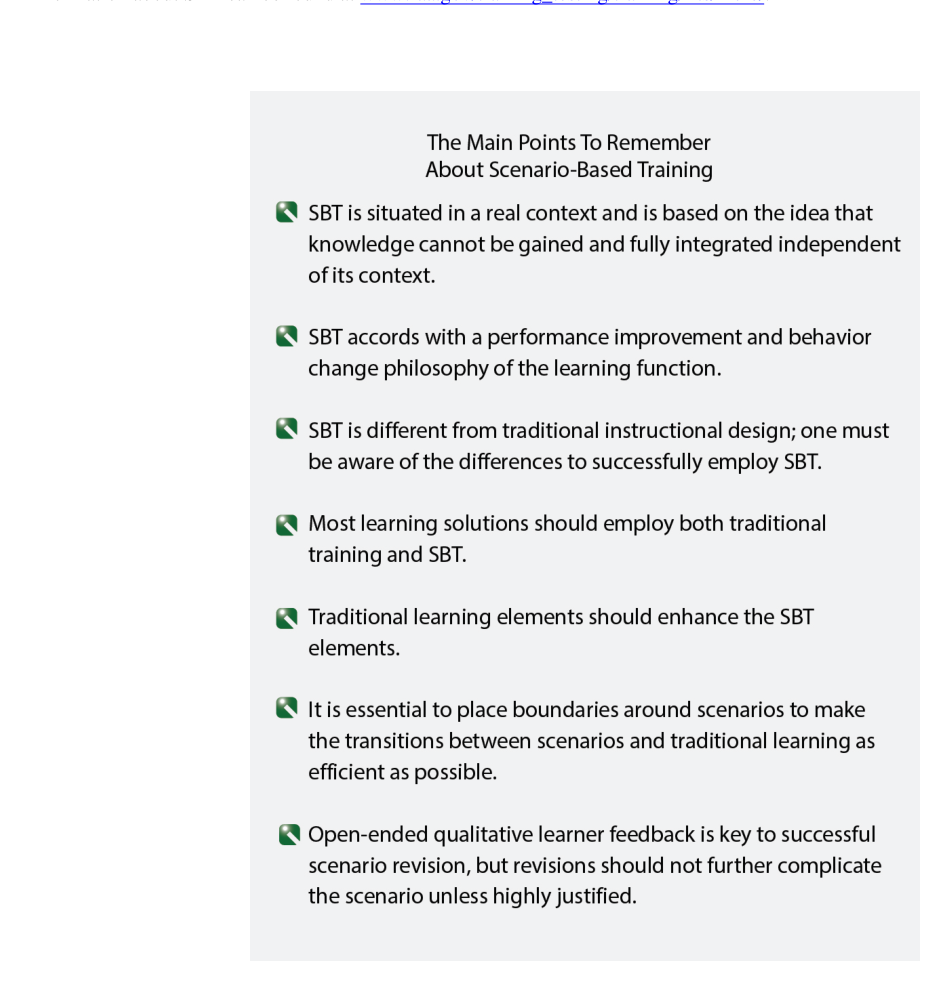
Picture a student who can flawlessly recite every step of a cross-country fuel calculation during a ground lesson, yet struggles to decide whether to divert when an unexpected headwind, marginal destination weather, and a pressing passenger combine into a single stressful moment in flight. That gap between isolated knowledge and real-world judgment is the central problem that scenario-based training (SBT) was designed to solve. The FAA's Aviation Instructor's Handbook (FAA-H-8083-9) defines SBT as a training system that uses structured, realistic scenarios to place learners inside a problem rather than in front of one, requiring them to gather information, assess risk, and exercise judgment exactly as a pilot in command must. Understanding SBT deeply — its theoretical roots, its mechanics, its pitfalls, and its relationship to conceptual learning — is essential for both the Flight Instructor Practical Test and the FAA Fundamentals of Instructing knowledge test.
The Learning Hierarchy: From Rote to Correlation
SBT draws its rationale directly from the FAA's framework of the levels of learning, which the Aviation Instructor's Handbook identifies as rote, understanding, application, and correlation. These levels form a hierarchy of increasing cognitive depth and durability.
Rote learning is simple memorization — a student can recite that the standard traffic pattern altitude is 1,000 feet AGL without comprehending why. It is the most fragile level; information memorized in isolation is easily forgotten and poorly transferred to novel situations. Understanding adds the why: the student grasps that 1,000 feet AGL provides traffic separation and gives adequate time to configure the aircraft. Application means the student can use that understanding to fly an appropriate pattern at an unfamiliar airport, even without an explicit instruction. Correlation — the highest level — occurs when the learner connects patterns across multiple domains simultaneously: understanding how traffic pattern altitude interacts with noise abatement procedures, local terrain, wake turbulence avoidance, and ATC instructions all at once.
Traditional lecture-and-drill instruction tends to produce rote and, at best, understanding. SBT is specifically engineered to push learners into application and correlation by embedding facts inside a context that demands their integration. A student who has only memorized VFR weather minimums knows numbers; a student who has worked through a scenario where marginal VFR gradually deteriorates while a passenger expresses urgency understands what those numbers protect and why violating them is catastrophic. That is conceptual learning.
How Scenario-Based Training Works
Structure of a Well-Designed Scenario
An effective SBT scenario, as described in the Aviation Instructor's Handbook, has several defining characteristics. First, it presents a realistic, complete situation — not a stripped-down drill with one variable, but a rich environment with multiple simultaneous factors. Second, it positions the student as the pilot in command and decision-maker, not an observer watching someone else solve the problem. Third, it includes embedded decision points where the student must gather information, weigh options, and commit to a course of action. Fourth, it evolves — the instructor may inject new information (a PIREP, a changing NOTAM, an ATC instruction) as the scenario unfolds, preventing the student from over-planning a canned response.
Consider a concrete example. A student is planning a cross-country flight to an airport 180 nautical miles away. During preflight planning, the scenario introduces: a METAR at the destination showing ceilings at 2,500 feet broken with a TAF trending lower; fuel burn from the last flight that was 5 percent higher than the POH value; a passenger who has a medical appointment and cannot be late; and a NOTAM closing the primary runway for construction. The student must integrate weather interpretation, fuel planning, risk management, aeronautical decision-making (ADM), and regulatory compliance — all simultaneously. No single checklist answers the question. That is SBT doing exactly what it is designed to do.
The Instructor's Role: Facilitator, Not Lecturer
One of the most important — and frequently tested — concepts about SBT is the transformation it demands of the instructor. The Aviation Instructor's Handbook describes this approach as guided discovery learning. Rather than standing at the front of a room presenting information, the SBT instructor asks guiding questions, listens actively, and withholds the answer long enough for the student to wrestle productively with the problem. Research consistently supports guided discovery as far more effective than passive reception of information, because the cognitive effort of working toward a conclusion strengthens the memory trace and builds transferable mental models.
Practically, this means the instructor might say, "Looking at that TAF, what are you thinking about your alternate planning?" rather than immediately explaining alternate weather minimums. The goal is to make the student's reasoning visible — to the student as much as to the instructor — so that errors in logic can be identified and corrected at the conceptual level rather than simply at the procedural level.
The Debrief: Where Conceptual Learning Is Consolidated
The Aviation Instructor's Handbook is explicit that the post-scenario debrief is not optional — it is where the instructional value of the scenario is actually realized. During the debrief, the instructor guides the student to articulate what they observed, what they decided, why they decided it, and what they might do differently. This reflection converts experience into mental models: the internal frameworks that allow skilled pilots to recognize patterns, anticipate problems, and respond effectively when the unexpected happens. Skipping the debrief is like doing all the reps in the gym and then not letting the muscle recover — the growth doesn't happen.
Effective debriefing questions are open-ended and principle-focused: "What was the most important piece of information you used?" or "At what point did you feel the risk level was changing, and why?" These questions reinforce correlation-level learning by requiring the student to synthesize across domains.
SBT and Aeronautical Decision-Making
The FAA Risk Management Handbook (FAA-H-8083-2) emphasizes that ADM is a perishable skill that must be practiced in realistic conditions, not merely read about. SBT is the primary instructional vehicle for building ADM competency. When students repeatedly work through scenarios involving risk factors — weather, fatigue, mechanical anomalies, passenger pressure — they build pattern recognition that allows faster and more accurate assessment of real hazards. The FAA's concept of hazard identification and risk mitigation becomes instinctive rather than theoretical. This is the difference between a pilot who reads about get-there-itis and a pilot who has felt the pull of it in a controlled training environment and learned to recognize and counter it.
Key Facts and Rules
- Four levels of learning: rote, understanding, application, correlation — SBT targets application and correlation.
- SBT is equipment-agnostic: scenarios can be conducted in ground school, on a desktop flight trainer, in a full-motion simulator, or during actual flight. The defining feature is the realistic problem structure, not the hardware.
- Guided discovery is the instructional technique paired with SBT — questions that lead the student toward insight, not lectures that deliver the answer.
- Mental models are the long-term cognitive product of effective SBT — internalized frameworks enabling pattern recognition and rapid, accurate judgment.
- ADM is a practiced skill, per FAA-H-8083-2 — SBT is the primary method of building it systematically.
- The debrief is a required element of SBT, not an optional add-on — conceptual learning is consolidated during structured reflection after the scenario.
Common Test Traps
- SBT is not primarily for memorizing procedures. A frequent distractor frames SBT as a tool for drilling checklists or building rote recall. The correct answer always ties SBT to higher-order learning — application, correlation, and ADM skill development.
- Instructor silence during the scenario is intentional and correct. Questions often ask what the instructor should do while the student works through a scenario. The answer is guided facilitation — asking questions — not immediate correction, demonstration, or taking control of the scenario.
- Omitting the debrief is a critical error. Some test questions treat the scenario exercise itself as the complete training event. Per the Aviation Instructor's Handbook, the post-scenario debrief is where conceptual understanding is actually consolidated.
- SBT is not the same as a simulation exercise. Not every simulator session is SBT, and SBT does not require a simulator. The scenario structure and decision-making requirement define SBT, not the technology used.
- Correlation is not the same as application. Students often confuse these two higher levels. Application means using knowledge correctly in a familiar context; correlation means integrating knowledge across multiple domains in novel or complex situations — the hallmark of expert judgment.