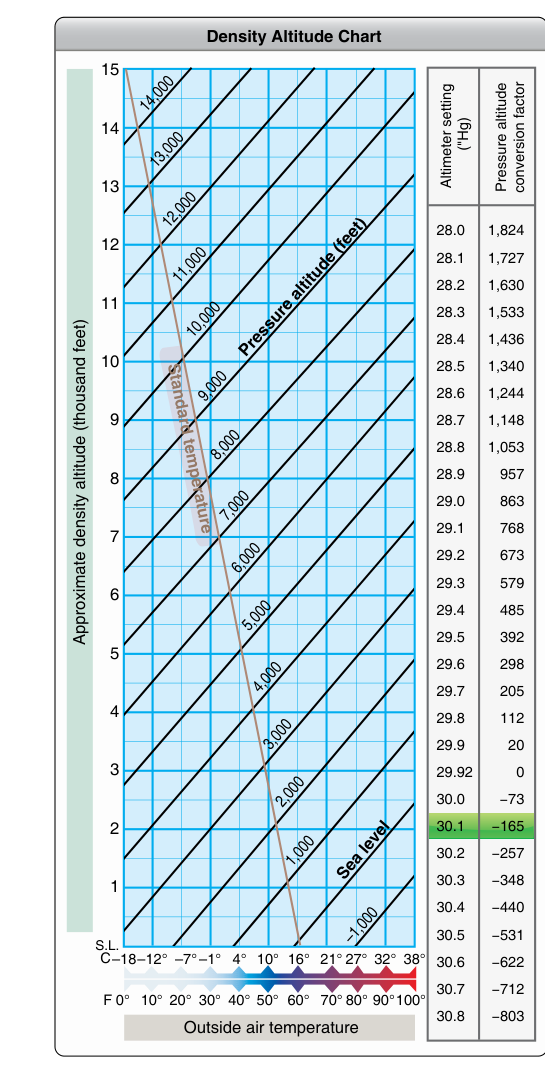
Every pilot hears the phrase density altitude early in training, but genuinely understanding its mechanics — and its consequences — can be the difference between a smooth departure and a catastrophic runway overrun. For sport pilots flying light-sport aircraft (LSA) with modest engines and short runways, density altitude deserves more than a passing glance. It deserves a systematic, numbers-first understanding before every flight conducted in heat, at elevation, or on a muggy summer afternoon.
What Density Altitude Actually Is
The FAA Pilot's Handbook of Aeronautical Knowledge (PHAK, FAA-H-8083-25) defines density altitude as pressure altitude corrected for non-standard temperature. To unpack that definition, start with pressure altitude: it is the altitude your altimeter indicates when you set the Kollsman window to 29.92 inHg. On a standard day — 15 °C (59 °F) and 29.92 inHg at sea level, with temperature decreasing at approximately 2 °C per 1,000 feet — pressure altitude and density altitude are identical. The instant actual temperature deviates above standard for a given pressure altitude, density altitude rises above pressure altitude. The air becomes less dense, and your aircraft performs as though it were operating at that higher altitude, regardless of what the ground elevation actually is.
Humidity adds a secondary effect. Water vapor is less dense than dry air, so high relative humidity further reduces air density. However, the PHAK is clear that temperature is the dominant variable; humidity is a contributing factor, not the primary driver. Still, on a hot and humid day, the combined effect can push density altitude several hundred feet above what temperature alone would suggest.
How to Determine Density Altitude
Sport pilots have several practical methods for calculating density altitude before flight. Each method should be cross-checked against the actual performance charts in the aircraft's Pilot Operating Handbook (POH) — no approximation replaces the POH.
Using the E6-B Flight Computer
On the analog E6-B, align the pressure altitude on the inner scale with the outside air temperature on the outer scale, then read density altitude from the designated window. This is the method most likely tested on the Sport Pilot knowledge test. Be precise: an error of even a few degrees Celsius can shift your density altitude result by several hundred feet.
Quick Field Estimate
A useful rule of thumb — grounded in the standard lapse rate relationship — is to add approximately 600 to 700 feet of density altitude for every 10 °F (about 5.6 °C) above standard temperature at your pressure altitude. For example, if your field sits at 3,500 feet pressure altitude and the temperature is 30 °F above standard, density altitude is roughly 5,300 to 5,600 feet. This estimate is conservative enough to use as a go/no-go trigger, but always follow up with the POH charts before departing.
POH Performance Charts
The most authoritative source is always the aircraft's own performance section. POH density altitude charts accept pressure altitude and temperature as inputs and directly output takeoff distance, accelerate-stop distance, and climb performance. For LSA, manufacturers often present both a standard conditions column and a correction factor table. Always use the worst-case data column that matches or slightly exceeds your actual conditions.
Why Density Altitude Devastates Performance
The performance penalties of high density altitude are cumulative and simultaneous — every system degrades at once. Understanding why each system suffers helps you retain the concept rather than memorize it blindly.
Engine Power Loss
A normally-aspirated (non-turbocharged) piston engine is essentially an air pump. It develops power by mixing fuel with a fixed volume of air. In thin air, each intake stroke captures fewer air molecules, so less fuel can be burned efficiently. Aviation training materials commonly cite a normally-aspirated engine losing approximately 3 percent of its rated power for every 1,000 feet of density altitude gain as a general rule of thumb, though the PHAK discusses this power loss qualitatively rather than asserting a fixed percentage. At 8,000 feet density altitude, you may retain only about 75 percent of sea-level power by this commonly used estimate. For an LSA with a 100-horsepower engine, that means operating on roughly 75 horsepower — a significant reduction in an aircraft that has little power margin to spare.
Propeller Thrust Loss
Even if the engine somehow maintained full power output, the propeller would still generate less thrust because it is working through thinner air. A fixed-pitch propeller — standard on most LSA — accelerates a mass of air rearward to produce thrust. With less air mass per unit volume, each revolution produces less thrust for the same RPM. This effect compounds the engine power loss rather than operating independently.
Reduced Aerodynamic Lift
Lift is proportional to air density. Thinner air requires the wing to achieve a higher true airspeed to generate the same lift it would produce at lower density. Because the airspeed indicator is a differential pressure instrument, it reads the same indicated airspeed at rotation regardless of density altitude — but the aircraft must cover more ground distance to reach that indicated airspeed, because the true airspeed (and thus groundspeed) at rotation is higher. This is the core reason takeoff ground rolls lengthen dramatically with rising density altitude.
Takeoff and Landing Distance Increases
The cumulative effect of reduced thrust, reduced power, and the need for higher true airspeed at liftoff can be striking. Aviation training references commonly note that at a density altitude of approximately 8,000 feet, takeoff distance can increase by 75 percent or more compared to sea-level performance, though the actual figure varies by aircraft type and should always be verified against the specific POH performance charts rather than treated as a fixed PHAK-stated value. For an LSA that normally lifts off in 900 feet, that translates to a ground roll exceeding 1,500 feet before accounting for obstacle clearance. Landing distances increase as well, because the aircraft crosses the threshold at a higher true airspeed and engine-assisted go-arounds are compromised.
Climb Performance Degradation
Reduced excess thrust directly reduces both rate of climb (feet per minute) and angle of climb (feet per horizontal distance). Obstacle clearance after takeoff — already a concern at short strips bordered by trees or rising terrain — becomes critical. The PHAK emphasizes that at high density altitudes, some aircraft may be unable to outclimb terrain gradients that would normally present no obstacle challenge at all.
Sport Pilot-Specific Vulnerability
LSA are specifically susceptible to density altitude hazards for several interrelated reasons. Their engines are small, normally-aspirated, and operating near maximum power during takeoff in any conditions. Their maximum gross weights are limited by the light-sport aircraft definition in 14 CFR 1.1 (1,320 pounds for landplanes, 1,430 pounds for seaplanes), which means small payload margins that can easily be consumed by fuel, a passenger, and baggage — leaving no performance buffer. Additionally, sport pilot certificates do not require the same breadth of aeronautical experience as a private certificate, meaning some sport pilots may encounter density altitude conditions without fully appreciating the numbers involved. Running the performance data is not optional; it is a safety-critical preflight task.
Key Numbers and Rules
- Standard sea-level conditions: 15 °C (59 °F), 29.92 inHg.
- Standard lapse rate: approximately 2 °C (3.6 °F) per 1,000 feet of altitude.
- Engine power loss: a commonly used training estimate is approximately 3% per 1,000 feet of density altitude for normally-aspirated engines.
- At 8,000 feet density altitude: roughly 75% of sea-level power available by this estimate; takeoff distance may increase 75% or more depending on the aircraft — always verify against the POH.
- Quick estimate: add ~600–700 feet of density altitude per 10 °F above standard temperature at the field.
- Humidity: reduces density slightly; temperature remains the dominant factor.
- IAS vs. TAS: rotate and lift off at the same indicated airspeed regardless of density altitude, but ground roll is longer because true airspeed (and groundspeed) at that IAS is higher in thin air.
Common Test Traps
- Density altitude above pressure altitude on a hot day: If temperature is above standard, density altitude exceeds pressure altitude. On a cold day, the reverse is true.
- High density altitude always means worse performance: Questions may describe a glamorous mountain airport on a warm afternoon and ask about performance. The answer is always degraded performance — longer rolls, reduced climb, less power.
- Do not confuse IAS with TAS at rotation: The aircraft rotates at the same indicated airspeed shown in the POH, but its actual speed over the ground is higher, which is why the ground roll lengthens.
- Humidity is real but secondary: Do not let humidity replace temperature as your primary concern. Temperature swings drive most density altitude changes you will encounter.
- Density altitude is not shown on any in-flight instrument: It must be computed. Your altimeter shows pressure altitude (with 29.92 set); no standard cockpit gauge directly displays density altitude.
Memory Aid
A widely used training mnemonic is "High, Hot, and Humid" — the three H's that drive density altitude upward and performance downward. This phrase is commonly taught but is not a verbatim FAA-endorsed term found in the PHAK or AFH. When all three stack together (a high-elevation field, afternoon heat, and summer humidity), treat the numbers with extra conservatism and consider delaying departure until cooler morning temperatures bring density altitude back down to a manageable level.