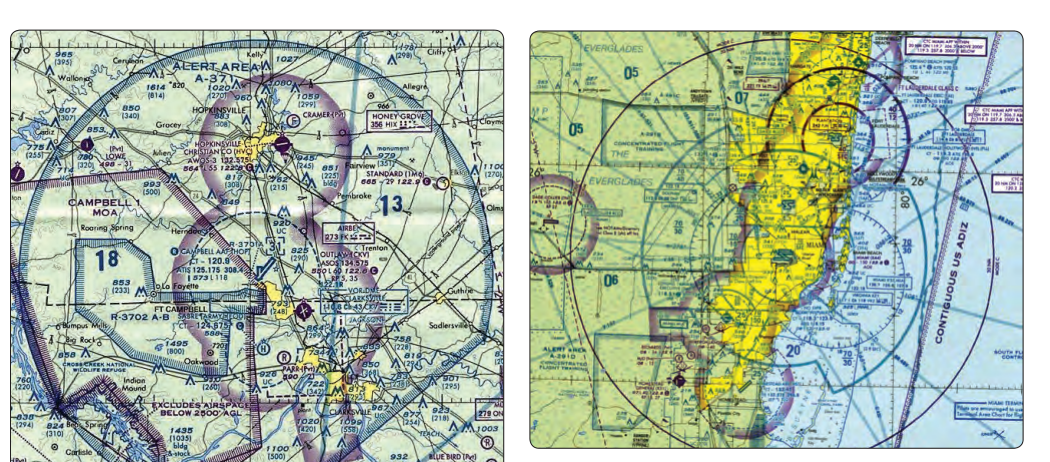
A Temporary Flight Restriction, or TFR, is a block of airspace temporarily closed to most flight operations by FAA order, published exclusively through the Notice to Air Missions (NOTAM) system. Unlike permanent restricted or prohibited areas that appear on sectional aeronautical charts, TFRs exist only in NOTAMs and official briefing products—which means a pilot who relies solely on a chart or a stale app cache can blunder into one with zero warning. For sport pilots, who already operate under a specific set of certification privileges and limitations under 14 CFR Part 61 Subpart J—including airspace endorsement requirements found in 61.325 and the general operating rules of Part 91—TFRs represent one of the most consequential preflight planning items on every checklist. Missing one can result in military intercept, certificate action, or disruption of life-safety operations. This article covers the regulatory basis of TFRs, every major TFR type a sport pilot will encounter, exactly how to decode a NOTAM, and the test traps that catch unprepared pilots every year.
Regulatory Foundation
The broad authority for TFRs comes from 14 CFR Part 91, which governs general flight rules for all civil aircraft including light-sport aircraft (LSA). Section 91.103 requires a pilot in command to become familiar with all available information concerning a flight before departure—and NOTAMs are explicitly part of that information. Ignoring a TFR is therefore a dual violation: the TFR regulation itself and the preflight planning requirement of 91.103. Several specific sections of Part 91 authorize different categories of TFRs, and each has different access rules.
Types of TFRs and Their Rules
Emergency Operations — 14 CFR 91.137
Wildfire-fighting TFRs are perhaps the most common type a VFR sport pilot will encounter in the western United States during summer and fall. Under 91.137, the FAA can establish a TFR to protect persons and property on the surface and to provide a safe environment for air tankers, helicopters, and lead planes. Three subparagraphs define who may enter: aircraft participating in disaster relief, aircraft with prior authorization from the controlling agency, or, in the case of 91.137(a)(3), any aircraft not hazardous to operations. The crucial safety point is that even a small LSA in a wildfire TFR can force an air tanker to abort a retardant drop on a fire line, directly endangering firefighters. The FAA and interagency fire community treat violations seriously, and enforcement actions follow quickly because radar and ADS-B track the offending aircraft in real time.
Space Launch and Reentry — 14 CFR 91.143
Commercial space activity has made 91.143 TFRs increasingly common near coastal launch sites. These TFRs protect the trajectory corridor from falling debris during ascent and the approach corridor during powered reentry. They are typically announced well in advance and appear as scheduled NOTAMs, but they can shift or extend if a launch is scrubbed and rescheduled. Sport pilots near Florida's Space Coast or California's Vandenberg area need to check for these routinely.
National Security — 14 CFR 91.141
Presidential movement TFRs are issued under 91.141 and are among the most strictly enforced restrictions in the entire NAS. When the President of the United States travels, two concentric TFR rings are typically established around the destination: an inner ring (often 10 nautical miles in radius) where no civil operations are permitted unless specifically authorized, and an outer ring (often 30 nautical miles) where VFR flight may be permitted at or below a specified altitude only if the pilot is in two-way radio communication with ATC. Sport pilots who are not operating in radio-equipped aircraft or who lack a Class B, C, or D endorsement face additional complications operating near the outer ring. Violators are intercepted by military fighters with no hesitation—interception procedures are detailed in the AIM Chapter 5, and they are not a drill.
Sporting Events, Air Shows, and Other Public Events — 14 CFR 91.145
Section 91.145 authorizes TFRs for large sporting events, major outdoor entertainment events, and similar gatherings. In practice, the FAA typically applies this TFR to stadiums with a seating capacity of 30,000 or more, per longstanding FAA policy—though this seating figure is not itself written into the text of 91.145. These TFRs are typically limited in altitude (often surface to 3,000 feet AGL) and radius (typically 3 nautical miles), but they can appear over or adjacent to small airports that sport pilots use routinely. An LSA pilot departing a grass strip inside the TFR radius during a college football game could find the runway itself inside the restriction.
Other TFR Authorities
Additional TFR authority exists for flight over national disasters and incidents under 91.137, hazardous materials incidents, and specific security-sensitive facilities. The FAA may also issue a Flight Restriction in the Vicinity of the Presidential and Other Parties (91.141) for Vice Presidential movement or other designees as defined by applicable security directives.
How to Find TFRs Before Every Flight
Three FAA-provided resources should be part of every sport pilot's preflight routine:
- FAA NOTAM Search (notams.faa.gov) — The authoritative source. Search by departure airport identifier, destination, or geographic area. Results are in raw NOTAM format.
- 1800wxbrief.com — The FAA's official integrated weather and NOTAM briefing portal. A Standard or Abbreviated Briefing automatically includes applicable NOTAMs for your route of flight and is the recommended method for 91.103 compliance. The system timestamps your briefing, creating a record that a preflight check was conducted.
- FAA TFR Graphical Map (tfr.faa.gov) — A nationwide graphical overlay of active and scheduled TFRs. Invaluable for a quick visual confirmation, but always cross-check with the official NOTAM text for exact boundaries and times.
Third-party apps and EFBs may display TFRs graphically, but they are not substitutes for an official briefing. App data can lag by minutes or even hours, and a sport pilot who receives a violation cannot successfully argue that an app showed clear airspace.
Decoding a TFR NOTAM: Four Critical Elements
Every TFR NOTAM, regardless of type, contains four elements you must extract before deciding whether your flight is legal:
- Lateral Boundary — Usually stated as a radius in nautical miles from a named geographic point, VOR, airport, or latitude/longitude coordinate. Some complex TFRs use irregular polygons described by a series of coordinates.
- Vertical Limits — Expressed in feet MSL or AGL, with both a floor and a ceiling. A TFR described as surface to 17,999 feet MSL prohibits all altitudes, including low-level flight. A TFR with a floor of 3,000 feet AGL technically allows flight beneath it, though sport pilots must still comply with their own altitude limitations and remain clear of clouds per 14 CFR 91.155.
- Effective Time — All NOTAM times are expressed in Coordinated Universal Time (UTC), also called Zulu time. A NOTAM valid from 1800Z to 2200Z in the Eastern time zone during Daylight Saving Time is active from 2:00 PM to 6:00 PM local—not 6:00 PM to 10:00 PM. Misreading time zones is a classic trap.
- Controlling Authority — Identifies who issued the TFR and, where applicable, who to contact for an authorization or waiver. For a wildfire TFR, this is often a specific ATC facility or Forest Service frequency. For a security TFR, the controlling authority will not grant exceptions to sport pilots without prior coordination.
Memory Aid
Use LAVA to remember the four TFR elements: Lateral boundary, Altitude limits, Validity (time in Zulu), Authority (who controls it). If any one of these elements places your planned flight inside the restriction, you do not depart until the conflict is resolved.
Sport Pilot–Specific Considerations
Sport pilots operating under sport pilot privileges may not require a radio and may not hold endorsements for Class B, C, or D airspace. This is significant near presidential TFRs where the outer ring requires two-way radio communication with ATC for VFR transit. An unendorsed sport pilot in an unequipped LSA effectively cannot legally operate in or near the outer ring of a presidential TFR at all. Additionally, the lower cruise altitudes typical of LSA operations (often 1,500–3,500 feet AGL) place sport pilots squarely within the altitude bands of most sporting event and wildfire TFRs. Flying low does not mean flying below the TFR.
Common Test Traps
- TFRs do not appear on sectional charts. Only permanent restricted, prohibited, and warning areas are charted. TFRs are temporary and exist solely in NOTAMs. A current chart is not proof of clear airspace.
- Lack of awareness is not a defense. Flight into a TFR is a violation regardless of whether the pilot saw the triggering event, heard about it on the news, or received a radio call. The pilot's obligation under 91.103 is absolute.
- Zulu time conversion errors are very common. Always calculate the local equivalent of NOTAM times, accounting for your time zone offset and whether Daylight Saving Time is in effect.
- Short-notice issuance is routine. Presidential TFRs in particular can be issued with only one to two hours of notice. A briefing obtained three hours before departure may already be outdated. Get the most current briefing as close to actual departure as possible.
- A graphical app showing no TFR is not an official briefing. Only a briefing from 1800wxbrief.com or a certificated flight service station satisfies the spirit of 91.103 and creates an official record of compliance.