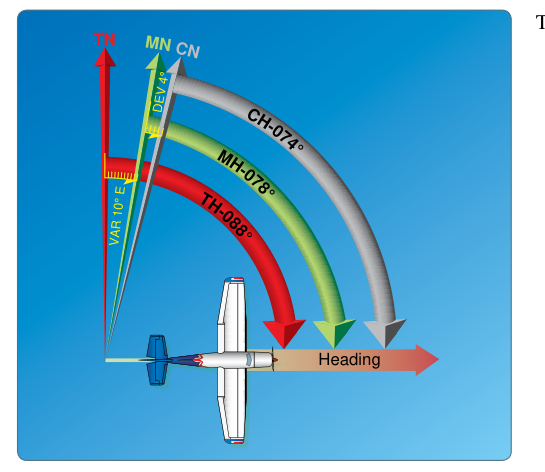
Every time you plan a cross-country flight, you are dealing with at least three different ways of expressing direction: the true course drawn on your chart, the magnetic course you dial into your compass rose or enter in calculations, and the compass heading (sometimes called indicated heading) you actually steer on the instrument panel. Getting these three values right — and converting cleanly between them — is one of the most reliably tested skills on the FAA Private Pilot Knowledge Test and one of the most practically important habits you will ever build as a pilot.
The reason three different numbers exist for what seems like the same idea — "the direction I want to fly" — is that the real world layers three separate sources of error on top of each other: the Earth's geography (true north versus magnetic north), the peculiarities of your individual airplane's magnetic environment (compass deviation), and any crosswind that pushes you off your intended track (wind correction angle). Strip those layers away one at a time and the conversions become logical rather than memorized.
True Course: Starting on the Chart
A true course (TC) is the direction of the line you draw on a sectional or WAC chart measured clockwise from true north — the geographic North Pole. Sectional charts are oriented to true north, so whenever you place your plotter along a route and read the angle at a meridian (line of longitude), you get a true course. This number has nothing to do with magnets, compasses, or wind. It is purely a geometric relationship between your departure point, your destination, and the Earth's axis.
Practical tip: always measure your true course at or near the midpoint meridian of your route, not just at the departure end. Over long legs, the direction of a straight line changes slightly relative to the curved meridians.
Magnetic Course: Correcting for Variation
Your airplane's compass does not point toward the geographic North Pole — it points toward the magnetic north pole, which wanders over time and is currently located in the Canadian Arctic. The angular difference between true north and magnetic north at any given location is called magnetic variation, and it is depicted on sectional charts as dashed magenta lines called isogonic lines. Each isogonic line is labeled with its variation value and either "E" (east) or "W" (west). The one special line where variation is zero is called the agonic line.
The conversion formula is:
Magnetic Course (MC) = True Course (TC) ± Variation
The sign rule is easy to remember: East variation is subtracted; west variation is added. Think of it this way — if magnetic north is to the east of true north from your location, your compass is already "pulled" eastward, so your magnetic course reading will be smaller than the true course. You correct by subtracting. If magnetic north is to the west, your compass reads a larger number than the true course, so you add the variation to get the equivalent magnetic course.
Example: You draw a true course of 090° on your sectional. Your area has 10° W variation (like much of the central and eastern United States). Your magnetic course = 090° + 10° = 100°. If instead you were flying in the Pacific Northwest with 18° E variation, your magnetic course = 090° − 18° = 072°.
Compass Heading: Correcting for Deviation
Even after correcting for variation, your cockpit compass introduces its own error called deviation. Deviation is caused by the magnetic fields generated by the aircraft's engine, avionics, wiring, and metal structures — all of which slightly deflect the compass needle away from magnetic north. Deviation varies not just by aircraft but by the heading of that aircraft, which is why every airplane carries a small card mounted near the compass called the compass deviation card (or compass correction card). It lists the deviation in degrees for various headings, typically in 30° increments.
The conversion formula is:
Compass Heading (CH) = Magnetic Course (MC) ± Deviation
The same sign logic applies: East deviation, subtract; west deviation, add. In practice, deviation values in light general aviation aircraft are usually small — often within ±5° — but they must be applied correctly, especially on headings where deviation is greatest.
Example continued: Your magnetic course is 100°. You consult the compass deviation card, which shows that on a heading of approximately 090°–120°, the deviation is 3° W. Your compass heading = 100° + 3° = 103°. That is the number you actually steer on the compass.
Wind Correction Angle: Heading vs. Course
There is an important distinction that trips up many students: course is where you want to go, while heading is where you point the nose. If there is any crosswind component, these will differ by the wind correction angle (WCA). The WCA is calculated during flight planning using the E6B flight computer (mechanical or electronic) or navigation software, and it is applied before variation and deviation in the full sequence.
The complete planning sequence from chart to cockpit is:
TC → apply WCA → True Heading (TH) → apply Variation → Magnetic Heading (MH) → apply Deviation → Compass Heading (CH)
Why does WCA go first? Because you are correcting for wind in the true-north world of the chart before translating that corrected direction into the magnetic world of the compass. If you have a 10° left crosswind correction and a 12° W variation, your compass heading could be quite different from your true course. Working the steps in order keeps every correction in its proper place.
The Full Worked Example
Suppose you are planning a flight with the following data:
- True Course from chart: 045°
- Wind correction angle (right crosswind): +8° (added because you crab right)
- True Heading: 045° + 8° = 053°
- Magnetic Variation: 5° E (subtract east)
- Magnetic Heading: 053° − 5° = 048°
- Deviation from card (near 045° heading): 2° W (add west)
- Compass Heading: 048° + 2° = 050°
You would steer 050° on the compass. Your ground track — if your WCA is correct — will be 045° true. The four values (TC, TH, MH, CH) are all different, but each one has a specific physical meaning and a specific correction linking it to the next.
Key Numbers and Rules
- East variation/deviation: subtract. West variation/deviation: add. This is the single most tested rule in this topic area.
- Isogonic lines are drawn in dashed magenta on sectional charts; the agonic line (zero variation) is a solid line.
- Variation values on sectional charts are updated periodically because the magnetic pole drifts; always use a current chart.
- Deviation is aircraft-specific and heading-specific — always consult the actual compass card in the airplane you are flying.
- The correct planning order is: TC → WCA → TH → Variation → MH → Deviation → CH.
- If a question gives you a compass heading and asks for the true course, simply reverse all the signs and work backwards.
Memory Aid
The classic mnemonic for the conversion sequence is "TVMDC — True Virgins Make Dull Companions" (or the more widely used "TV Makes Dull Children"). Each letter stands for one step:
- T — True (Course or Heading)
- V — Variation (apply to get Magnetic)
- M — Magnetic
- D — Deviation (apply to get Compass)
- C — Compass
When going from True to Compass (left to right in the mnemonic), remember: "Add West" — west variation and west deviation are both added. Going from Compass back to True (right to left), reverse the signs: west is subtracted. Some instructors pair this with the phrase "TVMDC — Add West" to capture both the sequence and the sign rule in one breath.
Common Test Traps
- Mixing up variation and deviation. Variation comes from the Earth's magnetic field and is read from the chart. Deviation comes from the airplane itself and is read from the cockpit compass card. They are corrected in that order — variation first, deviation second.
- Reversing the east/west sign rule. "East is least" (subtract) and "West is best" (add) is the traditional phrase. Many students get this backwards under time pressure. Write it on your scratch paper at the start of the test.
- Forgetting the WCA step. Some test questions provide wind data and expect you to compute true heading before applying variation. If you skip WCA and jump straight from TC to variation, you will get a wrong answer even if your arithmetic is perfect.
- Applying corrections in the wrong order. Applying deviation before variation — or confusing magnetic heading with magnetic course — is a classic error. The mnemonic TVMDC enforces the correct order; trust it.
- Working backwards without reversing signs. If a question gives a compass heading and asks for true course, every correction must be reversed. East values are now added when going from Compass toward True, and west values are subtracted. Students who memorize "add west" without understanding why often apply it in the wrong direction when the question is posed in reverse.