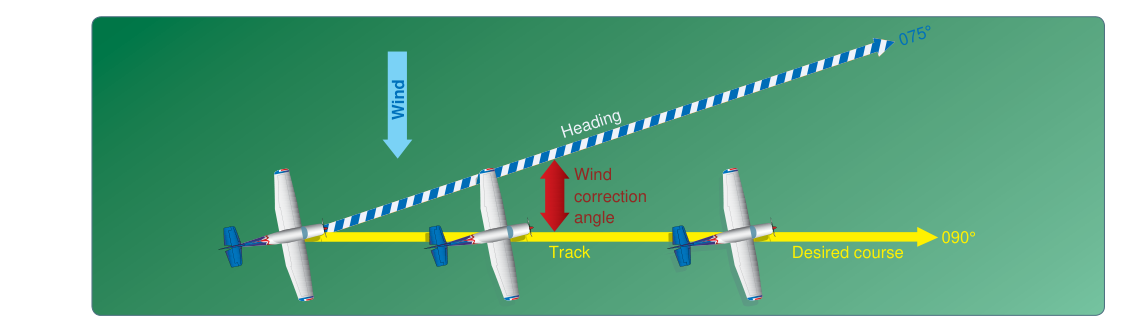
Every student pilot quickly discovers that an airplane in flight doesn't always point where it's going. Wind pushes the aircraft sideways, and unless the pilot compensates, the airplane drifts off course. The wind correction angle (WCA) is the deliberate crank of the nose into the wind to counteract that drift, keeping the aircraft tracking along the intended ground path. Closely related is groundspeed — the actual speed of the airplane over the ground, which determines how long a leg will take and how much fuel will be burned. Together, WCA and groundspeed are the two outputs of every wind triangle calculation and are tested heavily on the FAA Private Pilot Knowledge Exam.
Understanding these concepts requires a short tour of the three velocity vectors that every cross-country pilot must juggle: true airspeed (TAS), wind velocity, and groundspeed. Grasping how they interact geometrically is the key to confident, accurate navigation.
The Wind Triangle: How the Vectors Relate
Imagine the airplane as a boat crossing a river. The boat aims for the far bank (true course), the river current pushes it downstream (wind), and where the boat actually ends up moving over the ground is its resultant path. In aviation:
- True Course (TC) — the direction you want to travel over the ground, measured in degrees true from your chart.
- True Airspeed (TAS) — how fast the airplane moves through the air mass, in knots.
- Wind — reported as the direction FROM which the wind blows and its speed in knots. A wind of 270° at 20 knots comes from the west.
- True Heading (TH) — the direction the nose must point to achieve the desired true course. This differs from true course by the WCA.
- Groundspeed (GS) — how fast the airplane moves across the ground, determined by the vector sum of TAS and wind.
The wind triangle is literally a geometric triangle drawn (or solved mathematically) from these vectors. In practical cockpit navigation, pilots use an E6B flight computer — either the mechanical circular slide rule or its electronic equivalent — to solve this triangle quickly. The FAA Knowledge Exam provides problems where you must determine the correct heading and groundspeed given TAS, true course, and wind.
Wind Correction Angle: The Crab into the Wind
The wind correction angle is the angular difference between the true course you want to fly and the true heading you must steer. When a crosswind blows from the left, the WCA is applied to the left (nose points left of course); when wind is from the right, the WCA is applied to the right. The amount of correction depends on three factors: the crosswind component, TAS, and the angular relationship between the wind direction and the desired course.
For a mental approximation in the cockpit, pilots often use simplified formulas, but the authoritative method — and the one tested on the FAA exam — uses the E6B wind side. Here is how that works step by step:
- Set the wind direction under the true index on the rotating azimuth.
- Mark a wind dot upward from the center grommet a distance equal to wind speed.
- Rotate the azimuth to place the true course under the true index.
- Slide the card so that the wind dot falls on the TAS arc.
- Read groundspeed under the center grommet.
- Read the WCA (in degrees left or right) where the wind dot sits relative to the center line.
- Apply WCA to TC to get true heading: TH = TC ± WCA.
On an electronic E6B, you simply enter wind direction, wind speed, true course, and TAS, then read WCA and groundspeed directly. Many FAA exam questions provide these four values and ask for one of the outputs — always double-check that you're entering wind direction as the direction from which it blows, not toward.
Groundspeed: Why Headwinds and Tailwinds Matter
Groundspeed is the airplane's speed relative to the ground. A pure headwind (wind exactly opposite to the course) subtracts from TAS to reduce groundspeed. A pure tailwind adds to TAS and increases groundspeed. A pure crosswind (wind perpendicular to course) reduces groundspeed slightly and demands maximum WCA for the given conditions.
Consider a concrete example. A Cessna 172 cruises at 110 knots TAS on a true course of 090°. Wind is reported as 360° at 20 knots (from the north). Using the E6B, the pilot finds a WCA of approximately 10° left (nose points toward 080°) and a groundspeed of roughly 108 knots. The slight groundspeed reduction occurs because turning the TAS vector to correct for drift leaves a slightly shorter component along the course line, even though the wind itself is a pure 90-degree crosswind with no direct headwind or tailwind component. Now if the wind shifts to 270° at 20 knots (a direct tailwind for an eastbound course), groundspeed climbs to approximately 130 knots with zero WCA needed. The lesson: tailwinds save fuel and time; headwinds cost both.
From True Heading to Magnetic Compass Heading
The E6B gives you true heading, but the aircraft's compass reads magnetic heading. Pilots must apply two more corrections before dialing in the heading indicator:
- Variation — the angular difference between true north and magnetic north, found on sectional charts as isogonic lines labeled East or West. The memory aid: East is least, West is best (east variation is subtracted from true heading; west variation is added).
- Deviation — a small error caused by the airplane's own magnetic fields, listed on the aircraft's compass correction card. It is added or subtracted as directed on the card.
The full correction sequence: TC ± WCA = TH ± Variation = Magnetic Heading ± Deviation = Compass Heading. FAA exam questions often chain these steps together, so practice the full flow.
Why It Matters: Fuel, Time, and Safety
Accurate groundspeed is not merely academic — it directly determines estimated time en route (ETE) and fuel burn. ETE = Distance ÷ Groundspeed. If your planned leg is 90 nautical miles and your calculated groundspeed is 90 knots, you plan for exactly 1 hour of flight. Underestimate groundspeed (perhaps by forgetting a headwind) and you arrive later than expected with less fuel than planned — a potentially dangerous combination. Overestimate groundspeed and your position reports and fuel checks will be wrong from the start.
Under 14 CFR §91.151, VFR day flights require enough fuel to fly to the first intended landing and then continue for at least 30 minutes at normal cruise; night VFR requires 45 minutes of reserve. Both calculations rest on accurate groundspeed. Errors in WCA compound over distance: using the 1-in-60 rule, a 5° heading error introduces roughly 1 nautical mile of off-course error for every 12 miles traveled, so on a 100-mile leg you could be more than 8 miles off course without the correct WCA applied.
Key Numbers and Rules
- Wind is always reported as the direction it comes FROM, in degrees true (for aviation purposes).
- WCA is applied to true course to produce true heading: a left WCA means the nose points left.
- The complete heading conversion: TC ± WCA = TH ± Variation = MH ± Deviation = CH.
- VFR day fuel reserve: 30 minutes at cruise power (14 CFR §91.151).
- VFR night fuel reserve: 45 minutes at cruise power (14 CFR §91.151).
- A 10° heading error causes approximately 1 NM off-course per 6 NM traveled (the 1-in-60 rule provides a quick mental estimate).
- A direct headwind or tailwind affects only groundspeed, not WCA; a pure crosswind demands maximum WCA but has the smallest groundspeed effect.