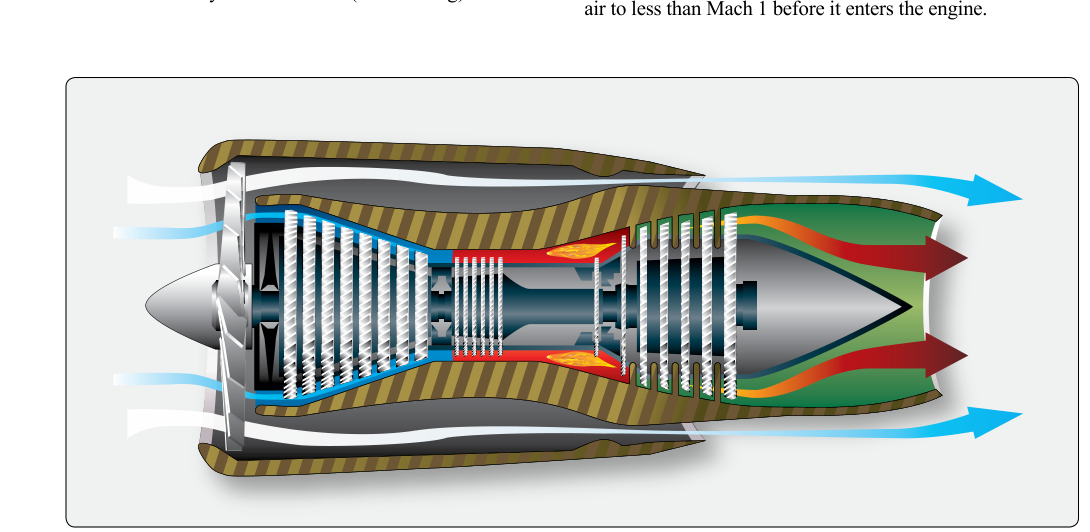
The turbofan engine is the powerplant of virtually every transport-category aircraft flying today, and understanding its fundamental operating principle—the bypass ratio—is essential for Airline Transport Pilot candidates. The concept governs fuel efficiency, noise, thrust output, and high-altitude performance limits, all of which appear on the ATP knowledge test and directly affect real-world line operations. This article dissects bypass ratio from first principles, traces how thrust is actually generated, and then ties both concepts to the high-altitude environment where transport jets spend most of their lives.
What Is a Turbofan and How Does the Bypass Ratio Work?
A turbofan is best understood as a turbojet engine with a large ducted fan mounted at the front, driven by energy extracted from the engine's turbine section. When air enters the inlet, it meets this fan first. The fan divides the incoming airflow into two distinct streams: a core stream that continues inward through the compressor, combustor, and turbine, and a bypass stream that flows through a separate annular duct surrounding the core and exits at the rear of the nacelle without ever being combusted.
The bypass ratio (BPR) is defined as the ratio of the mass airflow through the bypass duct to the mass airflow through the engine core. A BPR of 5:1, for example, means that for every pound of air processed by the combustion section, five pounds of air travel around it through the bypass duct. Modern high-bypass turbofans used on transport-category aircraft typically achieve bypass ratios in the range of 5:1 to 12:1, with some of the most fuel-efficient contemporary designs exceeding 12:1. Contrast this with early turbojet engines—which had no bypass stream at all and therefore a BPR of 0:1—or early low-bypass turbofans with ratios of 1:1 to 2:1. The shift toward ever-higher bypass ratios over the past several decades is one of the most consequential engineering trends in commercial aviation history.
How Thrust Is Generated: Newton's Third Law in Practice
All jet propulsion is an expression of Newton's Third Law: for every action, there is an equal and opposite reaction. A turbofan generates thrust by accelerating air rearward; the reaction force propels the aircraft forward. The net thrust equation quantifies this: net thrust equals the total mass flow rate of all air exiting the engine (both bypass and core streams) multiplied by the increase in velocity that the engine imparts to that air, minus any inlet momentum of the incoming air. Written simply: Thrust = (mass flow × exit velocity) − (mass flow × inlet velocity), accounting for both streams separately and then summing them.
Here is why BPR matters so profoundly from a thermodynamic standpoint. The propulsive efficiency of a jet engine is maximized when a large mass of air is accelerated by a small velocity increment, rather than a small mass accelerated by a huge velocity increment—even though both approaches can produce the same net thrust. The core stream exits at very high velocity but carries relatively little mass. The bypass stream exits at a much lower velocity but carries enormously more mass. The bypass stream therefore dominates the propulsive efficiency equation. On a modern high-bypass turbofan at typical cruise conditions, the fan and bypass stream generally provide the majority of the engine's total thrust output, with the exact proportion varying by engine design and bypass ratio, and the core contributing the remainder. This is also why specific fuel consumption (SFC)—the amount of fuel burned per unit of thrust produced—is dramatically better for high-bypass engines than for low-bypass or turbojet designs at subsonic cruise speeds.
High-Altitude Operations and Thrust Lapse
Understanding bypass ratio is inseparable from understanding what happens to turbofan performance as the aircraft climbs. Thrust depends on mass airflow, which in turn depends on air density. As altitude increases, air density decreases, and the mass of air the fan can capture and accelerate per unit time decreases proportionally. This phenomenon is called thrust lapse, and it is more pronounced in high-bypass engines because they depend so heavily on moving a large volume of air through the fan—the very thing that density reduction curtails most aggressively.
Because of thrust lapse, operators must consult certified performance data for every phase of high-altitude flight. The most safety-critical applications include:
- Second-segment climb: After an engine failure at V1, the one-engine-inoperative climb gradient requirement established under 14 CFR 25.121 must still be met, with operational compliance further governed by 14 CFR Part 121. Thrust lapse at higher density altitudes directly reduces the thrust available to meet this gradient.
- En route obstacle clearance: 14 CFR Part 121 operators must demonstrate that the aircraft can maintain a minimum net flight path (after accounting for engine failure) that clears all terrain and obstacles along the route. Reduced thrust at altitude tightens these margins.
- Maximum cruise altitude: The certified maximum altitude is reached when available thrust equals drag at maximum cruise thrust. Attempting to exceed this altitude—commonly called coffin corner—places the aircraft in a narrow speed band where low-speed (aerodynamic) buffet and high-speed (Mach) buffet limits converge, leaving virtually no usable speed range.
- Altitude-versus-temperature effects: On non-standard hot days, thrust loss is compounded. Many turbofan engines are flat-rated to a specific temperature (often called the flat-rating temperature or corner point temperature), an engine-specific engineering threshold below which full rated thrust is available; above that temperature, maximum thrust decreases with increasing temperature. Pilots must use performance charts, not rule-of-thumb assumptions.
Noise and Environmental Considerations
The large, relatively slow-moving bypass stream has a second major benefit: noise reduction. The high-frequency shriek of a turbojet's hot, high-velocity exhaust is substantially muffled when surrounded and diluted by the cooler, lower-velocity bypass flow. This is why high-bypass turbofans are so much quieter than their predecessors—a characteristic that directly affects compliance with noise certification standards under 14 CFR Part 36 and the associated ICAO noise chapters. Airport communities, noise abatement departure and arrival procedures (typically published in the Chart Supplement under airport remarks or as separate noise abatement procedure pages), and airline gate assignments can all be influenced by the noise footprint of the engine type, making BPR an operational concern, not just an engineering one.
Physical Tradeoffs of High Bypass Ratio
Increasing BPR is not without tradeoffs that ATP candidates should understand. A higher bypass ratio requires a physically larger fan diameter and correspondingly larger nacelle, which increases nacelle drag and structural weight. This is why the highest-BPR engines tend to appear on widebody, long-haul aircraft where the fuel-burn savings over many hours easily outweigh the weight and drag penalty of a larger nacelle. Narrowbody short-haul aircraft balance these factors differently. Additionally, very high bypass ratios become inefficient at transonic and supersonic speeds, because the large fan generates excessive drag and the low exit-velocity bypass stream loses propulsive efficiency as aircraft velocity approaches the bypass jet velocity. This is why supersonic transport designs use low-bypass turbofans or turbojets with afterburners—the BPR is deliberately kept low to optimize the exhaust velocity for high-speed flight.
Key Numbers and Rules to Know
- High-bypass turbofans: BPR approximately 5:1 to 12:1 or greater on transport-category aircraft.
- Low-bypass turbofans: BPR approximately 1:1 to 2:1, common on older transports and some military jets.
- Pure turbojets: BPR of 0:1—all airflow passes through the core.
- The fan stream typically provides the majority of total thrust on modern high-bypass designs, with the exact split varying by engine and bypass ratio.
- Thrust decreases with altitude primarily due to reduced air density reducing mass flow.
- Flat-rating temperature establishes the point above which rated thrust decreases; below it, full thrust is available regardless of ambient temperature (within limits). This is an engine-specific engineering concept rather than a fixed FAA regulatory value.
- 14 CFR Part 25, including 25.121, establishes airworthiness standards (including one-engine-inoperative climb performance requirements) for transport-category aircraft.
- 14 CFR Part 36 governs noise certification; high-BPR engines are inherently advantaged.
Common Test Traps
- Bypass air is not burned. The bypass stream is cold and unburned; it generates thrust purely through the momentum change imparted by the fan. No fuel is added to the bypass duct in a standard turbofan.
- Higher BPR does not equal higher maximum speed. High-bypass engines are optimized for subsonic cruise. Supersonic designs intentionally use lower bypass ratios because the large fan becomes a drag liability and efficiency penalty at high Mach numbers.
- Thrust is not power. Thrust is a force measured in pounds (or Newtons). Propulsive power equals thrust multiplied by true airspeed. A turbofan at brake release produces high thrust but relatively low power because airspeed is near zero.
- Density altitude still matters for turbofans. Unlike a normally aspirated piston engine, a turbofan is not displacement-limited, but it is absolutely density-dependent. Hot, high-elevation airports significantly reduce available thrust—always consult the aircraft flight manual performance charts.
- BPR affects SFC in both directions. While higher BPR improves SFC at subsonic cruise, at very low airspeeds (ground idle, taxi) the relationship is more complex. The test-relevant takeaway is the cruise-altitude fuel efficiency advantage.