Introduction: Why Air Density Drives Everything
At the core of every turbine engine's performance is one fundamental principle: thrust is produced by accelerating a mass of air rearward. The greater the mass of air passing through the engine per second, the greater the thrust produced. This is a direct consequence of Newton's Second Law — force equals mass times acceleration. Because air density determines how much mass occupies a given volume, any factor that reduces density directly reduces thrust. Altitude and temperature are the two most significant density-reducing variables a turbine pilot faces every day.
Understanding these effects is not an academic exercise. At the ATP level, correct interpretation of thrust ratings, flex-temperature takeoff procedures, engine limits, and high-altitude cruise planning all depend on a thorough grasp of how the atmosphere erodes thrust as you climb and as the thermometer rises.
The Standard Atmosphere Baseline
The International Standard Atmosphere (ISA) provides the reference framework. At sea level under ISA conditions, pressure is 29.92 inches of mercury (1013.25 hPa), temperature is 15°C (59°F), and air density is approximately 0.002377 slugs per cubic foot. As altitude increases, both pressure and temperature decrease. Pressure decreases because there is simply less air above. Temperature decreases at the standard lapse rate of approximately 2°C per 1,000 feet (or 3.5°F per 1,000 feet) through the troposphere, up to the tropopause, which in ISA is located at 36,089 feet. Above the tropopause in the lower stratosphere, temperature remains roughly constant at about −56.5°C.
This baseline matters because engine performance charts, thrust tables, and certified takeoff data are all referenced to ISA. Any deviation — called ISA deviation or delta ISA — must be accounted for. A day that is 10°C above standard is referred to as ISA+10.
How Altitude Reduces Thrust
As an aircraft climbs, the ambient air pressure drops. The engine's compressor ingests air at this lower pressure and lower density. Even if the compressor ratio remains the same, the absolute mass of air flowing through the engine per unit time decreases. Because thrust equals mass flow rate times the change in velocity of the air, lower mass flow means lower thrust — even if the exhaust velocity stays high.
Turbofan engines used on transport-category aircraft produce less net thrust at altitude for several interconnected reasons:
- Reduced inlet total pressure: The ram pressure recovery at the engine inlet is lower because ambient static pressure is lower. Less pressure at the fan and compressor face means less mass flow.
- Lower compressor delivery pressure: The compressor exit pressure is lower in absolute terms, so the combustion chamber and turbine sections process a less dense charge.
- Reduced combustion energy release per cycle: With less fuel-air mixture mass, the total heat energy released decreases, producing less work through the turbine and less thrust from the exhaust nozzle.
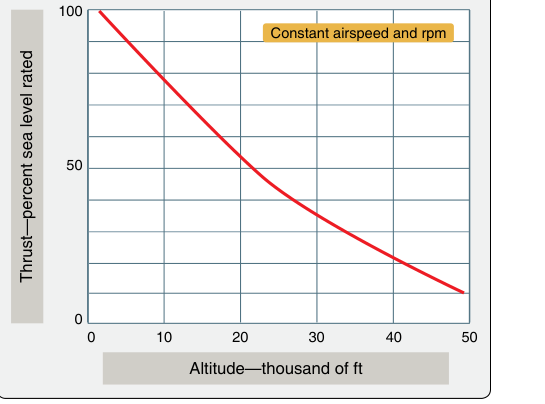
As a rough rule of thumb, jet thrust decreases approximately proportionally to the decrease in air density. Because density falls faster than a simple linear function of altitude, thrust loss accelerates at higher altitudes. By 35,000 feet, ambient pressure is roughly 23 percent of sea-level pressure, which means available thrust is drastically reduced compared to sea level. This is why maximum cruise thrust settings at high altitudes represent a much smaller absolute force than takeoff thrust at sea level.
The Thrust Lapse Rate Concept
Engineers and flight planners use the concept of thrust lapse rate to describe how thrust changes with altitude. For a given throttle or thrust lever position, thrust decreases as altitude increases. This lapse is not perfectly linear — it is influenced by the compressor design, bypass ratio, and whether the engine is flat-rated.
Flat rating is a key concept for ATP candidates. Most modern high-bypass turbofan engines are flat-rated. This means the engine is certified to produce its full rated thrust (for example, 25,000 pounds per engine) from sea level up to a specific temperature or altitude called the flat-rating temperature or flat-rating altitude. Below that ceiling, the engine is actually capable of producing more thrust, but the fuel control limits it to the rated value to protect engine life. Above the flat-rating limit — whether in temperature or altitude — the engine can no longer maintain rated thrust, and output begins to fall.
This flat-rating concept directly feeds into reduced-thrust (flex-thrust or assumed-temperature) takeoff procedures: the pilot declares a higher-than-actual outside air temperature to the thrust management computer, which then commands a lower thrust setting, deliberately operating below the flat-rated limit to reduce engine wear and noise while still meeting all regulatory performance requirements.
How Temperature Reduces Thrust
High ambient temperature reduces air density even at a constant pressure altitude. Recall the ideal gas law: density is proportional to pressure divided by absolute temperature. If temperature rises while pressure stays the same, density falls. A hot day at sea level can produce air that is effectively as thin as air at a significantly higher pressure altitude. This density-equivalent altitude is called density altitude.
The effects on the turbine engine mirror those of altitude:
- Lower air density entering the inlet reduces mass flow.
- The compressor must work harder to raise the pressure of a less dense charge.
- Turbine inlet temperature (TIT) or exhaust gas temperature (EGT) limits are reached sooner because the air passing through the turbine sections is hotter to begin with and carries less cooling capacity.
This last point is particularly important at the ATP level. On a very hot day, the engine may reach its temperature limit — maximum EGT or ITT — before it reaches its full rated thrust. The temperature limit, not the mechanical power limit, becomes the controlling factor. This is called a temperature-limited condition, as opposed to a pressure-limited condition where the compressor pressure ratio ceiling is the constraint.
Practically, on a hot and high departure — say, Denver in summer — the pilot may find that both density altitude effects and temperature limits combine to substantially reduce available takeoff thrust. Performance data must be consulted carefully, and it may be necessary to reduce payload, add a fuel stop, or defer departure to a cooler part of the day.
Combined Effects: Hot and High Operations
The worst-case scenario is a hot and high airport: high elevation combined with high temperature. Both reduce density simultaneously, compounding the thrust reduction. The PHAK and AFH both emphasize this combination as a critical takeoff performance threat. At such airports, maximum allowable takeoff weight may be significantly lower than at sea-level standard conditions. The certified performance charts in the AFM/POH are the definitive reference — pilots must use them, not estimate.
High-bypass turbofan engines have an additional characteristic worth noting: because most of their thrust comes from the large fan moving a high volume of air at relatively low velocity (rather than from the hot core exhaust), they are somewhat more sensitive to air density changes than older low-bypass or turbojet engines. The fan itself behaves somewhat like a ducted propeller, and its efficiency depends heavily on ingesting a sufficient mass of air.
Practical Cockpit Considerations
For the line pilot or ATP candidate, these principles translate to several concrete habits:
- Always check density altitude on hot days: Even at sea-level airports, temperatures well above ISA can meaningfully reduce climb performance and increase accelerate-stop distances.
- Use certified performance data: Engine and aircraft manufacturers account for all these effects in their certified thrust tables and performance charts. Trust the book, not intuition.
- Understand thrust derate vs. assumed temperature: A derate is a certified reduction in the thrust rating itself. An assumed-temperature reduction is a way of operating at less than the available flat-rated thrust by simulating a hotter temperature. Both reduce takeoff thrust but through different mechanisms, and operational rules govern when each may be used.
- Monitor EGT/ITT limits vigilantly in hot conditions: On a very warm day, aggressively advancing thrust levers may hit temperature limits quickly. Smooth, deliberate power application and close temperature monitoring are essential.
- Account for decreasing climb thrust: Even if takeoff thrust appears adequate, the thrust available during the climb-out segment decreases continuously as altitude increases. Obstacle clearance analysis must reflect this thrust lapse throughout the departure profile.
Common Test Traps
- Confusing pressure altitude with density altitude: Thrust and performance are governed by density altitude, not pressure altitude alone. Temperature must be included in the analysis.
- Assuming flat-rated thrust is always available: Above the flat-rating temperature or altitude, the engine cannot maintain rated thrust. Many candidates forget this ceiling exists.
- Thinking higher altitude always means lower EGT: At altitude, reduced airflow can allow EGT to rise toward limits at a given power setting, because there is less air mass absorbing the heat. Temperature limits may become more constraining, not less.
- Forgetting that thrust lapse affects obstacle clearance analysis: The second-segment climb gradient requirement must be met with engines producing altitude-degraded thrust, not sea-level thrust. Climb thrust tables, not takeoff thrust tables, apply to that segment.
- Misapplying the standard lapse rate above the tropopause: Above approximately 36,000 feet in ISA, temperature stops decreasing and remains constant. Thrust lapse behavior changes accordingly — this affects cruise planning on ultra-long-haul flights at very high altitudes.