Aircraft covered with fabric — whether classic Grade A cotton, poly-fiber materials like Dacron, or other approved alternatives — do not last forever. Ultraviolet radiation, moisture, temperature cycling, chemical exposure, and simple age all degrade the fibers over time. The challenge for the aviation maintenance technician (AMT) is that fabric can look perfectly acceptable on the outside while losing a dangerous fraction of its structural strength on the inside. Two practical, field-proven methods allow technicians to evaluate in-service fabric without destroying the aircraft: the punch test and the Maule tester. Understanding both methods — how they work, what the numbers mean, and where each one fits — is essential for any AMT working on fabric-covered aircraft.
The governing reference for aircraft fabric work is FAA Advisory Circular 43.13-1B, which addresses acceptable methods, techniques, and practices for aircraft inspection and repair, including fabric covering. The structural requirement is straightforward: fabric must retain a minimum breaking strength before it is considered airworthy for continued service. The commonly referenced minimum for Grade A cotton replacement is 56 pounds per inch of width (the new, undegraded standard is 80 lb/in); fabric that has fallen below 70 percent of its original strength — approximately 56 lb/in — must be replaced. Both the punch test and the Maule tester give the technician a way to estimate where the fabric currently stands relative to that floor.
Why Fabric Strength Matters
Fabric covering is a primary structural element on the aircraft surfaces it covers. On a wing, it transmits aerodynamic loads to the underlying ribs and spars. On a fuselage, it provides shape and, in some designs, shear load paths. When fabric degrades below minimum strength, it can fail suddenly under normal flight loads — especially during maneuvers, turbulence, or high-speed flight. Because fabric failure can be catastrophic, the FAA requires that the condition of covering be evaluated at each annual inspection. Visual inspection alone is not sufficient; a clear, taut-looking surface may still be alarmingly weak.
The Punch Test
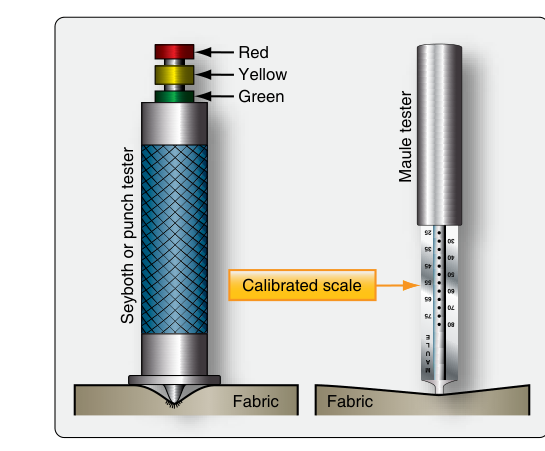
The punch test is the simpler of the two methods and requires no specialized equipment. A technician uses a standard fabric punch tester — essentially a cylindrical probe with a rounded, blunt tip — and presses it firmly and steadily into the fabric surface at a location away from reinforcing tape, ribs, and structural members. The probe is pushed by hand until the fabric either resists or yields.
The test is qualitative in the most basic sense: if the probe punctures or pushes through the fabric with light to moderate hand pressure, the fabric has lost significant strength and should be considered unairworthy. If the fabric firmly resists penetration and does not yield to reasonable thumb pressure, it is likely still above the minimum strength threshold. While this sounds imprecise, an experienced technician develops a reliable feel for the difference between fabric that is crisp and strong versus fabric that is papery, brittle, or rubbery with age.
The punch test is best suited as a quick screening tool. It is fast, requires no calibration, and can be performed anywhere on the aircraft. Its limitations are real, however: it depends on technician skill and experience, it is not calibrated to a specific numerical value, and it may not detect fabric that is marginally degraded — fabric that has dropped from 80 lb/in to 60 lb/in might still resist a thumb probe even though it has lost a quarter of its strength. For that reason, when the punch test raises any doubt, the Maule tester is the appropriate follow-up.
Proper Punch Test Technique
- Select test locations on open panels, away from tapes, reinforcements, and attachment points.
- Apply steady, perpendicular pressure — do not stab or jab, which can defeat even weak fabric by inertia.
- Test multiple locations on each surface, because degradation is often uneven (sun-exposed upper surfaces typically degrade faster than shaded undersurfaces).
- Record findings and note any areas of concern for follow-up Maule testing.
The Maule Tester
The Maule tester — named after its inventor — is a calibrated, spring-loaded instrument that provides a measurable, reproducible estimate of fabric breaking strength. It is the more precise of the two methods and is the standard for making a definitive airworthiness determination when fabric condition is in question.
The device consists of a spring-loaded plunger with a pointed tip, housed in a barrel with a calibrated scale. To use it, the technician places the tester perpendicular to the fabric surface and applies pressure until the plunger penetrates the fabric. At the moment of puncture, the calibrated spring mechanism records the peak force required. That force reading is then compared to a correlation chart (supplied with the tester or found in AC 43.13-1B guidance) to estimate the fabric's actual breaking strength in pounds per inch of width.
Because the Maule tester actually punctures the fabric, it must be used judiciously. Each test leaves a small hole in the surface. In practice, technicians select representative locations that can be patched or that fall on areas already scheduled for inspection. Typical test strategy includes:
- Testing the most UV-exposed surfaces first (upper wing surfaces, top of fuselage).
- Testing at least one location per fabric panel or bay.
- Avoiding test punctures near rib stitching, tapes, drain grommets, or inspection rings.
- Performing at least two or three readings per surface to account for local variation, then averaging the results.
The correlation between plunger penetration force and actual breaking strength is not perfectly linear and is affected by fabric type (cotton vs. polyester), weave tightness, and coating systems. For this reason, manufacturers of Maule testers supply specific correlation charts for different fabric types. The technician must use the correct chart; applying a cotton correlation to a polyester fabric (or vice versa) can produce a misleading result.
Key Numbers and Rules
- New Grade A cotton: 80 lb/in minimum breaking strength — this is the standard for new, undegraded cotton aircraft fabric.
- Minimum airworthy: 56 lb/in — fabric at or below this threshold (approximately 70 percent of new strength) must be replaced. This value is the key test-and-inspection standard referenced in AC 43.13-1B.
- The punch test is a qualitative screening tool — no calibrated reading, technician-dependent, best used for quick go/no-go screening.
- The Maule tester provides a calibrated estimate of breaking strength and is the definitive method for airworthiness determination.
- Each Maule tester puncture leaves a hole that must be patched — plan test locations accordingly.
- Correlation charts must match the fabric type being tested (cotton versus polyester, specific brand).
- Upper surfaces degrade faster than lower surfaces due to UV exposure — always test the worst-case locations first.
- Both methods should be documented in the aircraft maintenance records with date, location of tests, and findings.
Comparing the Two Methods
The punch test and the Maule tester are complementary, not competing. A sound inspection strategy uses the punch test as a rapid first pass across all fabric surfaces. Any area that feels suspect, brittle, rubbery, or that yields under thumb pressure should immediately be flagged for Maule testing. The Maule tester then provides the numerical confirmation (or reassurance) needed to make a documented, defensible airworthiness determination. Conversely, on an aircraft with fabric that clearly and consistently resists the punch test and shows no other signs of deterioration, the Maule tester confirms the obvious — but that confirmation is still valuable for the maintenance record.
Neither method replaces thorough visual inspection. Stains, mildew, mechanical damage, chafing at rib stitching, deteriorated dope or coatings, and evidence of animal or insect damage are all indicators of potential weakness that must be evaluated alongside the strength tests.
Common Test Traps
- Confusing the minimum strength value: The FAA knowledge test may present 56 lb/in and 80 lb/in as answer choices. Remember — 80 lb/in is the new standard; 56 lb/in is the minimum in-service standard. Fabric at exactly 56 lb/in is at the edge of airworthiness, not safely above it.
- Assuming the punch test gives a calibrated reading: It does not. The punch test is qualitative. Only the Maule tester provides a force reading that can be correlated to a breaking-strength value.
- Using the wrong correlation chart with the Maule tester: Polyester fabrics and cotton fabrics have different relationships between penetration force and breaking strength. Applying a cotton chart to a polyester fabric will give an incorrect strength estimate.
- Testing only one location per surface: Degradation is uneven. A single good reading in the middle of a panel does not rule out weakness at the edges or along rib lines where UV exposure or flexing may be more severe.
- Forgetting to patch Maule tester holes: Each puncture is a real hole in an airworthy surface. Holes must be patched per approved data before the aircraft is returned to service, even if the test confirms the fabric is strong enough to remain in service.