Ice accumulation on transport-category aircraft is not merely an inconvenience — it is a certificated hazard with the potential to catastrophically degrade aerodynamic performance, compromise flight instrument accuracy, and reduce engine thrust margins. The FAA distinguishes two fundamentally different strategies for managing structural ice: anti-icing, which prevents ice from forming on a surface, and de-icing, which allows a controlled layer to build and then removes it. Every system installed on a transport aircraft falls into one of these categories, and the distinction carries enormous operational, regulatory, and test significance for the Airline Transport Pilot knowledge test and oral examination alike.
The Four Major System Types
1. Thermal (Bleed-Air) Anti-Icing
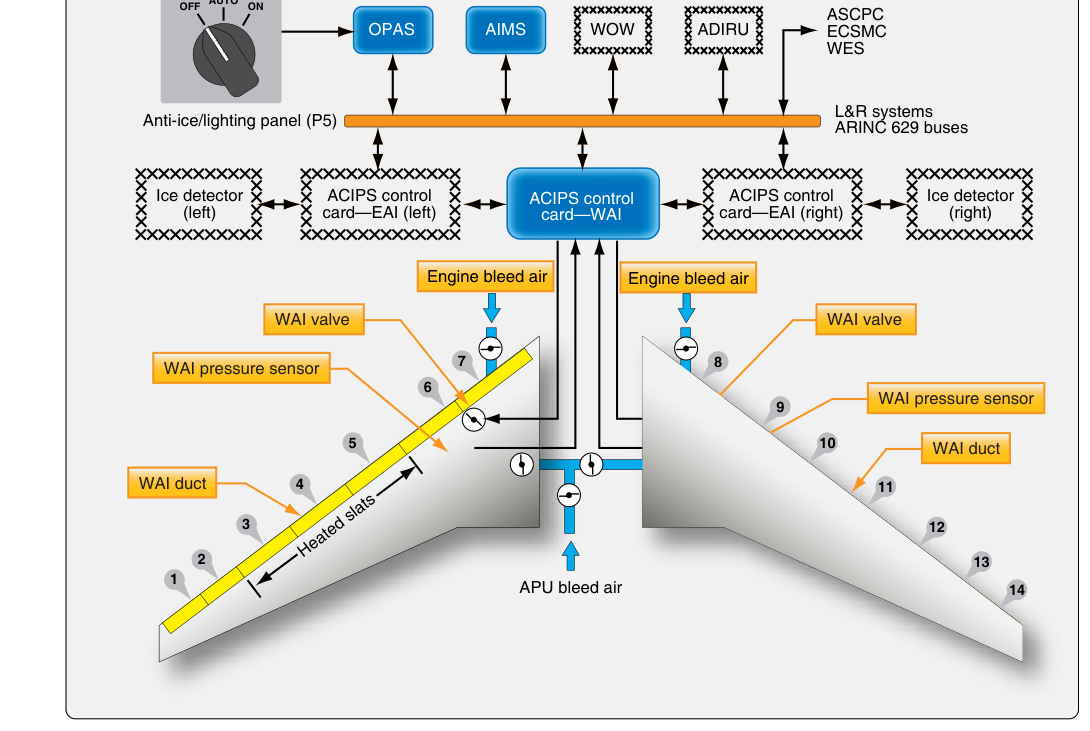
Bleed-air anti-icing is the dominant approach used on the wing leading edges and engine inlet lips of virtually every large jet transport. Hot, high-pressure air is extracted — or "bled" — from an intermediate or high-pressure compressor stage of a turbine engine. This air is ducted through a series of small-diameter perforated tubes called piccolo tubes routed spanwise inside the hollow leading-edge structure. The tubes direct jets of hot air against the inner skin, raising the outer surface temperature well above 32 °F (0 °C) so that supercooled droplets impinge and evaporate rather than accumulate. Because heat is applied continuously, the surface stays clean — making this a true anti-ice system in every respect.
Engine inlet lip anti-icing operates on the same principle and is typically the first ice protection system activated when flight crews encounter icing conditions or visible moisture below a threshold outside air temperature (often +10 °C or as specified in the aircraft's approved flight manual). Failure to activate engine anti-icing when required risks ice ingestion into the compressor, which can cause compressor stalls, blade damage, or flameout. It is equally important to recognize the performance penalty: extracting bleed air reduces net thrust and must be accounted for in takeoff performance data. Many operators publish separate takeoff performance tables for anti-ice-on conditions.
2. Electrical Anti-Icing and De-Icing
Electrical systems use resistive heating elements — thin metallic foil or wire — embedded in or bonded to surfaces. The cockpit windshields on transport aircraft are protected this way; high wattage is applied continuously to keep the glass above freezing and provide optical clarity. Pitot tubes, static ports, total-air-temperature probes, stall warning vanes, angle-of-attack sensors, and fuel vent scoops all rely on electrical heat as well. Because these surfaces are critical to flight data accuracy, they are typically powered on prior to or immediately after engine start and remain on throughout flight — functioning in anti-ice mode.
On turboprop and some piston-engine aircraft with electrically heated propeller boots, the system can be operated in a cycled de-ice mode: elements are energized for a short dwell time, allowed to heat the bond layer between the ice and the blade surface, and then shed by centrifugal force. This cyclic operation reduces electrical load and classifies the system as a de-ice rather than anti-ice system. The distinction is operationally meaningful because pilots must allow a thin ice layer to accumulate before initiating a cycle — activating the system too early when little or no ice has formed wastes energy without accomplishing useful shedding.
3. Pneumatic De-Icing Boots
Pneumatic de-icing boots consist of layered rubber-and-fabric bladders bonded to the leading edges of wings and tail surfaces. An engine-driven pneumatic pump or bleed-air source inflates the bladders in a rhythmic sequence — typically 6 to 8 seconds of inflation followed by deflation — which physically cracks and fractures the ice layer that has formed. The aerodynamic slipstream and residual ice stresses then carry the broken pieces away from the surface.
Boots are a de-ice system by definition. They require a minimum ice thickness — often described in the aircraft flight manual as roughly one-quarter to one-half inch — before activation is effective. Activating boots prematurely on older designs can cause ice bridging: the ice shell conforms to the inflated boot shape rather than cracking, creating a smooth aerodynamic shell that resists subsequent shedding cycles. While modern boot materials and inflation pressures have reduced bridging susceptibility, the FAA continues to reference this phenomenon in training material and it remains a tested concept. Boots are prevalent on turboprops, regional aircraft with straight wings, and older piston twins; most large swept-wing jet transports use bleed-air thermal systems instead because of the higher impact pressures and energy requirements at jet speeds.
4. Fluid (TKS) Anti-Icing and De-Icing
The TKS system (named after its British developers — Tecalemit, Kilfrost, and Sheepbridge Stokes) uses a glycol-based fluid pumped through a porous laser-drilled titanium panel bonded to the leading edge. Fluid weeps outward through thousands of tiny holes and spreads aft over the surface, mixing with supercooled droplets to depress their freezing point and prevent adhesion. When activated before entering icing conditions, TKS functions as an anti-ice system. When activated after ice has already bonded, the fluid undercuts the ice layer and allows it to shed — a de-ice function. Fluid quantity is finite, making TKS a limited endurance system. Flight crews must monitor fluid quantity and plan exits from icing conditions accordingly. TKS is common on business jets, high-performance piston singles and twins, and some smaller turboprops certified for flight into known icing (FIKI).
Why the Distinction Matters for Transport Operations
Structural icing alters airfoil geometry with brutal efficiency. FAA icing research cited in the Aviation Weather Handbook (FAA-H-8083-28) indicates that even a thin layer of roughness equivalent to coarse sandpaper on a wing leading edge can reduce maximum lift by as much as 30 percent and significantly increase stall speed. Clear ice adds weight and disturbs airflow simultaneously. Tailplane icing presents a particularly insidious hazard because it may not be visible from the cockpit and can cause an abrupt pitch-down if the tail stalls — a scenario worsened by flap extension.
Under 14 CFR Part 121, air carriers must have approved ice protection equipment and must operate in accordance with the certificate holder's approved ground deicing and anti-icing program when conditions require. Part 91 operators flying transport-category aircraft are similarly bound by the aircraft's limitations and the general requirement under 14 CFR §91.9 to operate within the approved flight manual. No certified ice protection system is approved for severe icing, and the FAA directs crews to exit severe icing immediately using any practical means.
Key Numbers and Regulatory Anchors
- Frost prohibition: 14 CFR §91.527 prohibits takeoff when frost, ice, or snow is adhering to the wings, control surfaces, propellers, or other critical surfaces. Even a thin coat of frost is unacceptable on transport-category aircraft — the leading edge must be physically clean.
- Pitot heat requirement: 14 CFR §91.207 requires an operable pitot heat indication system on aircraft equipped with heated pitot tubes when operating under IFR. Part 121 operations impose equivalent or more stringent requirements.
- Engine anti-ice activation: Most AFMs specify activating engine inlet anti-ice when OAT is at or below +10 °C in visible moisture (clouds, rain, snow, sleet, or fog with visibility below 1 mile), though the exact threshold varies by aircraft type.
- Ice bridging caution: Allow adequate ice accumulation (typically ¼ to ½ inch) before activating pneumatic boots, per aircraft flight manual guidance.
- TKS endurance: Fluid quantity provides finite protection; pilots must monitor quantity and plan for early exit from icing conditions.
Common Test Traps
- Boots are de-ice, never anti-ice. Exam distractors often label pneumatic boots as an anti-icing system. They remove ice after it forms; they do not prevent formation.
- Bleed-air extraction reduces thrust. Engine anti-ice imposes a measurable thrust and fuel-flow penalty. Takeoff data with anti-ice ON must be used in icing conditions.
- Pitot heat must be ON before entering IMC. Forgetting to activate pitot heat causes unreliable airspeed indications, a factor in numerous fatal accidents. It is not optional equipment during IFR operations.
- TKS timing changes the classification. TKS activated before icing = anti-ice; activated after ice forms = de-ice. The system is the same hardware; the timing determines the category.
- Tailplane icing is invisible and dangerous. Crews must not assume the wing protection system adequately protects the horizontal stabilizer; some aircraft have separate tail de-ice systems or prohibit certain flap configurations in severe icing.
- Severe icing requires exit, not just system activation. No installed system is approved for severe icing. The approved response is to change altitude, heading, or request an alternate routing immediately.
Memory Aid
Use the phrase "ANTI keeps it off; DE takes it off." Anti-icing systems — bleed air, continuous electrical heat, early-activated TKS — prevent accumulation. De-icing systems — pneumatic boots, cycled electrical propeller heat, late-activated TKS — remove what has already formed. Anchoring this distinction makes quick work of the many icing-system questions that appear on both the written knowledge test and the ATP oral examination.