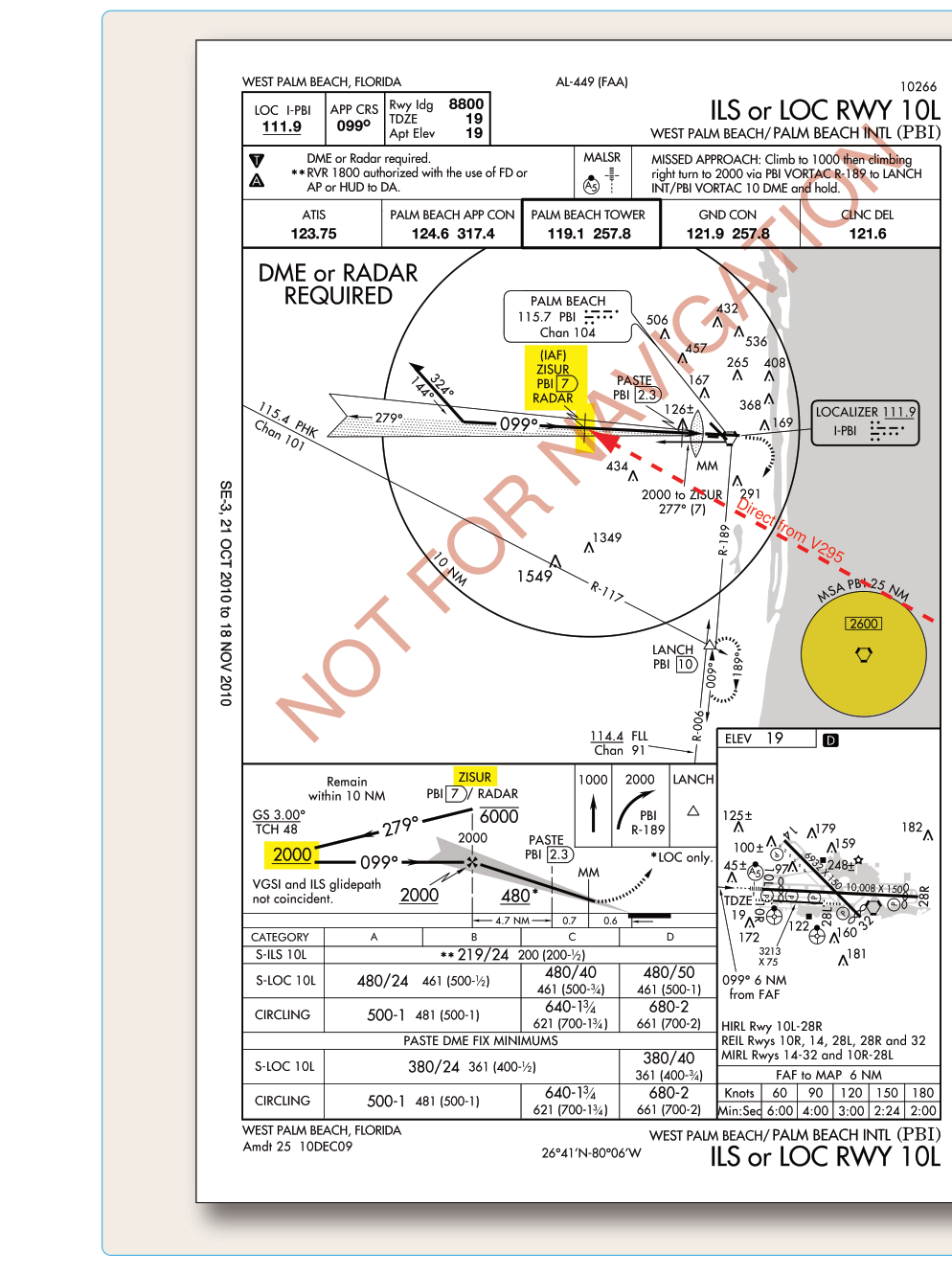
Few phrases carry more weight in the IFR world than "cleared for the approach." It sounds simple, but this short sentence from ATC sets off a carefully defined chain of pilot actions, each governed by FAA regulations and procedures. Misunderstanding what the clearance actually authorizes—and what it leaves to the pilot's judgment—is one of the most common sources of IFR confusion, and the FAA knowledge test probes this topic deliberately. Let's break it down from the ground up.
An approach clearance is ATC's authorization for you to conduct a specific instrument approach procedure to a specific runway (or, in some cases, an unspecified approach). It is issued after you have been sequenced into the terminal environment and are at or heading toward an appropriate fix or altitude. The clearance does not give you permission to land; landing clearance is a separate item handled by the tower. And critically, the approach clearance does not relieve you of responsibility for terrain and obstacle clearance until you are established on the procedure—the two are related but distinct concepts.
What the Clearance Actually Authorizes
When ATC says "Cleared for the ILS Runway 28 approach," they are authorizing you to fly the published instrument approach procedure as depicted on the approach chart. This means you may descend in accordance with the published altitudes, cross the depicted fixes at the specified altitudes, and continue to the decision altitude (DA) or minimum descent altitude (MDA) as appropriate. According to the Instrument Flying Handbook (FAA-H-8083-15), once cleared for the approach, the published procedure essentially becomes your clearance—you fly it as charted unless ATC amends it.
If ATC says simply "cleared for the approach" without specifying a particular procedure, and multiple approaches are available, this authorizes you to fly any published approach at that airport. In practice, pilots should clarify which approach they intend and confirm with ATC, but the authorization is broad. This situation is also codified in the AIM, which notes that a pilot may conduct any published approach when cleared for "the approach" without further specification.
The Role of the Initial Approach Fix and Intermediate Fixes
An approach clearance does not automatically authorize a descent from your last assigned altitude. You must be established on a segment of the published approach before you may descend to that segment's altitude. The key concept here is "established," which means you are on the depicted track and within the course limits defined by the procedure.
Specifically, a pilot may not descend below an intermediate or final approach fix altitude until reaching that fix or being established on the inbound course inside it. This protects obstacle clearance. The Instrument Flying Handbook describes the approach procedure in segments: the initial approach segment, intermediate segment, final approach segment, and missed approach segment. Each segment has its own obstacle clearance guarantee—but only when the procedure is flown as published.
If you are being radar-vectored to the final approach course, ATC is responsible for terrain and obstacle clearance while you are on the vectors. The moment you are told to resume your own navigation or are cleared for the approach from a vector, that responsibility transitions to you. This handoff moment is a critical awareness point in the cockpit.
Descending on the Approach: The Altitude Authorization Chain
Here is where pilots sometimes get into trouble. Suppose ATC assigns you 3,000 feet and then clears you for the ILS approach. You may not simply begin descending toward the glide slope from 3,000 feet wherever you happen to be. You must first be established on a segment of the approach—typically intercepting the glide slope from below while on the localizer course—before the approach altitudes supersede your assigned altitude.
The AIM makes clear that once cleared for the approach and established on the published procedure, published altitudes take precedence over previously assigned altitudes. However, "established" is the operative word. Until you have intercepted the final approach course and are tracking it, your last ATC-assigned altitude remains in effect. This is a nuance that the written test will test directly.
One practical implication: if you are cleared for the approach and also told "descend and maintain 2,000 feet," you must comply with 2,000 feet until established on a portion of the approach that authorizes a lower altitude. The approach clearance and the altitude assignment coexist until the procedure takes over.
Clearances for Specific Approaches vs. "Any Approach"
ATC almost always specifies the approach type and runway: "Cessna 345, cleared for the RNAV (GPS) Runway 15 approach." This restricts you to that specific procedure. If you need to fly a different approach—say, weather improves and you want the visual, or your avionics don't support the cleared approach—you must request an amended clearance from ATC. You cannot simply switch approaches on your own after receiving a specific clearance.
When ATC does not specify an approach, the broad authorization to fly any published approach applies. Still, good airmanship and communications practice calls for you to inform ATC which approach you intend, both to coordinate sequencing and to ensure you are on the right frequency for any approach-specific monitoring requirements.
Why This Matters: Safety and Situational Awareness
The structure of approach clearances exists to maintain separation and protect obstacle clearance for all aircraft in the terminal environment. When a pilot descends prematurely—before being established on the procedure—the published obstacle clearance guarantees no longer apply. The results can be catastrophic, particularly in mountainous terrain or at airports with significant obstacles on approach paths.
Additionally, misunderstanding the clearance can lead to altitude deviations that trigger loss-of-separation incidents with other IFR traffic. ATC sequences aircraft based on precise assumptions about where each pilot will be and when. An early descent or a missed turn breaks that chain.
Understanding the exact scope of an approach clearance also protects you during partial panel situations, unexpected weather, or distraction in the cockpit. Knowing precisely what you are and are not authorized to do reduces cognitive load at the moments when it matters most.
Key Numbers and Rules
- Established on the approach: You must be on the published track and within procedure limits before descending to published segment altitudes. This is not optional—it is required for obstacle clearance.
- Last assigned altitude holds: Until you are established on a segment of the approach, your ATC-assigned altitude remains in force even after receiving the approach clearance.
- Visual approach vs. instrument approach: A visual approach clearance authorizes a visual approach only—not an instrument approach. They are separate authorizations with different rules.
- "Cleared for the approach" (unspecified): Authorizes any published instrument approach at that airport, per the AIM. Pilot should still advise ATC of intended procedure.
- Landing clearance is separate: At towered airports, approach clearance does not include landing clearance. You must receive a separate landing clearance from the tower before touching down.
- Circling approaches: If cleared for a circling approach (e.g., "ILS Runway 10, circle to Runway 28"), you are authorized to circle per the published circling minimums. You must not descend below circling MDA until in a position from which a normal descent to landing can be made.
- Radar vectors to final: ATC owns obstacle clearance during radar vectors. Once you intercept the final approach course and are cleared for the approach, that responsibility transfers to you.
Common Test Traps
- "Cleared for the approach" equals permission to descend immediately. Wrong. You must be established on the procedure first. Your last assigned altitude governs until then. This is one of the most commonly missed concepts on the Instrument Rating knowledge test.
- Approach clearance includes landing clearance. Wrong—at least at towered airports. These are always two separate clearances. Only at non-towered airports does the approach clearance implicitly authorize landing after completing the approach.
- A specific approach clearance allows you to fly a different approach. No. If ATC clears you for the ILS Runway 28, you may not switch to the RNAV without requesting and receiving an amended clearance.
- During radar vectors, you are responsible for terrain clearance. Not until you are established on the final approach course. While being vectored, ATC is responsible for obstacle and terrain separation. This responsibility transfers at the intercept point.
- "Cleared for the approach" without a runway number is invalid. Actually, it is a valid broad clearance authorizing any published approach. However, it is unusual in practice and the pilot should confirm intentions with ATC to avoid confusion in a sequenced environment.
Mastering the precise meaning of approach clearances separates pilots who are merely current from pilots who are truly proficient in the IFR system. Study the AIM's guidance on approach clearances, practice reading approach charts with the authorization chain in mind, and always ask ATC if any clearance language is ambiguous. In instrument flying, clarity is not just courtesy—it is safety.