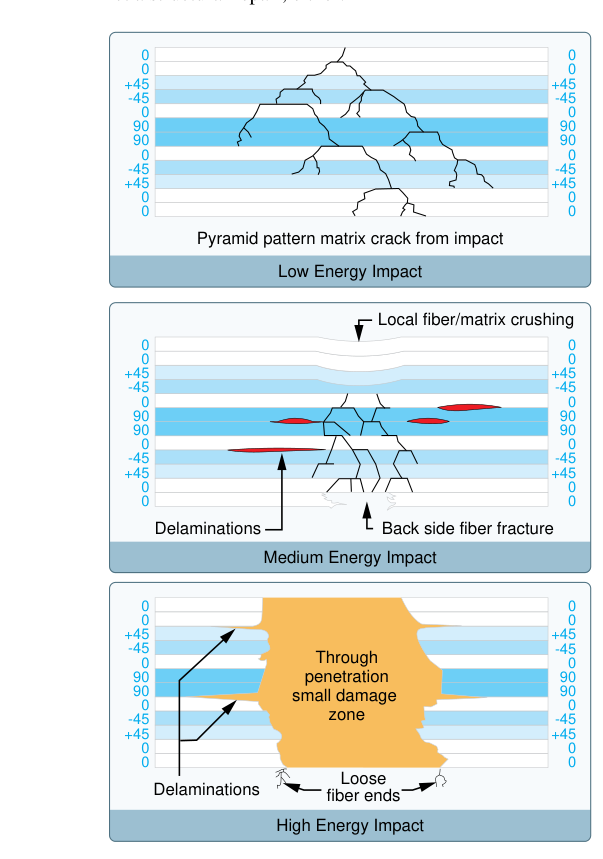
Modern aircraft structures increasingly rely on composite materials—fiberglass, carbon fiber, aramid (Kevlar), and hybrid laminates—because they offer outstanding strength-to-weight ratios and resistance to corrosion. Unlike metal, which typically dents, bends, or cracks in a visible and predictable way, composite structures can sustain serious hidden damage while appearing nearly pristine on the outside. This characteristic makes accurate damage classification one of the most critical skills an Aviation Maintenance Technician (AMT) can develop. Understanding whether a composite component has suffered a surface scratch, internal delamination, or a deeper impact injury directly determines whether a part can be returned to service, repaired in place, or must be replaced entirely.
The FAA's guidance on composite repair and inspection is grounded in the Aviation Maintenance Technician Handbook—Airframe (FAA-H-8083-31), which devotes extensive coverage to non-metallic structures. Every AMT working on composite airframes must be familiar with its classification framework, because the repair philosophy for composites is fundamentally different from sheet-metal work. The wrong classification—and the wrong repair—can leave a load-bearing structure weaker than before the damage occurred.
The Nature of Composite Structures
To understand composite damage, it helps to first understand what a composite laminate actually is. A composite panel is built up from multiple layers (plies) of reinforcing fiber fabric—such as woven fiberglass or unidirectional carbon fiber—that are saturated with a resin system (epoxy, polyester, or vinylester) and cured under heat or at room temperature. The bond between plies and between fiber and resin is what gives the part its strength. When that bond is disrupted anywhere in the stack, the structural behavior of the entire laminate can change dramatically.
Most aircraft composites are also sandwich structures, meaning a lightweight core material—typically Nomex honeycomb, aluminum honeycomb, or rigid foam—is bonded between two thin face sheets called skins. The skins carry tension and compression loads, while the core resists shear and keeps the skins separated to maximize bending stiffness. Damage to the core, even without obvious skin damage, can drastically reduce panel stiffness and strength.
Scratch Damage
A scratch is the least severe category of composite damage. By definition, a scratch affects only the surface layers of a composite part—typically the gel coat, paint, or the outermost resin-rich surface layer—without penetrating into the structural plies or disturbing the fiber reinforcement. Scratches commonly result from ground handling, tool contact, or abrasion from sand and debris.
During inspection, the AMT must determine whether a suspected scratch is truly superficial or whether the fibers beneath the surface have been cut or frayed. A scratch that cuts into the first ply of fabric—visible as white or fuzzy fiber exposure in carbon fiber parts—has crossed the line into more serious damage territory. Superficial scratches that do not expose fiber can often be repaired cosmetically with a compatible resin fill and refinishing, without the structural concern that deeper damage requires.
The key inspection tool at this stage is careful visual examination under good lighting, supplemented by a magnifying glass. Running a fingernail across the scratch to feel for raised fibers or a depression in the surface also helps. If any doubt remains about depth, a coin-tap test or other non-destructive inspection (NDI) method should be employed before making a disposition decision.
Delamination
Delamination is the separation of plies within the laminate or the separation of a face skin from the core in a sandwich structure. It is particularly insidious because it can exist entirely within the interior of a part, completely invisible to the naked eye. Delamination reduces the composite's ability to transfer shear loads between plies, which in turn degrades bending stiffness and can lead to sudden, catastrophic failure under load if left unaddressed.
Delamination can be caused by impact (more on that below), manufacturing defects (voids, insufficient cure, inadequate bonding pressure), water intrusion, or repeated thermal cycling that fatigues the resin bond. In honeycomb sandwich panels, moisture trapped in the core can freeze at altitude and expand, mechanically prying the skin away from the core—a freeze-thaw process that is a significant concern in aircraft that spend time at high altitude.
Detecting Delamination
The most field-practical detection method is the coin-tap test, sometimes called the ring test. The inspector taps the surface with a coin or a specialized tap hammer and listens to the acoustic response. A structurally sound laminate produces a sharp, high-pitched ring, while a delaminated region returns a dull thud or hollow sound. This method works well for detecting large delaminations but may miss small or deep separations. The FAA Airframe handbook acknowledges this limitation and emphasizes that coin tapping is a screening tool, not a definitive structural assessment for critical components.
More rigorous NDI methods include ultrasonic testing, where sound waves are transmitted through the laminate and reflected energy is analyzed; thermographic inspection, where the part is heated and a thermal camera maps heat dissipation anomalies over voids; and radiographic (X-ray) inspection for complex geometries or dense laminates. On certificated aircraft, the manufacturer's structural repair manual (SRM) will specify which NDI method is required for each component and damage zone.
The size and location of a delamination are just as important as its presence. A delamination in a lightly loaded fairing may be repairable with an injection of compatible resin and vacuum consolidation. The same size delamination in a primary spar cap or a wing skin in a high-stress zone may require a full structural repair or part replacement per the SRM limits.
Impact Damage
Impact damage is the most complex category and the most potentially dangerous. When a composite structure is struck by a foreign object—a tool drop, hail, bird strike, or runway debris—the energy must go somewhere. In metal, energy dissipates through plastic deformation (a visible dent). Composite laminates, by contrast, generally lack the ductile yielding behavior of metals and behave in a brittle manner across loading modes: instead of deforming plastically, energy is absorbed by a combination of fiber breakage, matrix cracking, and interlaminar shear (delamination), often spreading outward beneath the surface. This is why a composite part can look nearly perfect on the outside while sustaining a zone of internal fiber and matrix damage many times larger than the visible mark.
This hidden damage zone often propagates in a cone-like pattern, radiating downward and outward from the point of contact. The outer skin may show only a small indentation or scuff, but the internal damage—through-thickness cracks, broken fibers, shear cracks between plies—can extend across a much wider area. For carbon fiber laminates, even a barely visible surface indentation can correspond to significant internal fiber failure.
Impact damage inspection requires the AMT to use multiple methods. Visual inspection establishes the visible damage boundary. Coin-tap testing maps the acoustically suspect area, which is often significantly larger. For primary structure, ultrasonic or thermographic NDI is typically required before any repair disposition. The SRM damage limits define the maximum area of damage that can be repaired versus the threshold at which the component must be replaced.
Why Classification Matters: Safety and Airworthiness
Misclassifying composite damage is not merely an academic mistake—it can result in an aircraft returning to service with a structure that will fail before its expected design life. The FAA's Airframe handbook is explicit: a repair that restores cosmetic appearance but not structural integrity is not an airworthy repair. Composite repairs are designed to restore the original fiber paths and laminate thickness, ensuring that loads transfer the same way they did in the original structure.
Equally important is the concept of barely visible impact damage (BVID)—a term used widely in composite structural analysis. BVID refers to impact damage that a trained inspector might not reliably detect during a walk-around inspection but that can still reduce the residual strength of the structure. Manufacturers design to BVID tolerances, meaning primary composite structure must retain its required strength even with the presence of damage at the BVID threshold. Any damage exceeding BVID limits must be found and repaired before further flight.
Key Numbers and Rules
- Coin-tap test: A reliable screening tool, but not sufficient alone for primary structure; always verify with manufacturer NDI requirements.
- BVID (Barely Visible Impact Damage): There is no single universal numeric depth that defines BVID—thresholds vary by manufacturer, structure, and program, and the FAA Airframe handbook does not specify a fixed value—always consult the applicable SRM for the aircraft-specific threshold.
- Damage limits: SRM damage limits define areas by zone (Zone 1 = highly stressed, Zone 2 = lightly stressed, etc.); a repair permissible in a lightly stressed zone may require part replacement in a primary structure zone.
- Core damage: Any crushed, cracked, or water-contaminated honeycomb core must be fully replaced in the repair area before new face sheet plies are bonded; resin injection alone is not acceptable for compromised core.
- Documentation: All composite damage findings and repairs must be documented in the aircraft maintenance records per 14 CFR Part 43.
Common Test Traps
- Assuming visible damage = total damage: The FAA tests on the concept that composite impact damage is nearly always larger internally than it appears externally. Never limit your assessment to what you can see.
- Confusing delamination with disbond: Delamination is ply-to-ply separation within the laminate; disbond is separation of a bonded assembly (e.g., skin-to-core). Both are serious, but they require different inspection and repair approaches. Some tests use both terms.
- Thinking a scratch is always cosmetic: A scratch that cuts into reinforcing fibers is a structural defect, not a cosmetic one. Fiber exposure in a scratch changes its classification entirely.
- Overlooking water ingress: Questions about sandwich structure damage often focus on moisture intrusion and freeze-thaw delamination. Damaged face sheets allow water into the core, which degrades adhesive bonds and core material over time.
- Skipping the SRM: No generic repair procedure overrides the manufacturer's SRM. FAA test questions frequently test whether the AMT knows to consult the SRM before beginning composite repairs on certificated aircraft.