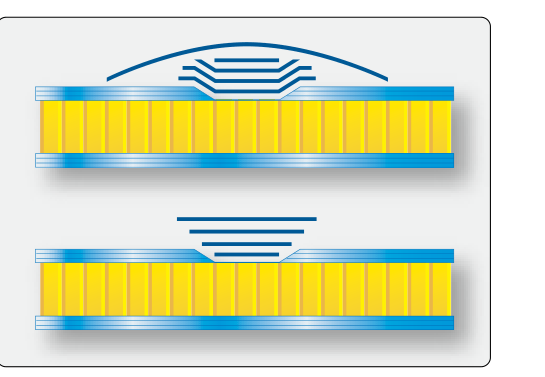
Fiberglass composite structures are found throughout modern general aviation and commercial aircraft — from fairings and control surfaces to entire fuselage skins and wing panels. For the AMT airframe technician, understanding how fiberglass is laid up and how the fabric is oriented is not merely academic; an incorrectly executed layup can compromise the structural integrity of a part just as surely as a crack in a metal spar. The FAA handbooks and advisory circulars that govern composite repair work make clear that technique, orientation, and resin management are all critical variables that must be controlled to produce an airworthy result.
This article covers the core mechanics of wet layup and dry layup (prepreg) processes, the significance of fiber orientation and ply sequencing, how to handle fiberglass fabric correctly, and the quality checks that distinguish a safe repair from one that must be redone. Whether you are preparing for the AMT Airframe knowledge test or working toward a supervised composite repair, these concepts are foundational.
Fiberglass Fabric Basics
Fiberglass cloth is woven from individual glass filaments bundled into yarns called rovings or tows. The weave pattern determines how the cloth handles, how it conforms to curves, and how loads are distributed through the finished laminate. The most common weave styles encountered in airframe work are:
- Plain weave: Each yarn crosses over and under alternating yarns in both directions. It is the most stable weave, resists distortion, and is easy to work with on flat surfaces, but it does not conform well to tight compound curves.
- Twill weave: Yarns pass over two and under two (or other combinations), creating a diagonal pattern. Twill is more drapeable than plain weave, making it easier to lay onto curved molds without bridging or wrinkling.
- Satin weave (harness satin): Yarns float over several others before going under one. This produces the most pliable fabric, ideal for complex compound curves, but it is also the least resistant to fraying and distortion during handling.
Cloth weight is expressed in ounces per square yard (oz/yd²). Lightweight cloths (2–4 oz) are used for surface finishes and thin fairings. Medium weights (6–9 oz) are common for structural skins. Heavier cloths (10 oz and above) are used for high-load areas or to build thickness quickly. Selecting the correct weight and weave for the original design specification is mandatory — substituting a heavier cloth to save plies, or a lighter cloth to make layup easier, changes the structural properties of the part.
Fiber Orientation and Its Structural Significance
The single most important concept in composite layup is that fiberglass carries load primarily along the fiber direction. A ply with fibers running at 0° (along the long axis of a panel) resists tension and compression in that axis very effectively but provides little resistance to loads applied at 90° to the fibers. This is the fundamental difference between composites and isotropic materials like aluminum, which have essentially the same properties in all directions.
Because of this directionality, the ply schedule — the ordered sequence of ply orientations used to build up a laminate — is engineered to carry the specific combination of loads the part will see in service. A typical quasi-isotropic layup uses plies at 0°, +45°, −45°, and 90°, which distributes stiffness and strength more evenly in all directions. A part designed primarily to carry bending loads (like a wing skin) may use more 0° plies along the span. When performing a repair, the technician must match the original ply schedule as closely as possible. Reversing ply angles, skipping plies, or using random orientation will degrade the part's performance in ways that may not be visible on the surface.
The selvage edge of woven fabric runs parallel to the warp yarns (the yarns running the length of the roll). The warp direction is typically stronger than the fill direction (the yarns running across the roll width) because warp yarns are under tension during weaving and therefore straighter, carrying load more efficiently. When the repair drawing specifies a 0° ply, the technician must confirm which direction is warp and align it accordingly.
Wet Layup Process
The wet layup method, sometimes called hand layup, is the most common technique for repair work in the field. In a wet layup, dry fabric plies are saturated with catalyzed liquid resin (typically epoxy or polyester) during the layup process itself. The steps follow a disciplined sequence:
- Surface preparation: The repair area is sanded, cleaned, and — if bonding to an existing composite — abraded to remove the peel ply or surface film. Contaminants (oil, moisture, release agents) will cause adhesion failures.
- Cutting plies: Fabric is cut to the specified shapes and orientations before mixing resin. Each ply should be labeled or kept in sequence to prevent out-of-order application. Scissors or a rotary cutter are used; tearing fabric distorts the weave.
- Resin mixing: Epoxy resin and hardener are combined in the exact ratio specified by the manufacturer — typically by weight using an accurate scale. An incorrect mix ratio will result in undercured resin that remains tacky, is brittle, or has grossly degraded properties.
- Ply wet-out: Each ply is placed on a flat surface (or directly onto the mold) and saturated with resin using a brush or squeegee. The goal is complete fiber wet-out with a resin-to-fiber ratio close to the design value specified by the manufacturer or repair data — the FAA handbook does not establish one universal percentage, as the correct ratio depends on fabric weight, weave, and process. Excess resin adds weight without adding strength; insufficient resin leaves dry fibers that act as stress concentrations.
- Layup and consolidation: Plies are placed in sequence, each consolidated by rolling or squeegee to remove entrapped air. Air bubbles (voids) weaken the laminate and are a primary cause of repair rejection on inspection.
- Cure: The laminate cures at room temperature or is post-cured with heat per the resin system's data sheet. Temperature, humidity, and time all affect the cure cycle and the final mechanical properties.
Prepreg and Vacuum Bag Techniques
Prepreg fabric is fiberglass cloth pre-impregnated with a resin system that is partially cured (B-staged) and stored under refrigeration to extend shelf life. Prepreg offers more consistent resin content and better mechanical properties than wet layup, but requires controlled storage, careful shelf-life management, and oven or autoclave cure. In field repair environments, prepreg is less common than wet layup, but the AMT must understand its requirements.
A vacuum bag is applied over the uncured layup (wet or prepreg) and connected to a vacuum source. The atmospheric pressure difference (up to approximately 14.7 psi of compaction pressure at sea level, corresponding to full vacuum) consolidates the plies, removes entrapped air and excess resin, and holds the layup against the mold during cure. Bagging materials include the release film (prevents the bag from bonding to the part), bleeder cloth (absorbs excess resin), breather cloth (distributes vacuum evenly), and the vacuum bag film itself, sealed with tacky tape. A leak in the bag allows air infiltration that can result in a porous, void-rich laminate.
Key Numbers and Rules
- Ply overlap (scarf) for repairs: Structural composite repairs use a tapered scarf joint to gradually transfer load back into the parent structure, with the scarf ratio (length of taper to laminate thickness) specified by the manufacturer or approved repair data — ratios commonly range from about 20:1 up to 60:1 or more for primary structure, and the FAA handbook does not set a single universal minimum ratio.
- Resin mix ratio: Must be followed exactly — even small errors in epoxy-to-hardener ratio (off by 5–10%) can significantly reduce cured properties.
- Void content: Excessive void content indicates a defective layup and is a quality concern for primary structure; acceptable void content thresholds are established by the applicable manufacturer engineering specification rather than a single FAA-mandated figure.
- Shelf life: Prepreg materials have a defined out-time (time outside refrigeration) and total shelf life; using expired prepreg is not permitted for airworthy repairs.
- Fabric storage: Dry fabric must be stored away from moisture, solvents, and contamination; even skin oils from bare hands can reduce adhesion and should be avoided by wearing gloves when handling fabric.
Common Test Traps
- Assuming orientation doesn't matter: Many students underestimate the importance of ply angle. The FAA tests whether you understand that reversing a ±45° ply or applying fabric at random orientation changes the structural properties of the part.
- Confusing warp and fill: The warp direction (along the roll length) is stronger than fill. If a drawing calls for warp aligned with the primary load path and you align fill instead, the part is weaker in its critical direction.
- Too much resin equals stronger: A common misconception. Excess resin (resin-rich laminate) adds weight, can introduce microcracks during cure, and does not improve strength. Proper wet-out to the design ratio is the goal.
- Skipping the scarf or using insufficient overlap: An undersized repair scarf creates a stress concentration at the repair boundary and may not transfer load adequately — a direct airworthiness concern.
- Ignoring pot life: Catalyzed resin has a limited working time (pot life). Attempting to use partially gelled resin results in poor wet-out, incomplete fiber impregnation, and a defective laminate regardless of how carefully the plies are placed.