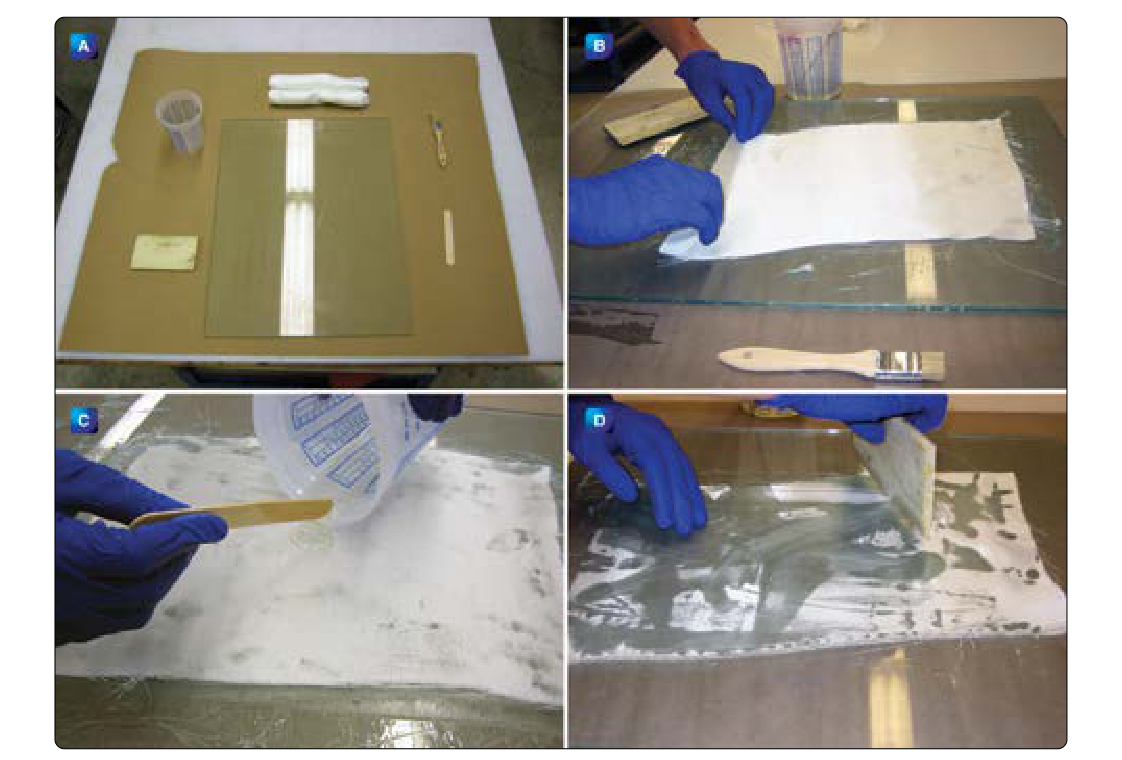
Modern aircraft structures rely heavily on fiber-reinforced composite materials, and the method used to combine those fibers with resin determines almost everything about the final part's strength, weight, and reliability. Two fabrication approaches dominate aviation maintenance and repair work: wet layup, in which dry fabric is manually saturated with liquid resin at the time of fabrication, and prepreg (pre-impregnated) layup, in which the reinforcing fibers arrive from the manufacturer already infused with a precisely metered, partially cured resin system. Both methods produce fiber-reinforced polymer structures, but their materials, tooling, cure requirements, quality outcomes, and practical shop demands differ significantly. FAA-certificated Aviation Maintenance Technicians (AMTs) working on airframe structures must understand both methods thoroughly — not only to perform repairs correctly, but to follow approved data and recognize when a method substitution is or is not acceptable.
How Composites Work: A Quick Foundation
A composite material combines a reinforcement (typically woven or unidirectional glass, aramid, or carbon fiber fabric) with a matrix (a polymer resin such as epoxy, polyester, or vinyl ester). The reinforcement carries tensile and compressive loads along the fiber direction, while the matrix transfers loads between fibers, protects them from the environment, and gives the part its shape. The final mechanical properties depend on fiber type, fiber orientation, fiber volume fraction (the percentage of the cured laminate that is fiber rather than resin), and the quality of the bond between fiber and matrix. Both wet layup and prepreg aim to create that bond — they simply do so at different points in the process.
Wet Layup: Process and Characteristics
In a wet layup, the technician begins with dry fabric cut to the required ply shapes and orientations specified in the repair or fabrication drawing. A liquid resin system — typically a two-part epoxy consisting of resin and hardener — is mixed in the ratio specified by the manufacturer and applied to each ply by brush, roller, or squeegee. The saturated plies are then positioned on the mold or repair surface in sequence. After all plies are in place, a release film, bleeder cloth, breather cloth, and vacuum bag are typically applied, and the laminate is consolidated under vacuum pressure, which removes entrapped air and excess resin.
Wet layup resins are room-temperature-stable; they are mixed only when needed, so there is no clock running on storage life until the two components are combined. Once mixed, however, the resin has a working time (pot life) — often 30 to 90 minutes depending on the formulation and ambient temperature — after which viscosity increases and the resin becomes unusable. Cure can occur at room temperature for many systems, though elevated-temperature post-cures are often required to achieve full mechanical properties and thermal resistance. Because wet layup repairs can frequently be performed with relatively simple equipment (a vacuum pump, a heat blanket or oven, and hand tools), the method is widely used for field and depot-level repairs on secondary structures, fairings, and control surface skins.
The principal limitation of wet layup is variability in resin content. A skilled technician using proper technique, squeegee pressure, and bleed plies can achieve acceptable fiber volume fractions, but manual mixing and application introduce the possibility of resin-rich or resin-starved regions, voids, and inconsistent ply-to-ply bonding. For this reason, wet layup is generally considered a lower-fiber-volume-fraction process compared to prepreg, and structural designs that use wet layup repairs account for this in their allowable stress values.
Prepreg: Process and Characteristics
Prepreg material is manufactured under controlled factory conditions: reinforcing fabric is run through a resin bath or film-transfer machine that deposits a precise, uniform quantity of partially catalyzed resin into and around the fiber tows. The resin is then advanced to the B-stage — a partially polymerized state in which the resin is tacky but not yet fully crosslinked. This controlled partial cure locks in the desired resin-to-fiber ratio and gives prepreg its characteristic slightly sticky, pliable character. Actual fiber volume fractions vary by material system and process, so technicians should verify specific values against the manufacturer's process specification rather than treat any single figure as an FAA-defined threshold.
Because the resin chemistry has already begun, prepreg must be kept cold to arrest further cure. Prepreg storage temperature requirements are manufacturer-specific — many aerospace prepreg systems are commonly stored around 0°F (-18°C) in a sealed, moisture-proof package, but the exact requirement varies by resin system and is not a fixed FAA-mandated figure, so the manufacturer's data sheet always governs. Every roll of prepreg material carries two critical time limits: freezer life (total acceptable time in frozen storage, often 12 months or more from manufacture date) and out-time (total accumulated time at room temperature, often 30 days or less). Once either limit is exceeded, the material must be disposed of, because the resin's degree of cure has advanced beyond the point where it will flow, consolidate, and crosslink correctly during the final cure cycle.
Prepreg layup is performed by cutting plies from the roll (still cold, or allowed to warm to room temperature for handling), positioning them on the tool in the specified fiber orientation, and applying each ply by hand or with a roller, using the material's inherent tack to hold plies in registration. After all plies are laid up, the assembly is vacuum-bagged and cured in an autoclave (a pressure vessel capable of simultaneously applying elevated temperature and hydrostatic pressure, with cure pressures varying by resin system) or, for lower-performance applications, in a heated press or oven with vacuum only. Autoclave cure consolidates the laminate under elevated pressure, further reducing voids and ensuring intimate fiber-matrix contact.
The result is a part with very consistent mechanical properties, low void content, and a high fiber volume fraction relative to wet layup. Prepreg laminates are the standard for primary structural components such as wing skins, spars, and fuselage panels on composite-intensive aircraft because the predictability of their properties allows engineers to design to tighter, more favorable allowables.
Why the Difference Matters for Airframe Maintenance
For the AMT, the most important practical consequence of the wet layup versus prepreg distinction is that repair methods are not interchangeable without approved data. A structure designed and originally fabricated with prepreg material has its structural allowables, laminate thickness, and repair schemes based on the fiber volume fraction and void content achievable with prepreg. Substituting a wet layup repair in that location — even with the same fiber type — will produce a laminate with lower fiber content and potentially higher void content, which may not restore the part to its original strength. Conversely, some repairs specified for wet layup materials would be unnecessarily complex if prepreg were used instead. The Aircraft Maintenance Manual (AMM), Structural Repair Manual (SRM), or FAA-approved repair data will always specify the required material form and process.
Temperature is another critical factor. Prepreg systems designed for high-temperature cure (177°C / 350°F systems are common in primary structures) will not achieve their design properties if cured at room temperature or with a simple heat blanket. The cure schedule — temperature ramp rates, hold temperatures, hold times, and cool-down rates — must be followed exactly. Wet layup systems, by contrast, are often formulated to cure at 60–80°C with a vacuum bag and heat blanket, making them more accessible for field repairs.
Key Numbers and Rules
- Prepreg storage temperature: commonly around 0°F (-18°C), but this is manufacturer-specific and not an FAA-mandated figure; always verify with the specific manufacturer's data sheet.
- Out-time limits: accumulated room-temperature exposure, commonly 30 days or less; out-time tracking is mandatory and must be documented.
- Autoclave pressure for prepreg cure: varies by resin system (commonly cited illustrative ranges span roughly 50–100 psi), combined with elevated temperature — equipment not available in most line-maintenance environments; always confirm the required cure pressure against the applicable process specification.
- Fiber volume fraction: prepreg is generally higher than wet layup, but the FAA handbook does not set fixed numeric ranges — actual values vary by material system and must be verified against manufacturer/process specifications.
- Void content target: the FAA handbook does not mandate a universal numeric target; acceptable void content for structural prepreg laminates is defined by the applicable manufacturer or process specification, and higher void content degrades interlaminar shear strength significantly.
- Pot life of wet layup resin: varies widely (30–90+ minutes) and is temperature-sensitive — warmer ambient temperatures shorten pot life.
- Repair authority: always use the applicable SRM or FAA-approved repair data; never substitute material forms without engineering approval.
Common Test Traps
- Confusing out-time with freezer life: These are two separate limits. A prepreg roll may have years of freezer life remaining but be expired on out-time if it was left at room temperature too long. Both must be within limits before use.
- Assuming wet layup and prepreg are interchangeable: The FAA knowledge test and practical test both probe whether candidates understand that material form and cure process are part of the approved repair data — one cannot simply swap methods without engineering approval.
- Overlooking void content implications: Voids reduce interlaminar shear strength dramatically. A laminate that looks intact on the surface but has elevated void content from poor technique or expired prepreg may fail at loads well below design limits, even though the FAA handbook does not prescribe a single numeric void-content threshold — the applicable engineering specification governs.
- Misidentifying cure requirements: Prepreg systems are often categorized by their cure temperature (250°F vs. 350°F systems). Using a 250°F cure cycle on a 350°F-system prepreg will leave the resin under-crosslinked, resulting in inadequate strength and heat resistance.
- Ignoring documentation requirements: For prepreg repairs, out-time and freezer-life records must be maintained and traceable. Missing or incomplete records can make a repair non-airworthy regardless of the apparent quality of the work.