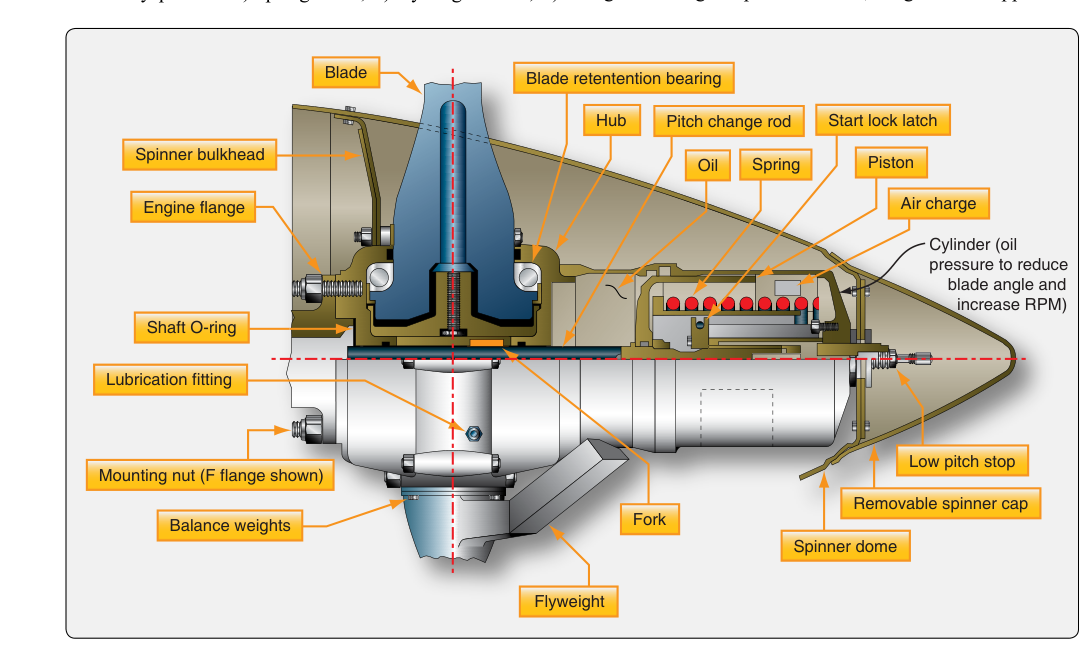
For pilots pursuing the Commercial Pilot certificate, a thorough understanding of propeller systems goes far beyond simply selecting an RPM and leaving the governor to do its job. Two concepts—feathering and the beta range—define the outer edges of propeller operation and carry serious airmanship, aerodynamic, and safety implications. The Airplane Flying Handbook (FAA-H-8083-3) and the Pilot's Handbook of Aeronautical Knowledge (FAA-H-8083-25) both emphasize that commercial-level pilots must understand not just what these systems do, but why they work the way they do and what happens when they are misused.
How a Constant-Speed Propeller Works
A constant-speed propeller uses a flyweight-driven governor to maintain a pilot-selected RPM across varying power and airspeed conditions. The governor monitors shaft speed and ports high-pressure oil to or from a piston inside the propeller hub. On most single-engine and light twin aircraft, oil pressure drives the blades toward low pitch (fine)—less blade angle relative to the plane of rotation, higher RPM—while spring tension and counterweights push toward high pitch (coarse)—greater blade angle, lower RPM. In the governing range, the system is self-correcting: if the airplane accelerates in a descent, the flyweights sense overspeed and increase pitch to absorb more torque, holding RPM steady.
This governing range, however, has limits. Below a minimum pitch called the low-pitch stop (also called the fine-pitch stop or in-flight fine stop), the governor loses mechanical authority. Above a maximum pitch, you approach feather. These boundaries define where normal governor control ends and where feathering or beta operation begins.
Feathering: Eliminating the Drag of a Dead Engine
When an engine fails on a multi-engine aircraft, the propeller is still exposed to the relative wind and will continue to rotate—a condition called windmilling. A windmilling propeller generates enormous parasite drag because the blades are at a pitch angle that forces them to act essentially like a flat disc pushing against the airflow rather than slicing through it cleanly. FAA-H-8083-3 notes that this drag can exceed the total aerodynamic drag of the rest of the airframe and can make directional control extremely difficult, especially near minimum controllable airspeed (VMC).
Feathering rotates the propeller blades to approximately 90 degrees of pitch—essentially parallel to the oncoming airflow. In this position, the leading edge of each blade faces directly into the wind. The result is that the blade presents its thinnest profile to the air, slicing through rather than resisting it, and aerodynamic drag is reduced dramatically. The blades may still rotate slowly or may stop entirely, both of which are vastly preferable to the high drag of a windmilling propeller.
Feathering System Mechanics
Because feathering must work even after engine oil pressure is lost—the very scenario that accompanies an engine failure—feathering systems use dedicated mechanisms separate from normal governor oil pressure. Common designs include:
- High-pitch spring and counterweights: On many designs, blade counterweights and a feathering spring provide force toward feather. Normal oil pressure keeps blades from going to feather during flight; when oil pressure drops, springs and counterweights move blades to the feathered position. This is a fail-safe toward feather design used in many turboprop systems.
- Feathering pump or accumulator: Some designs use a separate electric pump or a stored-oil accumulator to supply the oil pressure needed to drive blades to feather independent of engine oil pressure.
- Detent mechanism: The propeller control typically has a feather detent or gate that prevents inadvertent movement into feather during normal flight. The pilot must deliberately override or pull through this detent to feather the propeller.
Unfeathering Accumulators
An unfeathering accumulator stores oil under pressure so that a feathered propeller can be unfeathered without requiring engine oil pressure to be present first. When the pilot moves the prop control forward from the feather detent, the stored oil drives the blades out of feather to a pitch low enough that ram air can turn the blades, causing the engine to begin windmilling. This windmilling action turns the engine fast enough to attempt an in-flight restart. Not all multi-engine aircraft are equipped with an unfeathering accumulator; pilots must consult the aircraft's Pilot's Operating Handbook (POH) / Airplane Flight Manual (AFM) to determine what equipment is installed and exactly how it operates. Assuming an accumulator is present when it is not can mean an inability to restart a feathered engine in flight.
The Critical Engine and Feathering Priority
The concept of the critical engine—defined in FAA-H-8083-3 as the engine whose failure most adversely affects the aircraft's performance and handling—is inseparable from how propeller effects produce asymmetric thrust and drag. On a conventional twin with both engines turning clockwise (viewed from behind), the left engine is typically critical because the right engine's descending propeller blade generates more thrust, creating a longer thrust moment arm on the right side. If the right engine fails, that longer moment arm remains available on the left engine, so failure of the left engine produces the more adverse yaw and control effect, making the left engine the critical engine. Understanding this requires the pilot to recognize that feathering the propeller of the failed engine is one of the first-priority memory items precisely because drag, not just thrust loss, drives the control problem.
Beta Range: Ground-Only Direct Pitch Control
On turboprop aircraft and some advanced propeller designs, the blade pitch range extends below the in-flight fine-pitch stop into what is called the beta range. In this range, the governor is bypassed entirely; instead, the pilot has direct, manual control over blade angle through the power or condition lever. Beta range is divided into two sub-regions:
- Ground fine (flat pitch): Blades are set near zero degrees of pitch, reducing propeller thrust almost to zero and minimizing drag, allowing slow taxi speeds without heavy braking.
- Reverse pitch: Blades are moved to a negative pitch angle, meaning they accelerate air forward rather than rearward. This produces reverse thrust, which acts as aerodynamic braking after landing and can significantly shorten the landing roll while reducing brake wear and heat.
Why Beta Range Is Strictly Ground-Only
When beta range bypasses the governor, there is no automatic RPM limiting mechanism. If a pilot were to enter beta or reverse pitch in flight, the propeller could unload so severely that engine RPM would spike far above red-line limits within seconds. Additionally, asymmetric entry into beta on a multi-engine aircraft could produce violent yaw that may be unrecoverable. FAA-H-8083-3 and the Risk Management Handbook (FAA-H-8083-2) classify in-flight beta use as a critical hazard. Most turboprop aircraft incorporate a mechanical ground fine stop and weight-on-wheels interlocks designed to prevent beta selection in flight, but these mechanical safeguards are not foolproof and do not substitute for disciplined adherence to procedures and limitations published in the POH/AFM.
Operational Discipline in Beta Range
During landing roll, the pilot selects reverse by moving the power lever aft of the flight idle gate into beta and then into reverse. Power must be managed carefully to avoid exceeding RPM limits and to prevent foreign-object ingestion from debris blasted forward by the reversed airflow. The POH specifies the minimum airspeed at which reverse may be selected and the minimum airspeed at which reverse must be cancelled before taxi. Ignoring these limits risks propeller overspeed, structural damage, and FOD ingestion into the engine.
Key Numbers and Rules
- Feathered blade angle: approximately 90 degrees to the plane of rotation (streamlined to the airflow).
- Normal high-pitch (coarse) cruise angles are typically 20–35 degrees—do not confuse coarse pitch with feathered.
- Beta and reverse range exist below the in-flight fine-pitch stop; flight operations never go below that stop.
- Unfeathering requires checking the POH—not all aircraft have an accumulator.
- VMC demonstrations and multi-engine emergency procedures all assume timely feathering of the failed engine's propeller.
- Weight-on-wheels interlocks and ground fine stops are safeguards, not procedural substitutes.
Common Test Traps
- Confusing coarse pitch with feathered: Coarse or high pitch is the normal high-cruise blade angle, perhaps 30 degrees. Feather is approximately 90 degrees—a completely different position that requires deliberate pilot action past a detent.
- Assuming beta is available on all multi-engine aircraft: Beta range is a feature of turboprop and certain advanced designs. Conventional reciprocating twins have a fixed in-flight fine-pitch stop and no beta or reverse capability.
- Believing governor oil pressure feathers the blades: Standard governor oil pressure typically holds blades at the selected pitch and works against feathering. Feathering relies on springs, counterweights, or a dedicated pump—mechanisms independent of engine oil pressure.
- Assuming all twins have unfeathering accumulators: An accumulator must be confirmed in the POH; its absence means a different restart procedure or no air-restart capability at all.
- Thinking reverse thrust eliminates the need for brakes: Reverse is an aid to braking and reduces landing roll significantly, but aerodynamic reverse thrust effectiveness decreases as speed drops; normal brakes must be used as speed decreases during rollout.