On most piston and turboprop aircraft, a variable-pitch propeller works in a straightforward way: blade pitch is selected somewhere between fine (low pitch, high RPM) and coarse (high pitch, low RPM), and the thrust produced always acts forward. But a class of turboprop and some large reciprocating-engine aircraft goes further, allowing the propeller blades to rotate past flat pitch and into negative blade angles. When blade pitch goes negative, the propeller generates rearward thrust — thrust that acts against the aircraft's forward motion. This is the foundation of reverse-pitch operation. A closely related concept, beta mode, describes the entire range of direct blade-angle control that the flight crew exercises below the normal governing range, which includes both the ground-fine range and full reverse. Understanding how these systems work, what keeps them safe, and why they are essential on turboprop transports is fundamental knowledge for any Aviation Maintenance Technician (AMT) working on powerplant systems.
How Propeller Pitch Normally Works
In normal flight, a constant-speed propeller governor maintains a commanded RPM by automatically adjusting blade pitch. As engine torque increases, the governor coarsens the blades; as it decreases, the governor fines the blades. The governor operates within a defined pitch range bounded at the low end by the low-pitch stop (sometimes called the flight idle stop or beta stop), which is a mechanical or hydraulic limit that prevents the blades from going to flat or negative pitch during flight. This stop is critical: without it, a propeller that reached flat pitch in flight would lose all useful thrust and create enormous drag, while a propeller at negative pitch could generate reverse thrust powerful enough to destabilize the aircraft.
The pitch-change mechanism on most turboprop propellers uses engine oil pressure (or a dedicated propeller fluid system on some designs) to move a piston inside the propeller hub. Movement of that piston translates through a pitch-change rod or cam system into blade rotation about each blade's spanwise axis. On many designs, oil pressure drives the blades toward fine pitch, while counterweights and/or feathering springs drive blades toward coarse or feather pitch. The exact arrangement varies by manufacturer, but the maintenance technician must understand the specific fail-safe philosophy of every design encountered.
Beta Mode: Direct Blade Angle Control
The term beta refers specifically to the blade angle itself — the physical angular position of the blade chord relative to the plane of rotation. Beta mode is a condition of propeller operation in which the flight crew (or ground operator) directly commands blade angle rather than allowing the governor to automatically select pitch to maintain RPM. Beta mode is active whenever the power lever or condition lever is moved aft of the flight idle gate on a turboprop.
In beta mode, the normal governing function is suspended or overridden. The pilot's power lever position mechanically or electronically repositions a beta valve or beta control ring within the propeller control system. This valve sets the oil metering to the pitch-change piston at a fixed position corresponding to the commanded blade angle, rather than allowing the governor flyweights to modulate that oil flow. Because the governor is no longer in control, RPM is managed by fuel flow and engine torque rather than by automatic pitch changes. The result is a system with two separate but interacting variables: blade angle (commanded by the pilot's lever) and RPM (which rises or falls based on fuel flow).
Beta mode encompasses three distinct sub-ranges:
- Ground fine range: Blade angles just below the flight idle stop, from approximately flat pitch to a small positive angle. In this range, thrust is roughly zero or slightly positive but provides very little braking. The main purpose is to reduce propeller drag so the aircraft can taxi with low engine power without decelerating too aggressively.
- Flat pitch (0°): The blades are edge-on to the airflow. Aerodynamic thrust is theoretically zero, but in practice there is significant aerodynamic drag from the blades. Not normally used as an operating point but rather a transition through which the blades pass.
- Reverse pitch: Blade angles are negative, with the specific range depending heavily on the propeller design. In this range, the propeller actively generates rearward thrust, powerfully decelerating the aircraft on rollout.
Mechanical Safeguards Against In-Flight Reversal
Because inadvertent reverse pitch in flight would be catastrophic, propeller and airframe designers incorporate multiple layers of protection. The beta backup system is a critical safety feature. Most designs include at minimum the following:
- Flight idle gate (power lever mechanical stop): A physical detent or gate in the throttle quadrant prevents the power lever from being moved into the beta range unless the flight crew lifts a guard, depresses a trigger, or takes a deliberate two-step action. This guards against accidental selection.
- Weight-on-wheels (WOW) logic: Many turboprops use a squat switch (weight-on-wheels sensor) to electrically inhibit the beta valve from accepting reverse commands while the aircraft is airborne. Even if the power lever is inadvertently moved into the reverse range in flight, the system will not allow the blades to go below the flight idle stop angle.
- Beta backup valve: Some propeller control systems include a dedicated valve that mechanically prevents oil from flowing to drive blades below the low-pitch stop while the aircraft is in flight, independent of the pilot's lever position.
- Propeller RPM governing override: At very low or flat blade angles, some designs allow the governor to override direct beta commands if RPM exceeds a safe limit, protecting the engine and gearbox.
AMTs must verify the correct rigging and function of each of these safeguards during maintenance. A mistimed or mis-rigged beta system can allow inadvertent in-flight blade angle excursions, which is an airworthiness issue of the highest severity. Rigging procedures are detailed in the aircraft and propeller manufacturer's maintenance manuals, and those procedures must be followed precisely.
Reverse-Pitch Operation in Practice
On landing rollout, the pilot moves the power lever aft through the flight idle gate (after touchdown is confirmed) and into the reverse range. Fuel flow is simultaneously increased to maintain engine RPM in a range sufficient to develop hydraulic pressure for pitch change and to provide adequate torque. The blades go negative, generating strong rearward aerodynamic thrust that decelerates the aircraft. On many turboprop airliners and commuter aircraft, propeller reverse is the primary deceleration method, reducing brake wear dramatically and shortening landing roll significantly compared to wheel brakes alone.
The technician must appreciate that operating in reverse places unusual stresses on the propeller blades and hub. Centrifugal twisting moment (CTM) and aerodynamic twisting moment (ATM) act in directions they do not encounter during normal forward flight, and the bearings and pitch-change mechanism experience reversed loading. Inspection intervals and replacement criteria in the maintenance manual reflect these additional stress cycles.
Why Beta Mode Matters for Maintenance
From an AMT perspective, beta-mode and reverse-pitch systems are among the most safety-critical propeller topics because improper maintenance can directly endanger flight. Key maintenance responsibilities include:
- Rigging the beta control linkage: The relationship between power lever position and actual blade angle must be set precisely per the manufacturer's rigging chart. Under-travel prevents full reverse authority; over-travel may cause blade angles more negative than the structure can tolerate.
- Verifying the low-pitch stop: The mechanical low-pitch stop must be set to the manufacturer's specified angle. This stop is the last line of defense against inadvertent in-flight reverse. It is checked with a propeller protractor or blade-angle fixture.
- Testing WOW/squat switch interlocks: Functional testing of the in-flight reverse inhibit system must be performed after any maintenance on the landing gear, squat switch, or propeller control system.
- Inspecting pitch-change mechanism components: Beta valve wear, O-ring condition, and piston seal integrity all affect the precision of blade angle control. Leakage past the beta valve can cause uncommanded pitch changes.
- Balancing and tracking: Propeller balance and blade tracking remain just as critical in systems with reverse capability as in conventional propellers. Vibration in reverse is possible and must be within limits.
Key Numbers and Rules
- Blade angles in the flight range on a typical turboprop vary considerably by design, with fine pitch commonly in the low double digits and feather angle typically in the general vicinity of 80° to 90° — exact values are design-specific and must be taken from the manufacturer's data, not memorized as universal.
- The low-pitch (flight idle) stop is set to a specific positive angle defined by the propeller manufacturer for that model; the exact value varies significantly by design and must always be verified against the applicable maintenance manual rather than assumed.
- Ground fine (beta) range covers from the low-pitch stop down toward flat pitch, with the exact bounds being aircraft- and propeller-specific rather than standardized.
- Full reverse pitch angles vary considerably by propeller diameter and aircraft design, and on many transport-category turboprops can extend well beyond the modest negative angles seen on smaller designs.
- Rigging must always be performed with reference to the specific manufacturer's maintenance manual — no generic numbers apply across propeller models.
- Any maintenance affecting beta rigging, low-pitch stop, or reverse interlock systems typically requires a return-to-service functional test and often a ground run-up under controlled conditions.
Common Test Traps
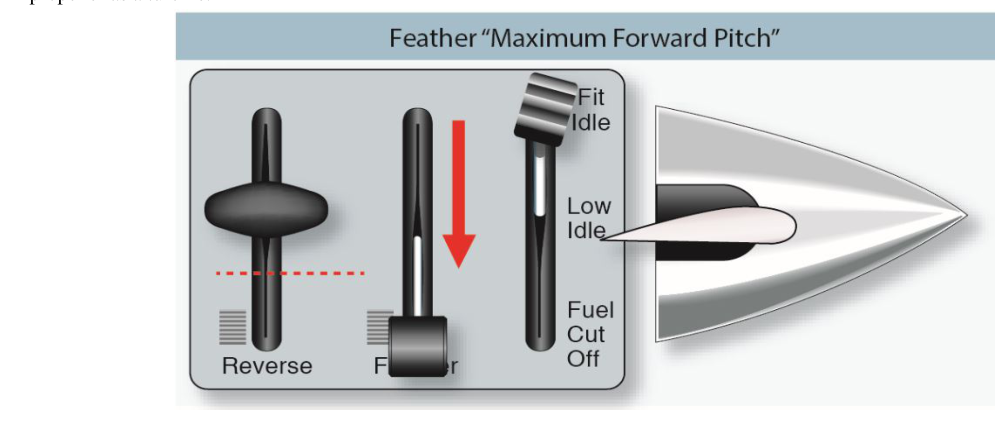
- Confusing beta mode with feathering: Feathering takes blades to a high positive pitch (design-specific, generally in the 80°–90° range) to stop rotation; beta mode takes blades to flat or negative pitch. They are opposite ends of the pitch range.
- Assuming reverse is available in flight: Properly functioning aircraft with WOW interlocks prevent in-flight reverse. However, a failure of the interlock system is a serious airworthiness concern, not a normal operating condition.
- Misidentifying what beta mode controls: In beta mode, the pilot directly commands blade angle; the governor does NOT maintain RPM via pitch — RPM is set by fuel flow. This is a fundamental difference from normal governing.
- Overlooking the centrifugal twisting moment: CTM always tries to drive blades toward flat pitch in a rotating propeller. Beta systems must overcome CTM to hold negative blade angles, which is why oil pressure (or another actuating force) must be maintained in reverse.
- Forgetting that low-pitch stop rigging is a safety-critical task: On FAA knowledge exams and practical tests, low-pitch stop setting errors are treated as airworthiness defects, not minor discrepancies, because of the in-flight reverse risk.