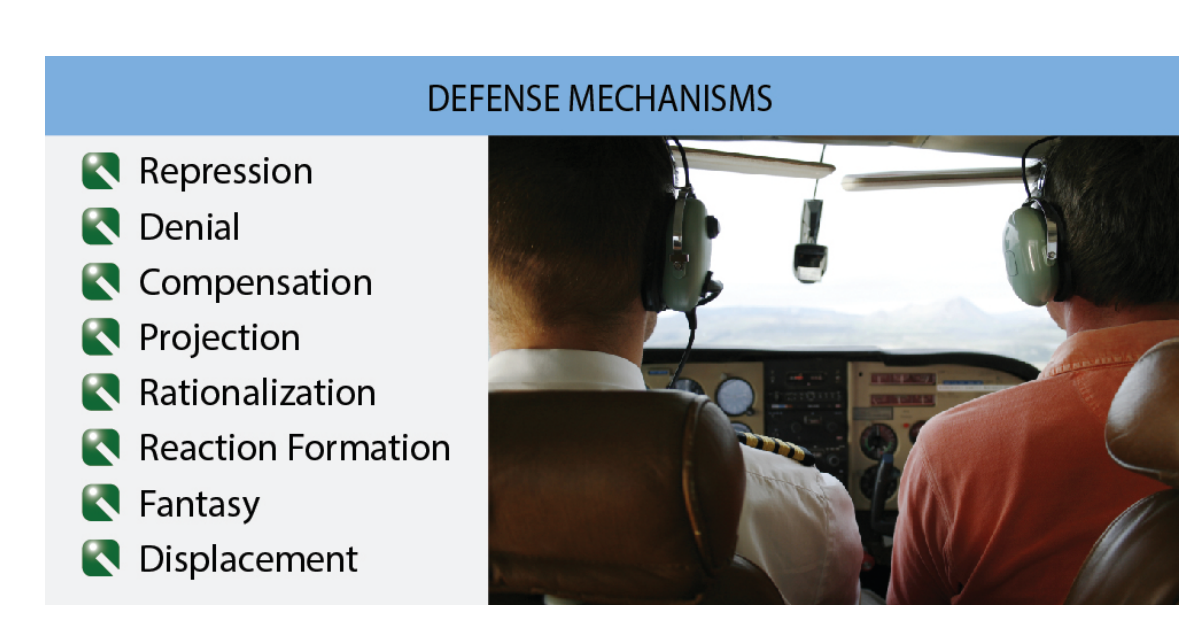
Learning to fly is exciting, but it is also genuinely challenging. Students face unfamiliar equipment, high cognitive demands, and the very real pressure of being evaluated on skills they have not yet mastered. When that pressure becomes uncomfortable, the human mind sometimes responds automatically with defense mechanisms — unconscious mental strategies designed to protect a person's self-image from anxiety, failure, or criticism. The FAA's Aviation Instructor's Handbook (FAA-H-8083-9) identifies these mechanisms as a natural part of human psychology, but warns that when left unaddressed they can seriously interfere with a student's ability to learn and progress safely.
Defense mechanisms are not deliberate dishonesty — they happen below the level of conscious choice. The student genuinely may not realize they are using one. That is exactly what makes them tricky for both the learner and the instructor to handle. Understanding the most common types helps instructors recognize what they are seeing and choose a constructive response rather than a frustrating standoff.
Common Defense Mechanisms in Flight Training
- Rationalization: The student invents a plausible-sounding excuse to explain away a mistake rather than accepting responsibility for it. Example: "The turbulence caused that unstabilized approach" when there was no meaningful turbulence. Rationalization feels logical from the inside, which makes it especially persistent.
- Denial (Flight from Reality): The student simply refuses to acknowledge a problem exists. A learner who consistently ignores poor crosswind correction and insists the landings are fine is using denial. This is one of the most dangerous mechanisms in aviation because it can cause a student to avoid addressing genuine skill deficiencies.
- Reaction Formation: The student displays the opposite of how they actually feel. A student who is deeply anxious may appear dismissive or overconfident, masking the underlying fear with bravado. This can mislead an instructor into thinking the student is ready when they are not.
- Projection: The student attributes their own feelings or shortcomings to someone else. "You're never satisfied with anything I do" may really mean the student is the one who is dissatisfied with their own performance.
- Aggression: Frustration spills out as hostility — toward the aircraft, the instructor, or the environment. Slamming controls or snapping at the instructor are visible signs that anxiety has exceeded the student's coping ability.
- Resignation: After repeated difficulties, the student gives up trying. They go through the motions without genuine effort, effectively withdrawing from the learning process. An instructor may mistake quiet compliance for acceptance when the student has actually stopped engaging.
Why It Matters
In any skill-based training program, progress depends on the student honestly identifying what needs improvement and working to fix it. Defense mechanisms break that feedback loop. A student who rationalizes poor instrument scan habits will never correct them; a student in denial about spatial disorientation tendencies may not take precautions seriously. According to FAA-H-8083-9, instructors bear a responsibility to create a supportive environment where students feel psychologically safe enough to lower these defenses and engage honestly with their own learning. Harsh criticism, sarcasm, or public embarrassment tend to reinforce defense mechanisms rather than dissolve them. A patient, non-threatening correction style — focusing on behavior, not personality — is the professional standard the handbook recommends.
Memory Aid
There is no single official mnemonic for every defense mechanism, but remembering the phrase "RADAR-P" can help you list the six main ones: Rationalization, Aggression, Denial, Anxiety-masking (Reaction Formation), Resignation, Projection. Think of it as scanning your student the way radar scans the sky — looking for hidden obstacles to learning.
Common Test Traps
- Defense mechanisms are unconscious, not deliberate. A student using rationalization is not lying on purpose — the FAA handbook is clear that these responses happen automatically to protect self-esteem.
- Resignation is easy to misread. A quiet, compliant student who has simply given up can look like an attentive learner. Watch for lack of initiative and absence of questions as clues.
- The instructor's job is not to "break" defenses aggressively. The handbook emphasizes building a supportive, non-threatening environment so defenses naturally lower — not confronting or shaming the student.
- Reaction formation can fool an evaluator. Overconfidence or bravado is sometimes a cover for deep anxiety, not genuine readiness. Do not accept surface behavior at face value when underlying performance says otherwise.