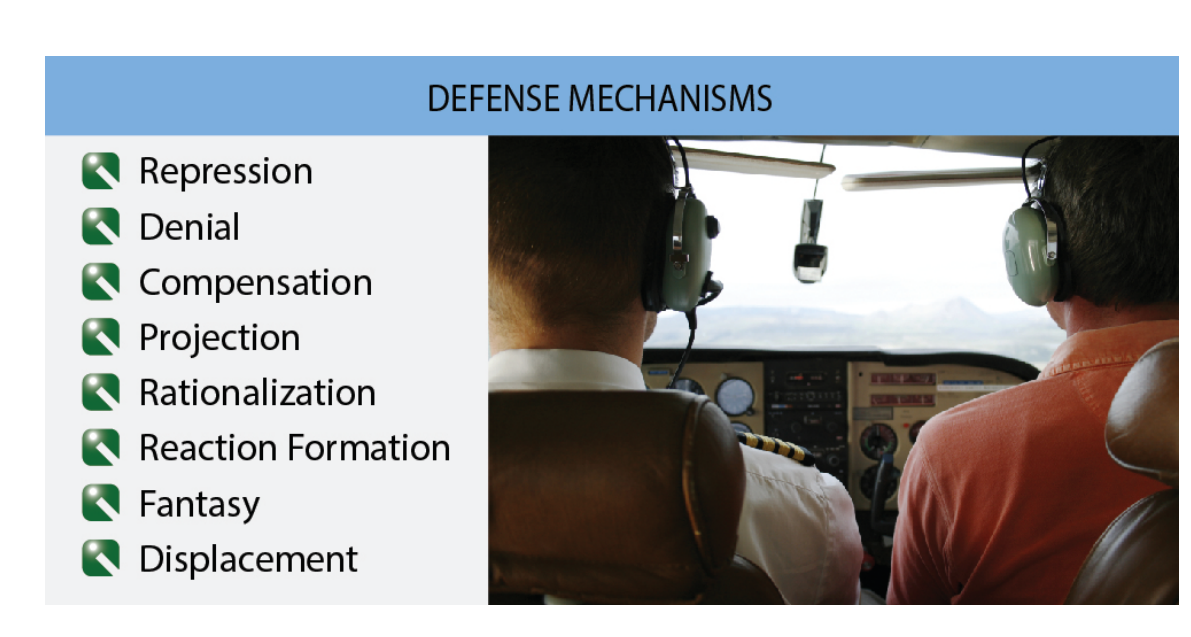
Learning to fly is one of the most demanding cognitive and emotional challenges an adult can undertake. New concepts, unfamiliar sensations, and the ever-present awareness that mistakes have consequences create a uniquely high-pressure environment. When students feel threatened by that pressure — whether from a poor maneuver grade, a sharp correction, or a failed knowledge test — their minds automatically reach for protection. The Aviation Instructor's Handbook (FAA-H-8083-9) calls these protective responses defense mechanisms: unconscious psychological strategies the ego uses to reduce anxiety, guilt, and threats to self-image. Because they operate below conscious awareness, students cannot simply choose to stop using them. Understanding what drives each mechanism, how it looks in the cockpit or classroom, and how to respond as an instructor is central to the Fundamentals of Instructing area of knowledge tested on the FAA Flight Instructor Airplane and Flight Instructor Instrument knowledge tests.
What Defense Mechanisms Are — and Are Not
The FAA-H-8083-9 is explicit on one crucial point: defense mechanisms are normal, universal human responses to stress — not signs of weakness, dishonesty, or bad character. Every person uses them to some degree. The problem arises in a training environment when a mechanism prevents a student from accurately perceiving their own performance, accepting corrective feedback, or engaging with the material. At that point, what begins as a healthy psychological buffer becomes an obstacle to learning and, ultimately, to safe flight.
It is equally important to understand that defense mechanisms are not the same as motivation problems. A resigned student may be deeply motivated to earn a certificate but have concluded — incorrectly — that success is beyond their reach. An instructor who mistakes resignation for indifference and responds with pressure rather than encouragement can push that student out of training entirely. Correct diagnosis of the mechanism determines the correct instructional response.
The Major Defense Mechanisms Identified by the FAA
Rationalization
Rationalization is one of the most common mechanisms in flight training. It occurs when a student constructs a plausible-sounding but ultimately false explanation for poor performance. A common example: a student who floated a landing blames a gusty crosswind rather than acknowledging excess approach speed and a late flare. The explanation is not necessarily a lie — there may have been a gust — but it serves to redirect responsibility away from the student's technique. The risk is that the actual control error never gets analyzed and therefore never gets corrected. Each flight builds on a false foundation.
Flight from Reality (Fantasy)
When the gap between a student's self-image and their actual skill level becomes too uncomfortable, some students mentally withdraw. FAA-H-8083-9 describes this as flight from reality, sometimes called fantasy. The student daydreams about already being a proficient pilot, mentally skips ahead to solo flight while still struggling with straight-and-level, or simply stops engaging with the lesson. In a ground briefing it may look like distraction; in the cockpit it may manifest as slow reactions and a blank stare. The student is not bored — they are overwhelmed and have retreated to a more comfortable mental place.
Aggression
Frustration that cannot be expressed directly toward its real source — the student's own perceived inadequacy — is often redirected outward. This is aggression. It may be directed at the instructor ("You didn't explain it that way last time"), at the aircraft ("This airplane's controls are stiff"), or at external factors like ATC or weather. Mild verbal aggression is common and manageable; the instructor should not take it personally. However, if a student's aggression escalates to the point of affecting aircraft control — abrupt inputs, slamming switches — it becomes a safety issue that must be addressed directly and calmly.
Resignation
The FAA-H-8083-9 identifies resignation as among the most hazardous defense mechanisms because it produces a student who stops trying altogether. Unlike apathy — which implies the student never cared — resignation follows repeated perceived failure. The student genuinely wanted to succeed, encountered too many setbacks, and concluded that success is unattainable. Outwardly, a resigned student may appear passive, give minimal effort, and offer little response to instructor feedback. They are not defiant; they have simply decided the outcome is predetermined. Left unaddressed, resignation leads to dropout or, more dangerously, a student who completes training without developing genuine confidence or competence.
Compensation
Compensation occurs when a student covers up a weakness by overemphasizing a more desirable trait, in order to distract attention — their own and the instructor's — from that weakness. A student who is exceptionally smooth on the radio and masters all the academic material but consistently avoids or underperforms on slow flight and stalls may be compensating. The danger for the instructor is that outstanding performance in one area can create a halo effect that masks deficiencies in another.
Projection
Projection involves attributing one's own shortcomings to others. A student who consistently misjudges traffic pattern altitude might insist that the instructor's callouts are timed incorrectly. The student is not consciously lying; they genuinely perceive the fault as external. Instructors should watch for patterns of blame that shift to different external causes while the underlying error remains constant, which can be a sign that projection is at work.
Denial
In denial, the student simply refuses to acknowledge that a problem exists. After a ground-loop on landing, a student in denial might say, "That wasn't really a problem — I had it the whole time." Unlike rationalization, where an alternative cause is offered, denial involves a refusal to accept that a deficiency occurred at all. It is especially problematic for safety-of-flight items and should be addressed factually and calmly, using concrete data (e.g., recorded track, airspeed readout, CFI observation) rather than opinion.
How Defense Mechanisms Impair the Learning Process
The FAA-H-8083-9 describes learning as requiring honest feedback loops: a student must perceive a gap between current and desired performance, accept that gap as real, and apply effort to close it. Defense mechanisms interrupt this process at the perception stage. If a student rationalizes, they never fully perceive the gap. If they deny, they reject evidence of the gap. If they resign, they perceive the gap but decide it is permanent. In each case, the corrective cycle breaks down. The instructor's role, then, is to restore accurate perception without triggering a deeper defensive retreat — a balance that requires both technical and interpersonal skill.
Effective Instructional Responses
The FAA emphasizes that directly confronting a defense mechanism — especially in front of others — typically reinforces it rather than dissolving it. Instead, the handbook points toward several evidence-based strategies:
- Use questions, not declarations. Rather than saying "You were fast on final," ask "What did you notice about the airspeed on short final?" This invites the student to self-diagnose, which is far more durable than being told.
- Separate the behavior from the person. Criticize the specific action, not the student's character or ability. "That flare was initiated 10 feet too high" is instructional. "You just can't seem to get landings" is destructive.
- Engineer early success for resigned students. Break complex tasks into sub-tasks the student can accomplish today. Success builds the self-efficacy needed to tackle larger challenges.
- Normalize difficulty. Tell students explicitly that a skill like crosswind landings typically requires many repetitions. Framing struggle as normal removes the sting of imperfection.
- Maintain consistent standards while varying instructional approach. Standards never lower to protect a student's ego, but the pathway to meeting those standards can be adapted to the individual.
Key Points for the FAA Knowledge Test
- Defense mechanisms are unconscious — students are not deliberately being deceptive or difficult.
- FAA-H-8083-9 identifies several defense mechanisms relevant to flight training, including rationalization, flight into fantasy, aggression, resignation, projection, compensation, and denial.
- Resignation differs from apathy: resignation follows repeated perceived failure; apathy implies the student never cared.
- Compensation can masquerade as strength — overall readiness cannot be judged from a single area of excellence.
- The correct instructor response is supportive redirection, not confrontation or increased pressure.
- Defense mechanisms are normal human behavior; their presence does not indicate a student is unsuitable for flight training.
Common Test Traps
- "The student is lying" — Test distractors sometimes frame rationalization or denial as intentional dishonesty. Defense mechanisms are unconscious; deception is conscious. These are legally and psychologically distinct.
- Confusing resignation with apathy — Questions may describe a passive, low-effort student and ask for the best instructor response. If the student once cared and stopped trying after failures, the answer is encouragement and structured success — not confrontation or dismissal.
- Assuming confrontation breaks through denial — The FAA position is the opposite. Factual, calm, evidence-based feedback in a private setting is more effective than direct challenge.
- Overlooking compensation — A student excelling in ground school while avoiding flight maneuvers may be compensating. The instructor must evaluate all required areas independently.