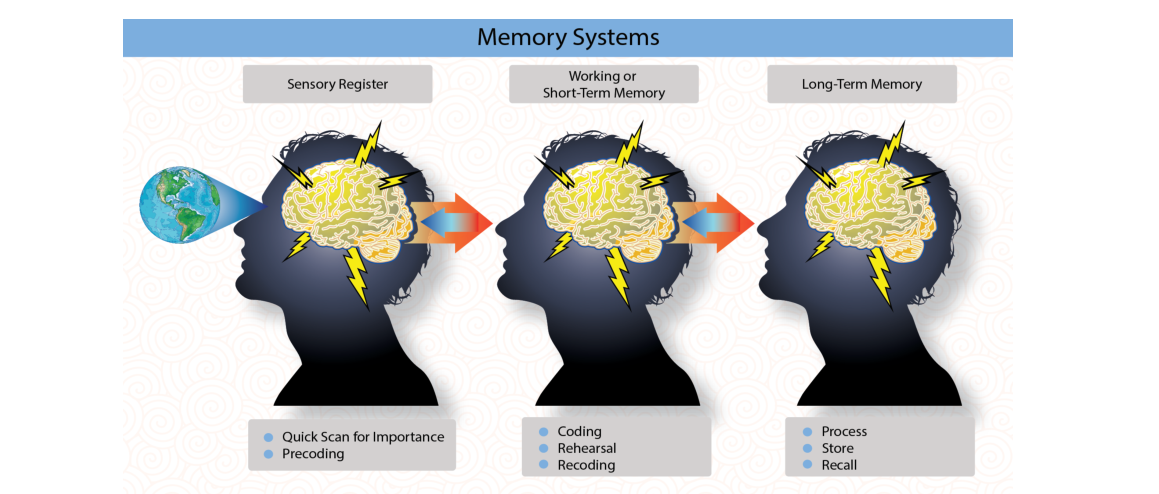
Every time a student pilot absorbs a new checklist, masters an emergency procedure, or internalizes the physical feedback of a coordinated turn, three interconnected memory systems are working in sequence: sensory memory, working memory, and long-term memory. The FAA's Aviation Instructor's Handbook (FAA-H-8083-9) addresses these systems in depth because a flight or ground instructor who understands them can design instruction that works with human cognition rather than against it. For students, the same knowledge enables self-regulation—the ability to recognize cognitive overload and deliberately manage it. In aviation, where information-processing errors can have fatal consequences, understanding how memory works is not an academic exercise. It is a safety skill.
Picture the memory pipeline as a three-stage filter. Raw sensory data floods in continuously, an infinitesimally small fraction gets selected for conscious processing, and an even smaller fraction eventually reaches durable storage. Each stage has its own capacity limits, time constraints, and encoding rules. A lesson designed without regard for those rules will waste a student's time and, worse, may leave critical knowledge too fragile to survive the stress of an actual emergency.
Sensory Memory: The First and Most Ruthless Filter
Sensory memory is the opening stage of the pipeline. It captures an essentially complete, high-fidelity snapshot of everything the nervous system detects at any given moment—visual images, sounds, tactile feedback from the flight controls, the smell of an overheating engine, the vestibular sensation of an unusual attitude. The FAA-H-8083-9 notes that this initial registration is extremely brief—generally described as lasting only a fleeting instant, from a fraction of a second up to a few seconds at most, before the data decays and is lost. The storage capacity during that fleeting window is enormous; the problem is not what goes in but what survives.
Survival depends entirely on attention. Only information that the learner actively attends to passes forward into working memory. Everything else vanishes without a trace. This explains a phenomenon every instructor has witnessed: a distracted student fails to comply with an ATC instruction they physically heard. The transmission was registered by sensory memory, but competing stimuli—managing airspeed, responding to the instructor, scanning traffic—captured attention instead. The ATC call was never attended to and therefore never processed. The practical takeaway for instructors is non-negotiable: you must secure a student's undivided attention before any meaningful instruction can begin. A vivid scenario, a direct question, or a moment of silence can all serve as attention anchors.
An equally important concept is selective attention. Because the cockpit is a rich multisensory environment, instructors must help students learn which stimuli deserve priority attention at which moments. Teaching a student to attend to the stall warning horn over extraneous radio chatter, for example, is partly a lesson in training sensory memory's selection process.
Working Memory: The Cockpit of Conscious Thought
Once information clears the sensory memory filter, it enters working memory, the stage where conscious, deliberate thinking occurs. Working memory is where a pilot solves a crosswind correction, decodes an amended clearance, or troubleshoots an abnormal indication. It is the most trainable and the most fragile part of the pipeline, defined by two hard limits that every instructor must internalize.
Capacity Limits
Working memory can hold roughly five to nine discrete items simultaneously, commonly described as seven plus or minus two—a general cognitive psychology finding referenced in the FAA-H-8083-9 rather than a rigid regulatory number, but a reliable structural constraint of human cognition nonetheless. When the number of active items exceeds the available slots, items are dropped. In a high-workload scenario—turbulence, an unexpected frequency change, a partial-panel indication, and a student struggling with the approach briefing all occurring simultaneously—the student's working memory saturates. Errors are not a sign of incompetence; they are the predictable result of exceeding a biological limit.
The primary instructional countermeasure is chunking: grouping related pieces of information into a single meaningful unit so they occupy only one working-memory slot rather than several. The acronym GUMPS (Gas, Undercarriage, Mixture, Propeller, Switches) is a classic example—five items compressed into one retrievable chunk. Checklists serve the same function: they offload working memory by externalizing the sequence so the pilot does not have to hold every step in mind simultaneously.
Duration Limits
Without active rehearsal or immediate use, information in working memory fades quickly—commonly cited in cognitive psychology as approximately 20 to 30 seconds, though this figure is a widely used approximation rather than a precise number stated in the FAA-H-8083-9. This is why a student who is read a complex clearance but must wait before reading it back may lose portions of it—the delay alone is enough to allow decay. Rehearsal strategies such as sub-vocal repetition or immediate write-down can extend retention within working memory until encoding into long-term memory can occur. Instructors should build pauses and repetition opportunities into complex verbal instruction for exactly this reason.
Cognitive Load and Instructional Pacing
The principle of cognitive load management follows directly from working memory's limits. A new student pilot cannot simultaneously manage airspeed, heading, altitude, and radio communication without overload because each of those tasks demands separate working-memory resources. Experienced pilots handle all of them because repetition has moved many sub-tasks into long-term memory, where they can be retrieved automatically with minimal working-memory involvement. This is the neurological basis of the instructor's progressive-training model: introduce one skill at a time, let it consolidate, then layer the next. Throwing a student into full-task complexity too early does not accelerate learning—it guarantees overload and reinforces errors.
Long-Term Memory: The Goal of All Training
Long-term memory is the destination. The FAA-H-8083-9 describes it as having a virtually unlimited capacity and being considered essentially permanent once information is reliably encoded. Unlike working memory, long-term memory does not decay passively; forgetting is primarily a retrieval problem rather than a storage problem. However, encoding information into long-term memory is not automatic. It requires deliberate effort and, critically, the right kind of effort.
Levels of Learning and Encoding Quality
The FAA handbook describes a four-level hierarchy of learning: rote, understanding, application, and correlation. Rote memorization—repeating a fact without comprehension—produces fragile long-term memory traces that are narrow, context-dependent, and prone to retrieval failure under stress. Understanding—knowing why the fact is true—creates richer encoding with more retrieval pathways. Application moves knowledge into procedural form tested in realistic conditions. Correlation, the highest level, allows a learner to connect knowledge across domains and adapt it to novel situations: a pilot who truly understands lift, not just the formula, can reason through an unfamiliar high-density-altitude scenario they have never practiced explicitly. Instructors should design every lesson to push students toward correlation, not merely toward correct rote answers.
Encoding Strategies That Work
- Meaningful association: Linking new information to knowledge already in long-term memory dramatically speeds encoding. Explaining why a magneto check produces an RPM drop is easier to encode than asking a student to memorize the acceptable drop limit alone.
- Spaced repetition: Reviewing material at increasing intervals is generally more effective than massed practice in a single session. The FAA-H-8083-9 discusses distributed practice favorably as an instructional technique, though instructors should treat it as sound pedagogical guidance rather than a rigid numeric standard.
- Emotional and contextual salience: Memories formed during vivid, realistic scenarios—including well-designed simulators and scenario-based training—encode more robustly than those formed in sterile classroom recitation.
- Physical practice: Procedural motor memory (the muscle memory of recovering from a spin, for example) is encoded through repetitive physical execution, not verbal description alone.
Retrieval Under Stress
Even perfectly encoded long-term memories can become inaccessible under high stress, fatigue, or hypoxia—all common aviation hazards. This is precisely why emergency procedures are practiced to automaticity: the goal is to reduce the retrieval demand on working memory during a crisis so that attention can remain on the airplane. A student who recites an engine-failure checklist correctly in the classroom but has never performed it in a moving cockpit under time pressure has not encoded it at a level sufficient for reliable retrieval when it matters.
Applying Memory Science to Instructional Design
An instructor who understands the memory pipeline structures lessons accordingly. The opening of every lesson should include an attention anchor to move information through sensory memory. New concepts should be introduced in small, chunked increments to stay within working-memory capacity, with checklists and reference materials available to externalize cognitive load. Meaningful explanations, spaced repetition, and realistic scenario practice should be used systematically to drive encoding toward long-term, high-correlation storage. Post-lesson reviews and subsequent flights that revisit prior material complete the loop.
Key Numbers and Rules
- Sensory memory duration: a fleeting instant, roughly a fraction of a second up to a few seconds; attention determines what survives.
- Working memory capacity: approximately 5–9 items (seven plus or minus two).
- Working memory duration without rehearsal: commonly cited as approximately 20–30 seconds (an approximation, not a fixed FAA-stated figure).
- Long-term memory capacity: considered unlimited for practical purposes.
- Levels of learning (lowest to highest): rote → understanding → application → correlation.
- Chunking reduces multiple working-memory items to a single retrievable unit (e.g., acronyms, checklists).
Common Test Traps
- Confusing capacity and duration in working memory: These are two separate limitations. Capacity (roughly seven items) and duration (roughly 20–30 seconds without rehearsal) are often tested independently. Know both.
- Assuming transfer to long-term memory is automatic: It is not. Without meaningful repetition, association, and practice, information from working memory simply decays.
- Treating rote as an acceptable endpoint: The FAA-H-8083-9 is explicit that rote is the lowest level of learning. Questions often ask which level is highest—the answer is correlation.
- Confusing sensory and working memory durations: Sensory memory lasts only a brief, fleeting moment; working memory lasts roughly 20–30 seconds without rehearsal. Do not conflate the two.
- Overestimating long-term memory retrieval reliability under stress: Long-term storage may be essentially permanent, but retrieval can fail under high stress or fatigue—the practical reason for drilling emergency procedures to automaticity.
Memory Aid
Use S-W-L: Sense it, Work it, Lock it in. Sensory memory senses the raw world for a fleeting moment; working memory actively processes a narrow slice of it under tight capacity and time constraints; long-term memory locks meaningful, well-practiced knowledge away for durable future retrieval. Each stage is the necessary gateway for the next.