What Is Communication in Flight Instruction?
Communication is the process by which an instructor transmits information, concepts, attitudes, and skills to a student. According to the Aviation Instructor's Handbook (FAA-H-8083-9), effective communication requires three elements working together: a source (the instructor), a symbol (the words, gestures, or demonstrations used to encode the message), and a receiver (the student). When any part of this chain breaks down, the message is lost, distorted, or misunderstood — and in aviation, misunderstanding can translate directly into unsafe behavior in the cockpit.
A CFI's technical knowledge is only as valuable as the ability to deliver it clearly. Many check ride failures and training plateaus can be traced not to a lack of knowledge on either side, but to communication barriers that prevented the knowledge from moving effectively from instructor to student. Identifying these barriers and correcting them is one of the most important skills a flight instructor can develop.
The Communication Process and Where It Breaks Down
The FAA describes communication as a two-way process involving encoding, transmitting, and decoding a message, followed by feedback. The instructor encodes an idea into words or actions, the student receives and decodes those symbols, and feedback tells the instructor whether the message was received accurately. A barrier can interrupt any of these steps. Understanding where the breakdown occurs helps the instructor choose the right remedy.
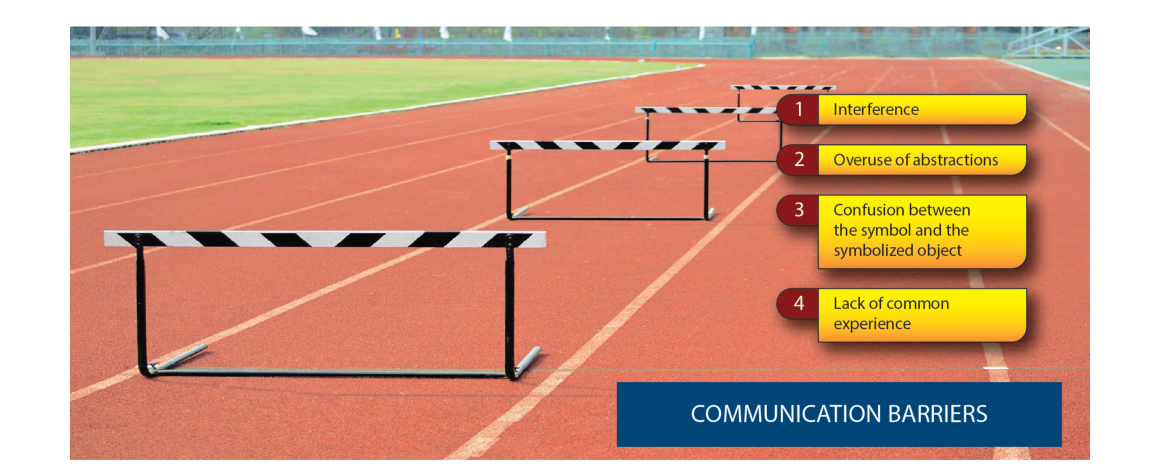
Barrier 1: Lack of Common Experience
The most fundamental barrier is a lack of common experience between the instructor and the student. Communication is only possible to the extent that both parties share a common understanding of the symbols being used. Words, phrases, and analogies only carry meaning if the listener has a reference point for them.
For example, if a CFI explains a coordinated turn by saying "keep the ball centered," but the student has never flown before and has no mental model of a slip-turn-skid relationship, the phrase is nearly meaningless without additional context. Similarly, aviation jargon — terms like density altitude, induced drag, or VFR on top — may be second nature to the CFI but completely foreign to the student. The more experienced the instructor, the greater the risk of inadvertently assuming shared knowledge that does not yet exist.
The remedy is to consciously build from what the student already knows, using analogies tied to everyday experience, and to continuously check for comprehension rather than assuming the message was received as intended.
Barrier 2: Confusion Between the Symbol and the Symbolized Object
A related barrier occurs when a student (or instructor) confuses a symbol with the thing the symbol represents. Words are not the objects they describe; they are abstractions. A student who hears the word "stall" may form a mental picture of an engine stopping — a perfectly logical association in everyday English — rather than an aerodynamic loss of lift. That mental picture will persist and cause confusion during every subsequent discussion of stall recovery unless the CFI recognizes the confusion and corrects it directly.
This is sometimes called semantic confusion. Aviation is full of words that have precise technical meanings that differ sharply from common usage: altitude, attitude, lift, drag, critical angle of attack, and manifold pressure are just a few. When a student nods and appears to understand, the instructor must verify through questioning whether the technical meaning has truly been grasped.
Barrier 3: Overuse of Abstractions
Closely related to the above, overuse of abstractions is a barrier that creeps into instruction when a CFI relies too heavily on theoretical or conceptual language without grounding it in concrete, observable experience. Abstractions are useful shorthand for those who already understand the underlying concept, but they obscure meaning for beginners.
Telling a student that "angle of attack determines lift" is abstract. Demonstrating how back pressure increases the pitch attitude and changes the aircraft's performance, then linking that experience to the definition of angle of attack, makes the abstract concept concrete. The Aviation Instructor's Handbook stresses that good instruction moves from the known to the unknown, from the concrete to the abstract, and from the simple to the complex. Violating this sequence creates a barrier.
Barrier 4: Interference
Interference refers to anything that disrupts the transmission or reception of a message. The FAA identifies two broad types:
- External interference includes physical noise (radio chatter, engine noise, ramp activity), poor intercom quality, cockpit distractions, ATC communications arriving during a critical instructional moment, or a student whose attention is pulled by traffic outside the aircraft.
- Emotional interference is often more powerful and more difficult to detect. A student who is anxious, frustrated, fatigued, or embarrassed cannot fully focus on incoming instruction. Anxiety in particular is a documented barrier to learning: when a student is in a high-stress state, the brain's capacity to process and retain new information is significantly reduced. A student who is afraid of stalls will hear the CFI's words about stall recovery but may not encode them effectively until the anxiety is addressed.
The instructor must manage both types. External interference is addressed by choosing quiet environments for ground instruction and managing cockpit workload. Emotional interference requires the instructor to develop sensitivity to the student's emotional state, use positive reinforcement, and create a psychologically safe learning environment.
Barrier 5: Inappropriate or Misunderstood Feedback
Communication is a two-way process, and inadequate or misinterpreted feedback can itself be a barrier. If an instructor asks "do you understand?" and the student says "yes" out of social pressure, politeness, or a desire not to appear incompetent, false feedback has occurred. The instructor incorrectly concludes the message was received and moves on, leaving a gap in the student's knowledge.
The remedy is to ask open-ended questions that require the student to demonstrate understanding rather than simply confirm it. Instead of "do you understand the power-off stall recovery procedure?", the CFI should ask "walk me through what you would do, step by step, when you approach a power-off stall." The student's response reveals actual comprehension. This technique also reinforces learning by requiring the student to actively reconstruct the information.
Barrier 6: Stereotyping and Preconceived Impressions
The Aviation Instructor's Handbook also highlights stereotyping as a communication barrier. When an instructor forms a fixed impression of a student — "this student is a natural" or "this student just doesn't get it" — the instructor may stop communicating effectively and start confirming a bias. Positive stereotypes can cause the instructor to skip essential steps or reduce feedback on errors. Negative stereotypes can cause the instructor to withdraw encouragement or unconsciously lower expectations, both of which impair the student's progress.
Preconceived impressions work in both directions. A student who has heard that a particular maneuver is extremely difficult may approach it with so much anxiety that the self-fulfilling prophecy creates the very failure they feared. The instructor must work to identify and counteract these impressions early.
Barrier 7: The Use of Inappropriate or Imprecise Language
Using language that is too technical, too casual, or ambiguous is a barrier in its own right. Aviation has a precise vocabulary for good reason: imprecise language in the cockpit causes dangerous misunderstandings. At the same time, an instructor who overwhelms a new student with dense technical jargon from the first lesson will lose them quickly. The CFI must calibrate vocabulary to the student's current level while consistently introducing and reinforcing correct terminology.
Casual language that substitutes colloquialisms for standard terminology — saying "give it some gas" instead of "advance the throttle," or "nose it down" instead of "lower the pitch attitude" — may feel more accessible but actually impedes the student's ability to communicate with other instructors, examiners, and controllers who use standard terms.
Memory Aid
The phrase "LAST FIX" can serve as an informal, non-FAA memory aid for reviewing barriers: Lack of common experience, Abstractions overused, Symbol-object confusion, Terminology mismatch, Feedback inadequate or false, Interference (external and emotional), and X-factor stereotyping and preconceived impressions. This mnemonic and its category labels are not found in the Aviation Instructor's Handbook, so use it only as a personal study tool rather than as an official FAA list.
Practical Application in the Cockpit and Classroom
During preflight briefings, the CFI should activate prior knowledge by asking what the student already knows about the day's maneuver, identifying any misconceptions before flight. In the cockpit, the instructor should narrate actions in real time using precise standard terminology, check comprehension at natural pause points, and watch for behavioral cues (hesitation, incorrect control inputs, puzzled expressions) that signal a communication breakdown even when the student has not verbally expressed confusion. During the debrief, using open-ended questions and encouraging the student to self-assess puts the responsibility for communication on both parties — reinforcing that learning is a shared process.
Common Test Traps
- "Lack of common experience" is identified by the FAA as a fundamental barrier to communication — do not confuse it with interference, which is a separate category.
- Asking "do you understand?" is explicitly identified in FAA material as an ineffective feedback technique because it invites a yes/no answer that may not reflect true comprehension.
- Emotional interference is closely related to external interference but reflects the student's internal psychological state — recognize it as a distinct, though related, concern rather than assuming a single rigid category structure will be tested.
- Stereotyping applies to both positive and negative assumptions about a student; a question that asks only about negative stereotypes is incomplete — both directions impair effective communication.
- Abstractions versus concrete experience: remember that the FAA's principle is to move from known to unknown and concrete to abstract, so starting with theory before experience violates this principle and creates a communication barrier.