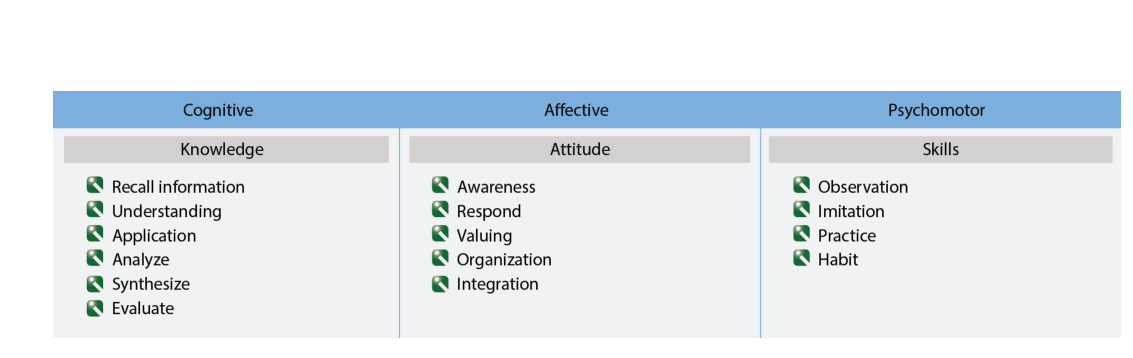
When a flight instructor teaches a student to fly, learning doesn't happen in just one way. The FAA's Aviation Instructor's Handbook (FAA-H-8083-9) identifies three broad domains of learning that together describe the full range of human learning: the cognitive domain (thinking and knowledge), the affective domain (attitudes and emotions), and the psychomotor domain (physical skills and muscle memory). A well-rounded flight instructor understands all three, because effective pilot training demands growth in each area simultaneously.
The cognitive domain covers intellectual skills—everything from memorizing the phonetic alphabet to analyzing a complex instrument approach. The FAA handbook describes cognitive learning as progressing through levels of complexity. At the simplest level, a student merely remembers facts (recalling that FAA guidance, such as AC 90-66, generally recommends a traffic pattern altitude of 1,000 feet AGL for propeller aircraft, though this varies by aircraft type and airport). At higher levels, the student comprehends, applies, analyzes, and ultimately evaluates information—for example, weighing weather data to make a go/no-go decision. This progression from rote memorization toward genuine understanding and judgment is a central goal of flight training. Instructors must push students beyond simple recall to make sure cockpit knowledge translates into sound aeronautical decision-making.
The affective domain deals with attitudes, values, and emotional responses. This is perhaps the most safety-critical domain for pilots. Research consistently shows that poor attitudes—such as invulnerability, impulsivity, macho behavior, resignation, and anti-authority thinking—are major contributors to aviation accidents. The FAA calls these the five hazardous attitudes. The affective domain is where students develop professionalism, situational awareness as a mindset, and the discipline to follow checklists even when they feel unnecessary. Instructors must model and reinforce positive attitudes from the very first lesson, because a student who has all the cognitive knowledge and motor skills but a reckless attitude remains a danger in the cockpit.
The psychomotor domain covers physical performance—the actual hands-and-feet skills of flying an airplane. Psychomotor learning begins with observing a demonstration, then progressing through imitation, practice, and eventually automaticity, where skills become smooth and nearly unconscious. A student's first attempt at a coordinated turn is deliberate and awkward; an experienced pilot performs the same maneuver almost without conscious thought. This frees up mental bandwidth for higher-order cognitive tasks like navigation and decision-making. Instructors help students reach automaticity through deliberate repetition and targeted feedback.
Why it matters
Understanding these three domains helps instructors diagnose why a student is struggling. If a student consistently enters the traffic pattern at the wrong altitude, the problem may be cognitive (doesn't know the rule), affective (doesn't feel it's important), or psychomotor (can't control the aircraft precisely enough to hit the altitude). Each diagnosis leads to a completely different remedy. Instructors who only address one domain while ignoring the others will find their students plateauing. The FAA emphasizes that all three domains must be developed together for a student to become a truly safe and competent pilot.
Memory aid
Use the acronym CAP to remember the three domains:
- C – Cognitive (knowledge and thinking)
- A – Affective (attitudes and feelings)
- P – Psychomotor (physical performance)
Think of a pilot wearing a CAP: the brim shades the eyes (what you see and think), the inside lining touches the head (how you feel), and the act of putting it on involves your hands (what you do).
Common test traps
- Confusing domains with levels: The FAA knowledge test may ask about the domains (cognitive, affective, psychomotor) separately from the levels within a domain (such as the cognitive hierarchy from knowledge to evaluation). Don't mix them up.
- Undervaluing the affective domain: Students sometimes assume attitude training is less important than stick-and-rudder skills. FAA research clearly ties hazardous attitudes to accidents—expect test questions that reinforce the affective domain's safety importance.
- Automaticity is primarily a psychomotor achievement: When a skill becomes automatic through repetition and practice, the Aviation Instructor's Handbook discusses this mainly within psychomotor skill development, though skill execution can also involve cognitive processing. Don't treat it as a strict either/or.
- All three domains are always present: Every flight lesson involves cognitive, affective, and psychomotor learning simultaneously. The domains are not mutually exclusive, and the FAA expects instructors to address all three in every lesson plan.