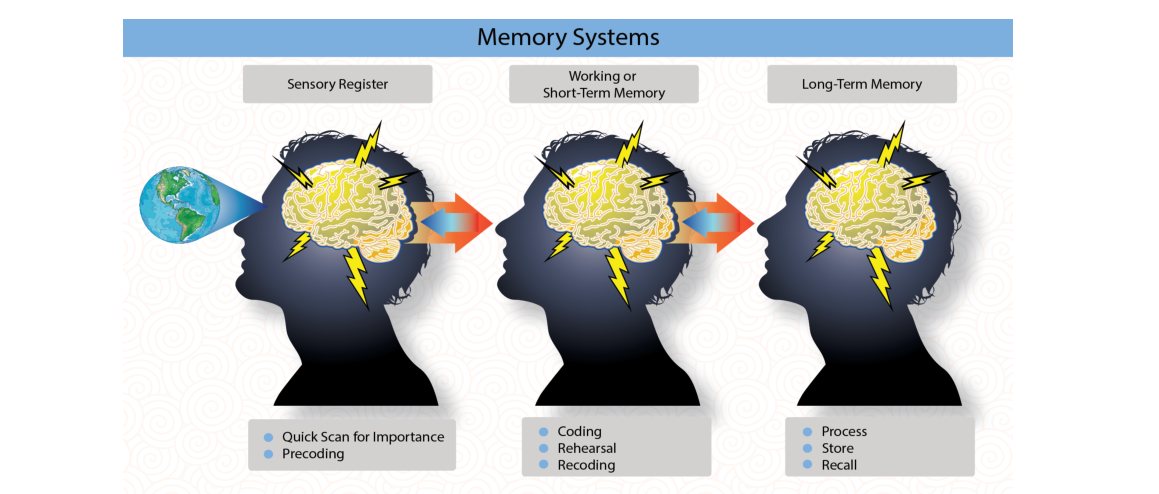
Every time a student sits in the cockpit for the first time, their brain is flooded with competing stimuli: engine noise, radio chatter, instrument readings, control pressures, fuel smells, and the spatial disorientation of an unfamiliar environment. Whether any of that raw experience becomes lasting, usable knowledge depends almost entirely on how well the instructor understands the three-stage model of human memory. The FAA's Aviation Instructor's Handbook (FAA-H-8083-9) presents sensory memory, short-term memory, and long-term memory as the core framework for understanding how learning happens — and, crucially, why it sometimes fails. For Flight Instructor and Ground Instructor applicants, mastering this framework is not optional: it appears throughout the Fundamentals of Instructing (FOI) portion of FAA knowledge tests and the corresponding ACS tasks.
The Pipeline Model of Memory
A useful mental model is to picture human memory as a three-stage pipeline. Information enters through the senses, moves into a brief but active processing workspace, and — if the conditions are right — gets permanently encoded in a vast long-term store. A bottleneck or breakdown at any stage means the information is lost, regardless of how clearly the instructor presented it. Understanding each stage in depth allows the instructor to design lessons that keep information moving all the way through the pipeline to permanent storage.
Stage One: Sensory Memory
Sensory memory is the first and shortest stage. Every piece of information that reaches the human nervous system — a flicker of the VSI, the click of a trim switch, the feel of adverse yaw, the controller's clipped transmission — is held in sensory memory for only an extremely brief instant, typically described as less than one second. During that fleeting window, the brain performs a rapid triage: is this stimulus worth conscious attention? If the answer is no, the information is discarded permanently and the student never even has an opportunity to learn it.
This is why selective attention is so critical in flight training. A student overwhelmed by novelty will unconsciously filter out critical cues. The instructor's job at this stage is to act as an attention director — verbally cueing the student to look at a specific instrument before a maneuver, or asking a focused question that primes perception in the right direction. Techniques such as the sterile cockpit concept during critical phases of flight leverage this same principle: by eliminating irrelevant sensory input, you increase the probability that the important inputs pass the triage filter and move forward.
Anxiety amplifies the problem. A nervous student's attentional bandwidth narrows, which means even prominently displayed information can fail to register at the sensory stage. Establishing a calm, structured environment is not just an interpersonal nicety — it is a prerequisite for effective sensory processing.
Stage Two: Short-Term Memory (Working Memory)
Information that survives the sensory filter enters short-term memory (STM), often called working memory because it is the active workspace where conscious thought occurs. The FAA-H-8083-9 describes STM as having severely limited capacity — research commonly cited in educational psychology suggests the average person can hold approximately seven chunks of information, plus or minus two, at a given moment. Equally important is the time constraint: without active rehearsal or meaningful connection to existing knowledge, information in STM is lost within a matter of seconds.
In a practical flight lesson, these limitations have immediate consequences. Consider a student learning coordinated turns for the first time. Processing visual bank angle, cross-checking the ball, applying rudder pressure, monitoring altitude, and managing throttle simultaneously may already approach or exceed working memory capacity. If the instructor chooses that same moment to explain Class B airspace dimensions, the earlier items will simply drop out of working memory before they can be processed — a phenomenon the handbook associates with cognitive overload. The student is not being inattentive or careless; the architecture of human memory physically cannot accommodate the load.
Effective instructors mitigate STM limitations through several strategies grounded in the FAA-H-8083-9:
- Chunking: Grouping related items into a single meaningful unit reduces the number of discrete items competing for STM slots. A pre-landing checklist memorized as a flowing procedure becomes one chunk rather than seven separate items.
- Appropriate pacing: Allowing time for processing between new concepts prevents earlier material from being displaced before it can be transferred to long-term memory.
- Primacy and recency: Items presented first and last in a lesson are better retained; structure lessons to place the most safety-critical information in those positions.
- Meaningful rehearsal: Asking the student to explain a concept back in their own words, or to apply it immediately in context, keeps information active in working memory long enough for encoding to begin.
Stage Three: Long-Term Memory
Long-term memory (LTM) is the goal of all instruction. The FAA-H-8083-9 describes LTM as having virtually unlimited capacity and the ability to retain information indefinitely. Unlike the fragile, time-limited nature of STM, properly encoded long-term memories can be retrieved years later with appropriate cues. The challenge is not storage space — it is the encoding process itself.
The handbook uses the term coding to describe the mental process by which new information is linked to existing knowledge already residing in LTM. This is why the principle of building on prior experience is so central to good instruction. When an instructor explains angle of attack by comparing it to the angle a paddle makes as it moves through water, the student connects a new aeronautical concept to a familiar physical experience — and that connection is what makes the information stick. Abstract information presented without any anchor to prior knowledge is difficult to encode and quick to be forgotten.
Repetition supports long-term retention, but the FAA-H-8083-9 is careful to distinguish between meaningful practice and rote repetition. Rote repetition — repeating a phrase without understanding — produces only shallow encoding that is easily disrupted by stress or an unusual situation. Deep encoding, achieved by understanding relationships, causes, and applications, produces the durable knowledge that a pilot can retrieve and apply during an emergency or an unexpected scenario. This distinction between rote learning and understanding is a recurring theme in both the FOI content and the broader philosophy of the ACS.
Why the Three-Stage Model Matters for Aviation Safety
In most educational settings, a forgotten fact costs a test point. In aviation, a forgotten checklist item, a misremembered VFR weather minimum, or a failure to recall the proper emergency procedure can be catastrophic. The three-stage memory model is not academic theory for its own sake — it is a safety architecture. Instructors who understand where information can be lost are equipped to design lessons, ground briefings, and debriefs that systematically reduce those losses. Ground school review before each flight primes LTM retrieval; structured post-flight debriefs reinforce encoding; scenario-based training creates the meaningful associations that make knowledge robust under pressure.
Key Numbers and Rules
- Sensory memory duration: an extremely brief instant, typically less than one second — just long enough for attention-based filtering.
- Short-term memory capacity: approximately seven items (plus or minus two); information is lost within a matter of seconds without rehearsal.
- Long-term memory: considered unlimited in both capacity and duration; requires meaningful coding (association) for reliable encoding.
- The transfer mechanism from STM to LTM is coding — connecting new information to existing knowledge.
- Anxiety, fatigue, and distraction all degrade sensory filtering and reduce effective STM capacity.
Common Test Traps
- Confusing which stage has limits: STM has both a capacity limit and a time limit. LTM has neither. FAA knowledge test questions frequently test whether applicants can correctly assign these constraints to the right stage.
- Assuming repetition alone is sufficient: Rote repetition without meaningful association produces weak LTM encoding. The handbook emphasizes coding — connection to prior knowledge — as the essential transfer mechanism.
- Overlooking the sensory stage as a cause of learning failures: When a student fails to register information at all, the cause is often that it was filtered out at the sensory stage due to inattention, overload, or anxiety — it never reached STM. Test questions may present this as a scenario and ask the instructor to identify the cause.
- Confusing sensory memory duration with STM duration: Sensory memory lasts less than a second; STM lasts a matter of seconds without rehearsal. Swapping these time frames is a classic distractor.
- Thinking understanding automatically equals long-term retention: Understanding accelerates encoding, but meaningful practice and review are still required to firmly establish information in LTM and ensure reliable retrieval under operational stress.
Memory Aid
The three stages follow a natural sequence that can be recalled as