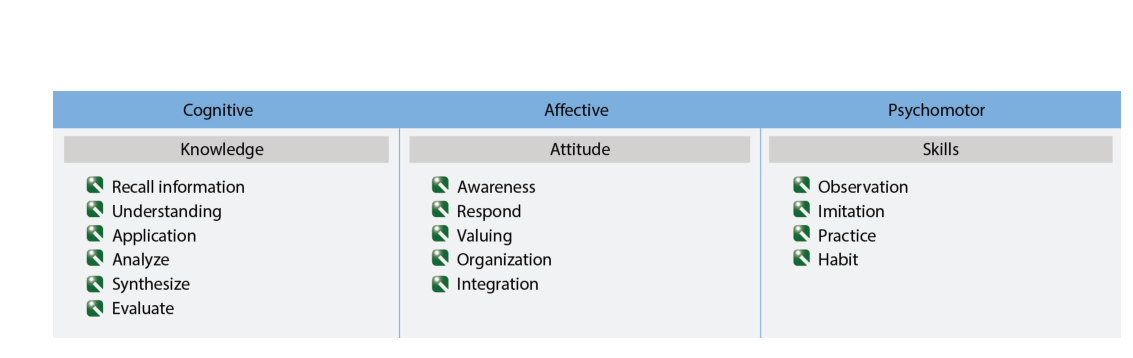
When you step into the role of a flight or ground instructor, your job reaches far beyond demonstrating maneuvers or reciting regulations. You are simultaneously shaping how a student thinks about aeronautical problems, what a student values as a pilot, and how a student moves the controls with precision and confidence. The FAA's Aviation Instructor's Handbook (FAA-H-8083-9) organizes all human learning into three broad categories called the domains of learning: the cognitive domain (intellectual knowledge and reasoning), the affective domain (attitudes, emotions, and values), and the psychomotor domain (physical skill and coordination). A well-designed flight lesson intentionally and simultaneously addresses all three, because a gap in any one of them can—and does—produce accidents.
Each domain contains a hierarchy of levels, moving from the simplest, most passive behaviors at the bottom to the most complex and independent at the top. Recognizing where a student sits within each hierarchy gives an instructor the diagnostic precision to set realistic lesson objectives, select the right teaching method, and measure genuine mastery rather than surface-level performance.
The Cognitive Domain: Thinking, Knowing, and Deciding
The cognitive domain encompasses all mental processes—recalling a memory item, understanding a concept, applying a rule, and ultimately rendering a sound aeronautical decision. The Aviation Instructor's Handbook draws on Benjamin Bloom's classic taxonomy and arranges cognitive learning through six ascending levels.
- Knowledge – The ability to recall specific facts from memory: the traffic pattern altitude at an uncontrolled airport, the VFR cloud clearance requirements, or the stall speed in the Pilot's Operating Handbook.
- Comprehension – Understanding the meaning of that recalled information. A student who can explain why induced drag increases at high angles of attack has moved beyond raw recall into comprehension.
- Application – Using knowledge in a new but familiar situation. Calculating a crosswind component for a specific runway and wind condition, or applying density altitude concepts to a hot-day takeoff performance calculation, are classic application tasks.
- Analysis – Breaking a complex problem into its parts to find relationships or causes. Diagnosing a rough-running engine by systematically considering fuel, ignition, and induction factors is an analytic exercise.
- Synthesis – Assembling separate pieces of knowledge into something new. Building an impromptu divert route that accounts for weather, fuel state, terrain, and ATC involves synthesizing multiple knowledge areas simultaneously.
- Evaluation – The highest cognitive level: making a reasoned judgment about quality, validity, or a course of action. A well-executed go/no-go decision before a cross-country flight—weighing fuel, weather, pilot currency, and aircraft airworthiness—is a pure evaluation task.
The FAA knowledge test necessarily focuses on the lower levels of this hierarchy, but the Airman Certification Standards (ACS) explicitly expect applicants to operate at the analysis and evaluation levels during oral examinations and practical tests. Instructors who limit their teaching to knowledge and comprehension—rote memorization of answers—are producing students who can pass written tests but are ill-prepared for the dynamic environment of actual flight. Scenario-based training and Socratic questioning are the principal tools for pushing students toward the upper levels of the cognitive hierarchy.
The Affective Domain: Attitudes, Values, and Character
The affective domain is the most difficult to teach, the hardest to assess, and arguably the most consequential for flight safety. It governs a student's willingness to learn, the attitudes brought to every flight, and the degree to which safety-conscious values become genuine personal traits rather than performances. The Aviation Instructor's Handbook identifies five ascending levels in the affective domain.
- Receiving – The baseline: the student is at least open and willing to pay attention. A student who resists instruction or dismisses safety briefings has not even reached this level.
- Responding – The student actively participates, asks questions, and reacts to instruction rather than passively absorbing it.
- Valuing – The student genuinely perceives worth in what is being taught. A student who voluntarily reviews weather data before a lesson—not because they were told to, but because they see its importance—is at the valuing level.
- Organization – The student begins integrating newly acquired values with previously held beliefs, resolving conflicts and forming a consistent personal value system about aviation safety and airmanship.
- Characterization – The attitude has become a stable, defining characteristic of the person. A pilot at this level follows checklists, respects weather minimums, and makes conservative decisions not because an instructor is watching, but because that behavior is authentically who they are.
This domain is critical in aviation because the FAA identifies hazardous attitudes—anti-authority, impulsivity, invulnerability, macho, and resignation—as significant causal factors in accidents (as discussed in FAA-H-8083-2, the Risk Management Handbook, and reinforced in FAA-H-8083-9). These are affective problems, not cognitive ones. A student can pass every written test and still pose a serious safety risk if their attitude toward risk, rules, and personal limitations has never been addressed. The instructor's role in the affective domain includes modeling professional behavior, using open-ended debrief questions that invite honest self-assessment, and recognizing when a student's attitude warrants a direct, frank conversation.
The Psychomotor Domain: Physical Skills and Automaticity
The psychomotor domain covers the physical execution of flight skills—the hand, foot, and eye coordination required to hold a heading in turbulence, flare at the precise moment before touchdown, or trim an aircraft for hands-off level flight. The Aviation Instructor's Handbook describes psychomotor skill acquisition as a progression through three general stages.
- Cognitive stage – The early stage in which the student mentally works through what to do, often while watching a demonstration and building an understanding of what correct performance looks, sounds, and feels like. Performance is halting and requires deliberate, conscious thought about each step.
- Associative (practice) stage – The student practices the skill repeatedly, and instructor guidance and self-correction refine performance. Errors become less frequent, movements become smoother, and the student begins to link individual steps into a coordinated sequence. This stage requires patience from both instructor and student.
- Autonomous stage – The skill is performed smoothly, consistently, and largely automatically, without requiring deliberate conscious attention for each sub-step.
Reaching the autonomous stage is the operational goal of psychomotor training because automaticity frees cognitive bandwidth for higher-order tasks. A pilot who must consciously think through every control input during an approach cannot simultaneously monitor traffic, manage communications, and evaluate landing conditions. When the stick-and-rudder skills are habitual, the conscious mind is available for situational awareness and decision-making. Instructors must resist external pressure—scheduling demands, student eagerness, cost concerns—to advance a student before psychomotor skills are genuinely autonomous. A student who can only execute a maneuver when coached step-by-step is still at the associative stage and is not operationally ready for solo flight.
Why All Three Domains Must Be Addressed Together
The three domains are inseparable in actual flight operations. Consider a student who knows (cognitive) that continued VFR flight into IMC is statistically fatal, yet pushes into deteriorating weather anyway. That student's affective domain has not been developed to the valuing or characterization level. Or consider a student with excellent attitudes and solid knowledge who loses aircraft control during an unexpected turbulence encounter—the psychomotor habit simply was not there. Effective instruction treats each lesson as an opportunity to develop all three domains through a deliberate blend of ground discussion, scenario-based questioning, hands-on practice, and honest debriefing.
Key Numbers and Rules to Know
- The cognitive domain has six levels; evaluation is at the top, knowledge at the bottom.
- The affective domain has five levels; characterization is the highest and the ultimate instructional goal for attitude development.
- The psychomotor domain has three general stages as described in FAA-H-8083-9 — cognitive, associative, and autonomous; the autonomous stage is the endpoint that enables safe solo and checkride performance.
- Hazardous attitudes (anti-authority, impulsivity, invulnerability, macho, resignation) are affective domain problems requiring affective domain interventions, not just cognitive remediation.
- The ACS evaluates applicants at the analysis and evaluation levels of the cognitive domain during practical tests—not merely at the knowledge or comprehension levels.
Common Test Traps
- Confusing domains by example: A student demonstrating a smooth crosswind landing is working primarily in the psychomotor domain, even though cognitive knowledge of crosswind technique is involved. Classify the dominant learning type.
- Synthesis vs. evaluation: The FAA handbook places evaluation above synthesis in the cognitive hierarchy. Many students reverse these two—know the correct order.
- Affective domain difficulty: Test questions regularly emphasize that attitudes are the hardest to change and the most important to long-term safety. The affective domain is not a soft afterthought.
- Associative vs. autonomous: A student who needs verbal prompting to complete each step of a maneuver is at the associative stage, not the autonomous stage. Do not confuse successful coached performance with independent mastery.
- Characterization as the goal: Test items often distinguish between a student who performs safely under observation versus one who is a safe pilot by disposition. The latter reflects characterization.
Memory aid
Use CAP to recall the three domains: Cognitive, Affective, Psychomotor. Just as a cap covers your whole head, all three domains together cover the whole learner—thinking, feeling, and doing. No complete pilot is developed by addressing only one or two.