Eights on pylons is one of the most intellectually satisfying maneuvers on the commercial pilot practical test. Unlike ground reference maneuvers such as turns around a point, which require constant bank adjustments to maintain a fixed radius, eights on pylons focuses on a different goal entirely: keeping the extended wingtip line aimed precisely at a selected ground reference point called a pylon. When flown correctly, the wingtip appears to pivot on that pylon as if connected by an invisible rod. The secret to making that happen is flying at exactly the right altitude — the pivotal altitude.
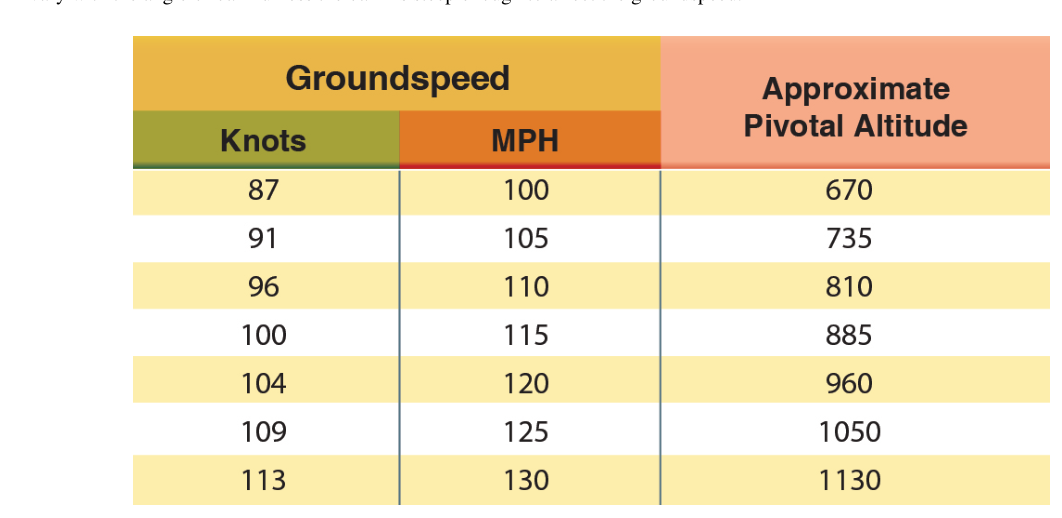
Pivotal altitude is the specific altitude above ground level at which, for a given groundspeed, the line of sight from the cockpit along the longitudinal axis of the aircraft, extended through the wingtip, appears to remain fixed on a ground point during a banked turn. It is not an arbitrary number — it is a direct mathematical consequence of your groundspeed. The FAA formula (from the Airplane Flying Handbook) expresses this relationship: pivotal altitude in feet equals groundspeed in knots squared, divided by 11.3. So at 100 knots groundspeed, pivotal altitude is approximately 885 feet AGL. At 90 knots it drops to roughly 717 feet AGL. You do not need to memorize the formula for the checkride, but you absolutely must understand what it means: faster groundspeed requires higher altitude; slower groundspeed requires lower altitude.
Why it matters
Because wind constantly changes your groundspeed around the figure-eight, your pivotal altitude is never constant throughout the maneuver. On the downwind side of the pylon your groundspeed is higher, so the correct pivotal altitude is higher. On the upwind side it is lower. This means you must continuously climb and descend slightly as you fly around each pylon — not by chasing an arbitrary altitude on the altimeter, but by watching the pylon reference itself.
The key sight picture is everything. If the pylon appears to move forward (toward the nose), you are too low — add a little back pressure to climb. If the pylon appears to slide rearward (toward the tail), you are too high — ease forward to descend. Bank angle is adjusted only to keep the wingtip pointed at the pylon as the altitude changes cause the radius to shift slightly. You select two pylons roughly 500–1,000 feet apart, fly a figure-eight ground track between them, and transition smoothly from one circle to the next over the crossover point.
Pylon selection matters. Choose two prominent ground references at roughly the same elevation, in an area free of obstacles and away from congested areas. The entry is typically made at the correct pivotal altitude, wings level, on a 45-degree angle to the line between the two pylons, at a groundspeed representative of normal cruise.
Memory aid
"High and fast, low and slow" — when your groundspeed is high (tailwind), you need a higher pivotal altitude. When your groundspeed is low (headwind), you need a lower pivotal altitude. If the pylon moves forward, go higher. If the pylon slides back, go lower.
Common test traps
- Confusing eights on pylons with turns around a point. Turns around a point maintain a constant radius by varying bank. Eights on pylons maintains a visual reference line to a fixed pylon by adjusting altitude — there is no predetermined radius requirement.
- Thinking bank angle controls the pylon reference. Bank angle is adjusted to follow the pylon as altitude changes affect the turning radius, but it is altitude — not bank — that corrects a wandering pylon sight picture.
- Forgetting that pivotal altitude changes with wind. A common test question asks what happens to pivotal altitude on the downwind leg. The answer: it increases, because groundspeed is higher on the downwind side.
- Misapplying the formula direction. The formula GS²÷11.3 uses groundspeed in knots, not miles per hour. Using mph would give you an incorrect (and dangerously high) altitude value. Always use knots.