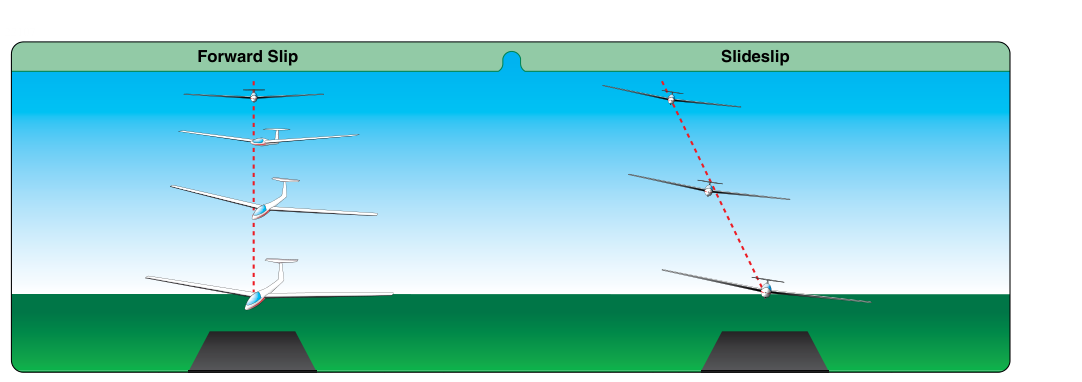
A slip is one of the most elegant tools in a pilot's repertoire: a deliberate cross-control maneuver that weaponizes parasite drag to steepen a descent without letting airspeed run away. By banking with aileron while simultaneously applying opposite (top) rudder, the pilot yaws the fuselage broadside to the relative wind, dramatically increasing form drag. The airplane descends more steeply, yet the nose attitude and airspeed remain relatively stable because pitch still governs speed. Two distinct variations—the forward slip and the sideslip—share this same aerodynamic foundation but serve entirely different purposes in the traffic pattern. For commercial pilot applicants, understanding the mechanics, the differences, the limitations, and the decision-making behind each is not merely an academic exercise; it is a demonstrated flight proficiency standard under the Commercial Pilot Airman Certification Standards.
The Aerodynamics of a Slip
When an airplane flies in coordinated flight, the longitudinal axis aligns with the relative wind and the ball in the inclinometer sits centered. In a slip, the pilot intentionally decouples these two: the longitudinal axis is yawed out of alignment with the flight path, presenting the side of the fuselage to the oncoming airstream. This non-streamlined presentation creates substantial parasite drag, which is proportional to the square of the velocity and the effective frontal area. The greater the bank angle (and therefore the greater the yaw displacement), the larger that frontal area and the higher the drag. This drag acts as an aerodynamic speed brake, allowing the glide path to steepen considerably—sometimes nearly as effectively as full flaps—while the pilot holds back-pressure to maintain the target approach speed. The Pilot's Handbook of Aeronautical Knowledge (PHAK, FAA-H-8083-25) classifies the slip under intentional uncoordinated flight, distinguishing it sharply from an accidental skid or slip caused by poor rudder coordination.
Forward Slip: Trading Altitude for Position
In a forward slip, the pilot's goal is to lose altitude rapidly while maintaining the existing ground track. The technique is straightforward in concept but demands precision in execution. The pilot selects a bank direction—let's say left aileron to bank the left wing down—and simultaneously applies right (top) rudder to prevent the nose from following the bank and turning left. The result is that the nose points to the right of the actual flight path, the fuselage angles across the wind, and drag increases sharply. The airplane continues to track straight ahead toward the runway threshold, but descends at a much steeper angle than the normal glide.
Control harmony in the forward slip is worth internalizing: aileron controls the magnitude of the slip (more bank = more fuselage area exposed = more drag = steeper descent), while rudder controls the direction (keeping the ground track straight by opposing the turning tendency). Pitch attitude still governs airspeed. If you need to steepen the descent further, you increase bank angle; if you need to reduce the sink rate, you shallow the bank or roll wings level. The Airplane Flying Handbook (AFH, FAA-H-8083-3) notes that the airspeed indicator may be unreliable during a slip if the pitot-static ports are positioned such that the yawed fuselage disturbs the pressure readings—so pilots should be alert to this instrument quirk and use pitch attitude and known performance references as the primary speed cues.
Practical forward-slip scenarios include: arriving high on short final with insufficient runway remaining to execute a safe go-around and re-sequence; landing on a short strip or off-airport field where floating even a few hundred feet could be disqualifying; operating an airplane with inoperative or restricted flaps; and steep-approach noise-abatement procedures at certain airports. For the commercial applicant, the examiner expects the pilot to set up the forward slip smoothly, maintain coordinated entry and exit, hold the target airspeed within the ACS tolerance, and transition cleanly to the round-out and touchdown.
Sideslip: Correcting Lateral Drift in Crosswinds
The sideslip uses identical cross-control inputs but pursues a completely different objective: keeping the airplane's longitudinal axis aligned with the runway centerline while preventing lateral drift caused by a crosswind. In this technique, the pilot lowers the upwind wing with aileron—generating a horizontal component of lift that opposes the crosswind's push—while applying downwind (top) rudder to align the nose with the runway heading. The fuselage is again angled to the relative wind, but now the angle is deliberate positioning to counteract crosswind drift rather than to maximize drag for altitude loss.
Because the longitudinal axis remains aligned with the runway centerline throughout the approach and through the flare, the upwind main gear touches down first, followed by the downwind main gear, and finally the nosewheel. This sequence avoids the side-load stress on landing gear that would result from touching down while crabbed. The AFH distinguishes this wing-low method of crosswind correction from the crab method and recommends the sideslip—or a combination crab-then-sideslip transition just before touchdown—as the standard technique. The magnitude of the bank and rudder deflection required depends entirely on wind speed and direction; stronger crosswinds demand more aileron and more rudder to maintain centerline alignment.
One nuance that trips up students: in a sideslip with a crosswind, the pilot may also be losing some altitude more steeply than in a normal coordinated approach, because the fuselage is exposed to some drag—but this is a secondary effect. The primary purpose is lateral correction, not altitude management. If the pilot simultaneously needs to lose altitude and correct for crosswind, they may find themselves in a hybrid that resembles both techniques at once, but the naming convention follows intent.
POH Limitations: When Slipping Is Prohibited
Perhaps the most safety-critical fact about slips is that some airplanes prohibit or restrict slipping with flaps extended. The classic example from FAA training literature involves certain high-wing aircraft where extended flaps can disturb airflow over the horizontal stabilizer during a slip, reducing elevator effectiveness or causing a pitch-down tendency. The Pilot's Operating Handbook (POH) / Airplane Flight Manual (AFM) is the authoritative source for any such restriction, and 14 CFR Part 91 requires compliance with AFM limitations. On a commercial knowledge test and practical exam alike, a pilot must be able to identify this restriction and articulate why it exists. The blanket assumption that flaps and slips are always compatible is a tested—and dangerous—error.
Key Numbers, Rules, and Considerations
- Airspeed in a slip: The target approach speed is maintained with pitch attitude, just as in normal flight. Adding roughly 1.3 VS0 as a reference is common for short-field approaches; the slip reduces the glide path angle without requiring a nose-low attitude.
- Pitot-static error: The AFH specifically warns that airspeed indications may be unreliable in a slip; use established pitch attitudes and verify with known aircraft performance.
- Bank angle limits: There is no FAA-mandated maximum bank angle for a forward slip, but excessive bank angles on short final reduce lateral control margin. Pilot judgment, aircraft performance data, and POH guidance govern.
- Flap restriction: Always check the POH before slipping with flaps. This is a go/no-go item, not a judgment call.
- Crosswind component: The maximum demonstrated crosswind component listed in the POH is a performance figure, not a regulatory limit—but it remains the practical ceiling for most pilots in a sideslip crosswind landing.
Common Test Traps
- Reversing aileron and rudder roles in the forward slip: Students often state that the rudder steepens the descent and the aileron keeps the nose straight. This is backwards. Aileron sets the bank (and therefore the drag); rudder opposes the turning tendency to hold the ground track.
- Assuming both slips look identical from outside: They use the same cross-control inputs but the resulting aircraft path differs—forward slip tracks straight; sideslip tracks aligned with the runway while drifting is prevented.
- Confusing slip with skid: In a slip the ball deflects toward the low wing (away from the direction of turn). In a skid the ball deflects toward the outside (high wing side). Both are uncoordinated, but for opposite reasons.
- Thinking the airspeed increases dramatically: The nose attitude is not pitched steeply down, so airspeed stays relatively stable. It is the drag-induced steeper glide path—not increased speed—that makes the forward slip effective at losing altitude.
- Ignoring flap/slip restrictions: A scenario question asking whether a pilot should slip with flaps fully extended on a specific aircraft type demands the answer: check the POH first. Assuming it is always permissible is a common and tested error.
Memory Aid
"Forward slip fixes altitude; Sideslip fixes drift." Both use cross-controls. The goal—and the scenario—tell you which technique to apply. On a knowledge or oral exam, identify what the pilot is trying to accomplish, then name the maneuver accordingly.