Eights-on-pylons is one of the most intellectually satisfying maneuvers in the private pilot curriculum—and one of the most frequently misunderstood. Unlike standard ground-reference maneuvers such as turns around a point, the pilot does not try to maintain a fixed radius around the pylon. Instead, the goal is to find and maintain a specific altitude—called pivotal altitude—at which the extended lateral axis of the aircraft (an imaginary line through the wingtip) appears to remain perfectly fixed on the selected ground point, or pylon, with no fore-or-aft drift. The result, when done correctly, looks as though the wingtip is skewered on the pylon while the airplane orbits around it.
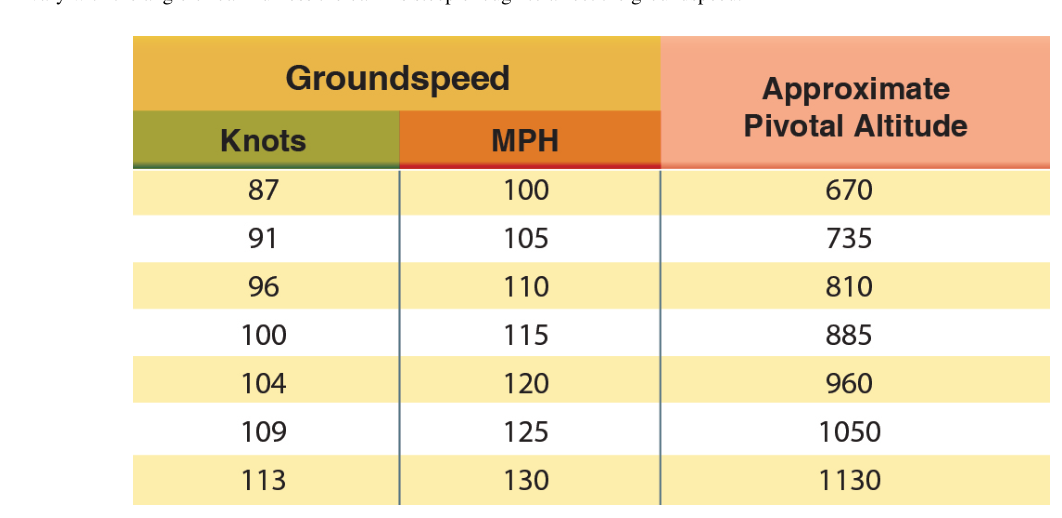
The key formula driving the entire maneuver is straightforward: pivotal altitude is directly proportional to groundspeed squared. The FAA approximates this relationship as groundspeed (in knots) squared, divided by 11.3, to yield pivotal altitude in feet above ground level. For example, at 100 knots groundspeed, pivotal altitude is roughly 885 feet AGL. At 90 knots it drops to about 716 feet AGL. This means pivotal altitude is not a fixed number—it changes continuously as wind accelerates or decelerates the aircraft across the ground during the figure-eight flight path.
Why It Matters
Understanding this concept transforms the maneuver from a confusing exercise into an elegant application of physics. When the reference line drifts ahead of the pylon (the pylon appears to move forward toward the nose), the aircraft is too high—the pilot must descend to lower pivotal altitude. When the reference line drifts behind the pylon (the pylon appears to move backward toward the tail), the aircraft is too low—the pilot must climb. The correction is always a change in altitude, not a change in bank angle or heading to chase the pylon.
This is also where airspeed sensitivity becomes critical for flight instructors teaching the maneuver. As the aircraft flies the eight, it will have a tailwind on one side of the pylon and a headwind on the other. A tailwind increases groundspeed, which raises the required pivotal altitude. So the pilot must climb slightly. Turning into the headwind lowers groundspeed and lowers pivotal altitude, requiring a slight descent. A well-executed eights-on-pylons maneuver has the pilot continuously making subtle altitude corrections in response to these groundspeed changes. The bank angle steepens or shallows naturally to maintain the visual reference—it is a result of flying the correct altitude, not a control input the pilot consciously manages.
For the flight instructor, the most important teaching point is to help students resist the instinct to chase the pylon with rudder or aileron. That instinct is almost universal among beginners. Frame it this way: the pylon tells you where to be vertically, not laterally. Teach students to scan for the pylon's movement relative to a fixed reference mark on the wingtip or window, and react with the elevator accordingly.
Memory Aid
A reliable way to remember the correction direction: "Pylon goes forward, you're too high—push forward." If the pylon drifts toward the nose, you are too high; ease forward pressure and descend. If the pylon drifts toward the tail, you are too low; climb to regain pivotal altitude. Some instructors pair this with the phrase "Low and the pylon falls behind"—too little altitude and you will watch the pylon drift backward out of your reference.
Common Test Traps
- Pivotal altitude is about groundspeed, not airspeed. The FAA knowledge test may present a scenario with wind; remember that the wind component along the flight path changes groundspeed and therefore changes pivotal altitude, even if the indicated airspeed stays constant.
- Bank angle is not the primary control input. A common distractor answer involves steepening bank to keep the wingtip on the pylon. The correct control is altitude (elevator). Bank adjusts naturally.
- The formula uses groundspeed squared divided by 11.3 (knots/feet). Some students confuse the divisor or the units. Know the formula and remember it produces an AGL value, not MSL.
- Drift correction differs from other ground-reference maneuvers. In turns around a point, bank angle varies to correct for wind. In eights-on-pylons, the pivot point is held with altitude changes. Confusing the two is a very common test error.