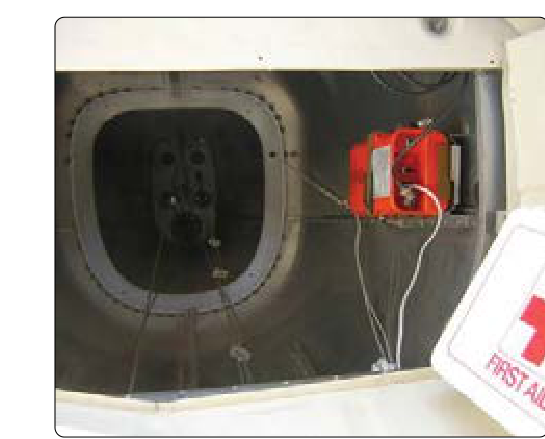
An Emergency Locator Transmitter (ELT) is a self-contained radio device designed to survive an aircraft accident and immediately begin broadcasting a distress signal that search and rescue (SAR) teams can home in on. For aviation maintenance technicians (AMTs), understanding ELT technology is not merely academic — improper installation, missed inspection deadlines, or a defective battery can mean the difference between a downed crew being found in hours versus days. The FAA addresses ELTs in 14 CFR Part 91.207 and the relevant technical standards in TSO-C91a and TSO-C126, making this a heavily tested topic on the AMT Airframe knowledge examination.
This article covers every category of ELT type recognized by the FAA, the specific inspection and maintenance requirements that apply, battery replacement rules, operational testing procedures, and the common errors that trip up both technicians and knowledge-test candidates.
How ELTs Work
When an aircraft experiences a sudden deceleration consistent with a crash — typically in the range of 3.5 to 6 g or more, depending on the unit — an inertia switch (also called a G-switch) activates and the ELT begins transmitting. Modern digital ELTs encode a unique 15-digit identification number in a 406 MHz digital burst that is relayed through the COSPAS-SARSAT satellite network to a Mission Control Center (MCC), which then alerts the appropriate Rescue Coordination Center (RCC). Older analog units transmitted only on 121.5 MHz and 243.0 MHz; those frequencies are still monitored by some aircraft but are no longer actively monitored by COSPAS-SARSAT satellites for distress alerting. This is a critical distinction: 406 MHz ELTs provide precise location data and registration information within minutes; 121.5 MHz-only units provide neither.
Inside the unit, a dedicated lithium battery powers the transmitter. The battery is sized to power continuous transmission for at least 48 hours at temperatures as cold as −20°C (−4°F), per TSO requirements. Some units also incorporate an integrated GPS receiver that encodes the aircraft's precise coordinates directly into the 406 MHz signal, dramatically shrinking the search area from a 5-kilometer radius to less than 100 meters.
ELT Types Defined by the FAA
The FAA classifies ELTs into several distinct types based on their deployment method and intended use. Understanding these categories is essential for airframe technicians because the installation requirements and activation methods differ for each.
- Fixed ELT (Type AF — Automatic Fixed): Permanently mounted in the aircraft structure, usually in the aft fuselage near the tail. Activation is automatic via the G-switch upon impact. This is by far the most common type found in general aviation aircraft. It must be mounted so that the antenna is oriented for optimal signal radiation and the G-switch axis is aligned with the longitudinal axis of the aircraft.
- Automatic Portable ELT (Type AP): Automatically activated like the AF type but can be manually removed from the aircraft and used as a portable unit, for example if survivors must abandon the aircraft after ditching. It comes with a water-resistant case and may include a lanyard for flotation.
- Automatic Deployable ELT (Type AD): Automatically ejects from the aircraft and activates upon impact or immersion in water. Commonly used on transport-category aircraft, turbine helicopters, and aircraft operating over remote terrain where the airframe may be destroyed on impact.
- Survival ELT (Type S): Not automatically activated. Must be manually activated by survivors. Carried in a survival kit or life raft. Not permanently mounted in the aircraft. Does not satisfy the carriage requirement of 14 CFR 91.207 on its own.
- Personal Locator Beacon (PLB): A closely related device that is registered to a person rather than an aircraft. PLBs transmit on 406 MHz and are carried by individuals. They are NOT ELTs and do NOT satisfy the aircraft ELT requirement under 14 CFR 91.207, though they provide an additional layer of SAR capability.
Regulatory Requirements: Who Must Carry an ELT
Under 14 CFR 91.207, most U.S.-registered civil aircraft are required to be equipped with an approved automatic ELT. The regulation specifies that the ELT must be attached to the aircraft and must be capable of transmitting on 121.5 MHz (for homing purposes) and, for units approved under TSO-C126 or later, on 406 MHz as well. Under 14 CFR 91.207(f), specific exemptions exist, including aircraft engaged in training operations conducted entirely within a 50 nautical mile radius of the airport from which the flight originated (provided the aircraft remains within that radius), certain turbojet/turbofan-powered aircraft manufactured before a specified date while engaged in flight testing, aircraft carrying an FAA-approved portable ELT in lieu of a fixed unit, aircraft equipped with equivalent approved equipment, and specific research or manufacturer flights. There is no blanket exemption for aircraft used for general "experimental purposes" or for acrobatic aircraft simply because the ELT might be damaged by maneuver loads.
The ELT must be properly registered with NOAA (for 406 MHz units) so that when a distress signal is received, rescue authorities can immediately identify the aircraft, its owner, and emergency contact information. An unregistered 406 MHz ELT activation generates a valid satellite alert but provides no identifying information, slowing the SAR response. Technicians should remind aircraft owners to update registration whenever the aircraft changes hands.
Inspection Requirements
The inspection obligations for ELTs are both specific and time-sensitive. 14 CFR 91.207(d) spells out the following:
- Annual inspection: The ELT must be inspected within 12 calendar months of the previous inspection. This inspection is typically performed during the annual inspection of the aircraft. The technician must verify that the ELT is securely mounted, the antenna connection is tight and undamaged, the unit is operational (see operational check below), and the battery expiration date has not passed.
- Battery replacement — calendar life: The battery must be replaced (or recharged for rechargeable types) when the date printed on the battery or ELT reaches expiration. This expiration date must be legibly marked on the outside of the ELT.
- Battery replacement — cumulative use: Under 14 CFR 91.207(c), the battery must also be replaced when the ELT has been in use (cumulative transmission time, including test transmissions) for more than one cumulative hour, OR when 50 percent of its useful life (or, for rechargeable batteries, 50 percent of useful life of charge) has expired — whichever occurs first. Even brief inadvertent activations count toward the one-hour limit.
- Post-accident inspection: After any impact severe enough to activate the G-switch — even if no actual crash occurred — the ELT should be inspected for physical damage, G-switch reset, and battery integrity before the aircraft returns to service.
Operational Testing Procedures
Testing an ELT without triggering a false alarm or satellite alert requires strict adherence to approved procedures. 14 CFR 91.207(g) permits operational testing only during the first five minutes of any UTC hour, and the test transmission must be limited to three audio sweeps on 121.5 MHz. The test should be conducted with a hand-held VHF radio to verify the warbling tone is audible, or with the aircraft's own comm radio tuned to 121.5 MHz. Never activate a 406 MHz ELT for a ground test unless the manufacturer's procedures specifically authorize it with an internal test mode, because even a momentary 406 MHz burst will register as a real distress alert in the COSPAS-SARSAT system and can trigger an emergency response.
Many modern 406 MHz ELTs have a built-in self-test function that checks internal circuitry and GPS lock without actually transmitting on 406 MHz. The technician should use this self-test mode as directed in the ELT's maintenance manual. Documentation of all tests must be entered in the aircraft maintenance records, including the date, duration of transmission, and the technician's signature.
Why It Matters
The practical stakes of ELT maintenance cannot be overstated. Studies by the NTSB and search-and-rescue agencies consistently show that ELTs sometimes fail to activate in accidents — due to impact damage to the antenna, mounting orientation errors that prevent the G-switch from triggering, or dead batteries. An ELT that passes its annual inspection is still only as good as its installation. Technicians must verify that the antenna cable is free from chafing, that the mounting bracket securely holds the unit against crash loads, and that the G-switch orientation matches the manufacturer's specified installation axis.
Inadvertent ELT activations are also a significant problem. A jostled unit during maintenance, a hard landing, or even a static discharge can activate the ELT. Any activation on the ramp should be silenced promptly and the appropriate authorities notified that the activation was inadvertent. Failure to notify can consume SAR resources needlessly and is a regulatory concern.
Key Numbers and Rules
- 406 MHz — primary distress frequency for satellite detection (TSO-C126)
- 121.5 MHz — secondary homing frequency; still required on most ELTs
- 48 hours — minimum battery transmission life required at −20°C
- 12 calendar months — maximum interval between ELT inspections (14 CFR 91.207(d))
- 1 cumulative hour or 50% of useful life — usage/calendar thresholds triggering mandatory battery replacement, whichever occurs first (14 CFR 91.207(c))
- First 5 minutes of any UTC hour — only window for authorized operational test transmissions
- 3 audio sweeps — maximum allowable test transmission length on 121.5 MHz
- TSO-C91a — governing TSO for older 121.5/243 MHz ELTs
- TSO-C126 — governing TSO for 406 MHz digital ELTs (current standard)
Common Test Traps
- Confusing ELT types: The Type S (Survival) ELT is manually activated and does NOT meet the automatic ELT carriage requirement of 91.207. Candidates often assume any ELT satisfies the rule.
- Battery replacement triggers: Many candidates remember only the calendar expiration date and forget that exceeding one cumulative hour of use — including ground tests — or reaching 50% of the battery's useful life, also mandates battery replacement, whichever occurs first.
- Testing timing: Tests may only be conducted during the first five minutes of any UTC hour, not any time the technician decides. Conducting a test at an unauthorized time is a regulatory violation.
- 406 MHz test transmissions: Transmitting on 406 MHz during a ground test (other than via the manufacturer's approved internal test mode) generates a real satellite alert. This is a common and serious error.
- Registration vs. installation: A properly installed 406 MHz ELT that is not registered with NOAA still complies with the installation requirement of 91.207, but the aircraft owner has failed to meet registration obligations — a subtle but exam-relevant distinction.