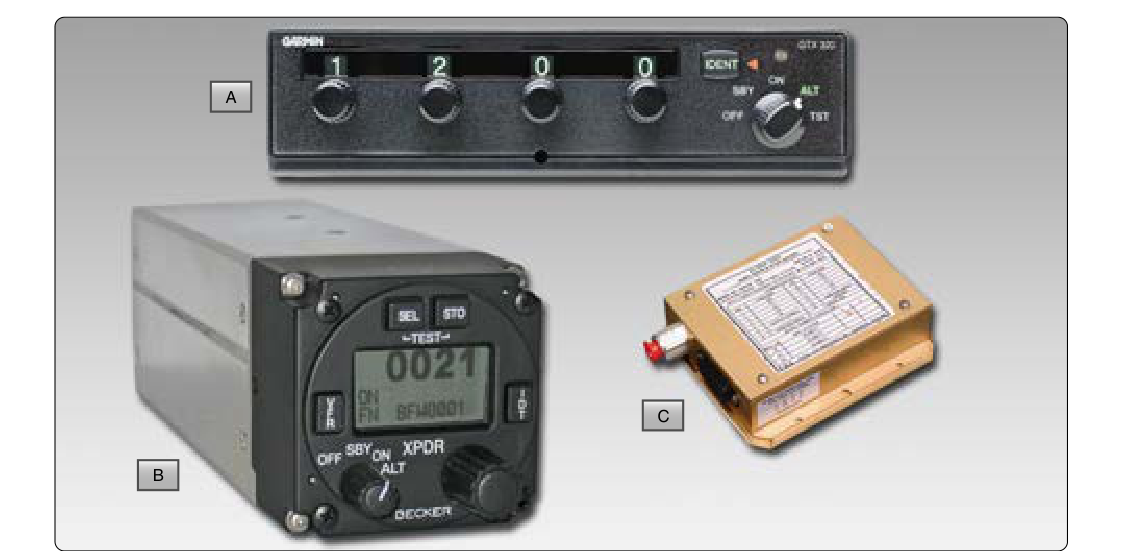
Air traffic control relies on secondary surveillance radar (SSR) to track aircraft far more precisely than primary radar returns alone. The transponder — short for transmitter-responder — sits at the heart of this system, replying to ground interrogations with coded signals that tell controllers exactly who you are, how high you are, and, with modern Mode S equipment, a wealth of additional data. For the aviation maintenance technician (AMT) working on airframe systems, understanding transponder modes, the altitude encoder interface, and the regulatory requirements for inspection and testing is essential to keeping aircraft legally and safely airworthy.
This article covers the three main transponder modes found in general aviation and air carrier fleets — Mode A, Mode C, and Mode S — explains how the encoder fits into the picture, and details what the FAA requires of maintenance personnel when inspecting, testing, and returning this equipment to service.
How Secondary Surveillance Radar Works
Primary radar detects aircraft by bouncing radio energy off the airframe and measuring the reflected return. Secondary surveillance radar takes a different approach: a ground interrogator transmits a specific pulse pair on 1030 MHz, and the aircraft transponder — if it receives a valid interrogation — fires back a reply on 1090 MHz. Because the aircraft is actively transmitting rather than merely reflecting, the return is far stronger and carries encoded information. ATC radar displays decode these replies and present them as data blocks alongside the radar return, giving controllers altitude readouts, aircraft identity codes, and more.
Transponder Modes Explained
Mode A — Identity Only
Mode A is the baseline interrogation mode. The ground station sends a specific pulse spacing (8 microseconds between the two framing pulses) that the transponder recognizes as a Mode A interrogation. The transponder replies with a 12-bit code — the familiar four-digit octal squawk code assigned by ATC, such as 1200 for VFR flight. Mode A provides position (through the radar sweep geometry) and identity, but carries no altitude information. From a maintenance standpoint, Mode A operation is straightforward: the transponder encodes the pilot-set squawk code and fires the reply. There is no encoder connection needed for Mode A alone.
Mode C — Altitude Reporting
Mode C interrogations use a pulse spacing of 21 microseconds. When the transponder recognizes a Mode C interrogation, it replies not with the pilot-set squawk code but with a Gillham code representing pressure altitude from the connected altitude encoder (also called an air data computer or blind encoder). This altitude is referenced to 29.92 in Hg (standard pressure), and ATC computers apply the current altimeter setting to convert it to indicated altitude for display. The encoder typically connects to the transponder via a 11-bit parallel Gray code (Gillham code) output. Altitude resolution in Mode C is 100-foot increments.
The encoder itself is a pneumatic device plumbed into the aircraft's static system. As static pressure changes with altitude, the encoder converts that pressure to a digital code. Because the encoder is in the static system, any leak or fault in the static plumbing affects both the altimeter and the encoder output — a critical maintenance connection. If the static system has been opened for any reason, the entire system requires the tests specified in 14 CFR Part 91.
Mode S — Selective Addressing and ADS-B Integration
Mode S (Select) transponders represent a significant technological leap. Each Mode S transponder has a unique 24-bit ICAO address assigned to the aircraft — essentially a permanent electronic tail number. Ground interrogators can selectively address individual aircraft rather than broadcasting to all transponders simultaneously, which greatly reduces signal interference in high-density traffic environments. Mode S supports all Mode A and C interrogations for backward compatibility, and also answers Mode S-specific interrogations carrying the aircraft's unique address.
Critically for today's airspace, Mode S transponders with Extended Squitter (ES) capability — designated 1090ES — form the backbone of ADS-B Out. The transponder broadcasts position (from an approved WAAS GPS source), velocity, altitude, and identification spontaneously at approximately once per second without waiting for a ground interrogation. Under 14 CFR 91.225, ADS-B Out is required in the airspace where a Mode C transponder was previously required (Class A, B, and C airspace, and above 10,000 feet MSL, among other areas). For the AMT, this means that a full Mode S/ADS-B installation involves not only the transponder but also a certified GPS position source and proper wiring between them.
The Altitude Encoder: Maintenance and Interface
The altitude encoder (blind encoder) is a dedicated avionics box plumbed to the static system and electrically connected to the transponder. It has no display — it exists solely to provide the transponder with a digital pressure altitude signal. Some modern installations combine the encoder function into the primary altimeter or air data computer. Key maintenance considerations include:
- Static system integrity: The encoder is only as accurate as the static source. Leaks, obstructions, or alternate static source use all affect encoder output. Any work on the static system triggers retesting requirements.
- Wiring and connector condition: The Gillham code parallel interface uses multiple wires, each carrying one bit of the altitude code. A broken wire or corroded connector can cause the transponder to report an incorrect altitude — sometimes a grossly wrong value — without triggering any cockpit indication.
- Compatibility: Encoder and transponder must be compatible. The AMT should verify that the encoder's altitude range and output format match the transponder's input specifications, following the manufacturer's installation manual and any applicable Supplemental Type Certificate (STC) data.
Regulatory Requirements: 14 CFR Part 43 and Part 91
The FAA's inspection and testing requirements for transponders and encoders are found primarily in 14 CFR 91.413 and 14 CFR Part 43, Appendix F. These rules are among the most frequently tested on AMT knowledge exams.
- 24-calendar-month inspection interval: Under 14 CFR 91.413, transponders used in controlled airspace must be inspected and tested in accordance with Appendix F of Part 43 within the preceding 24 calendar months. This applies to all aircraft operating in controlled airspace — not just air carriers.
- Who may perform the test: The test must be performed by a certificated repair station equipped to perform the tests, or by the manufacturer. A certificated airframe/powerplant (A&P) mechanic alone cannot perform the required transponder checks without appropriate test equipment and authorization; this work typically goes to an avionics shop or certified repair station.
- What Appendix F requires: Part 43, Appendix F specifies a comprehensive series of tests including reply frequency, suppression, receiver sensitivity (minimum triggering level), dynamic range, Mode A code, Mode C altitude accuracy, Mode S address, and — for ADS-B equipped units — squitter performance. Altitude encoder accuracy must be verified across a range of test altitudes, with tolerances of ±125 feet compared to a known accurate reference.
- Static system test (14 CFR 91.411): Whenever the static system has been opened on an IFR-certified aircraft, an altimeter and static system check is required under 91.411. Because the encoder is part of the static system, any time this test is triggered, the encoder's plumbing connections must be verified leak-free as part of the overall test. VFR-only aircraft are not subject to 91.411 but are still subject to the transponder test under 91.413 if they operate in controlled airspace.
- Return to service documentation: After a successful transponder test, the repair station issues a test record that must be retained. The aircraft logbook or maintenance record should reflect the date and result of the test, reference to Part 43 Appendix F, and the identity of the facility performing the work.
Why It Matters: Safety and Legal Consequences
A malfunctioning or inaccurate transponder is not merely an avionics inconvenience — it is a safety hazard and a regulatory violation. ATC uses Mode C altitude readouts to provide traffic alerts and to sequence aircraft. A transponder reporting 1,000 feet of incorrect altitude could cause a controller to issue incorrect traffic information or miss a conflict. In TCAS-equipped environments, a faulty Mode C readout can trigger false Resolution Advisories or suppress valid ones.
Operating in Class A, B, C, or E airspace above 10,000 feet MSL without a functioning Mode C transponder is a violation of 14 CFR 91.215. For airspace requiring ADS-B Out (91.225), operating without a properly functioning system is similarly prohibited. An aircraft returned to service after avionics work with an untested or out-of-tolerance transponder/encoder exposes the technician, the operator, and the pilot to certificate action and civil penalty.
Key Numbers and Rules
- Mode A interrogation pulse spacing: 8 microseconds
- Mode C interrogation pulse spacing: 21 microseconds
- Transponder reply frequency: 1090 MHz
- Ground interrogator frequency: 1030 MHz
- Mode C altitude resolution: 100-foot increments in Gillham code
- Encoder accuracy tolerance: ±125 feet per Part 43, Appendix F
- Inspection interval: 24 calendar months (14 CFR 91.413)
- Mode S ICAO address length: 24 bits (unique per aircraft)
- ADS-B Out broadcast rate: approximately 1 squitter per second (1090ES)
Common Test Traps
- Calendar months vs. hours: The transponder inspection is on a 24-calendar-month cycle, not a flight-hour basis. A transponder tested on March 15 of one year is due again by the last day of March two years later — even if the aircraft has barely flown.
- Who can do the test: Many students assume any A&P can perform a transponder check. In fact, Part 43 Appendix F testing requires specific test equipment and authorization — typically a certificated repair station. An A&P without that equipment cannot sign off this inspection.
- Encoder is in the static system: Test questions sometimes ask what system the altitude encoder connects to. The answer is the static system (pneumatically), not the pitot system. Pitot pressure drives airspeed; static pressure drives altitude and the encoder.
- Mode C reference is pressure altitude: The transponder always reports pressure altitude (29.92 in Hg reference), never indicated altitude. ATC computers apply the local altimeter setting to display indicated altitude. A student who confuses these two may miss questions about what the encoder actually measures.
- ADS-B Out is not the same as ADS-B In: Mode S/ES transponders broadcast ADS-B Out. ADS-B In (receiving traffic and weather) is a separate function requiring additional avionics (a traffic display). The transponder itself does not provide the pilot with ADS-B traffic or weather information.