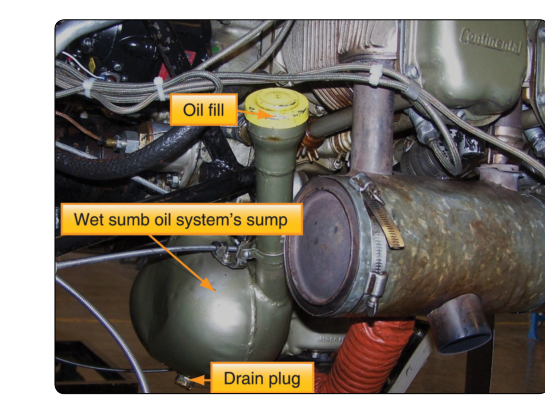
Engine oil is sometimes called the lifeblood of a reciprocating engine, and the analogy holds up under scrutiny. Oil reduces metal-to-metal friction at bearings, journals, and cam surfaces; carries heat away from pistons and cylinder walls that water cooling alone cannot reach; helps piston rings seal combustion gases and maintain compression; and cushions the shock loads that power changes impose on connecting-rod and main bearings. Without a reliable, continuous supply of properly pressurized oil, an aircraft engine can seize within minutes. For the commercial pilot candidate, understanding the two primary oil system architectures—wet sump and dry sump—is not an abstract exercise. It shapes how you preflight, how you interpret cockpit gauges in flight, and how quickly you act when something goes wrong.
Functions of Engine Oil: The Full Picture
The FAA's Pilot's Handbook of Aeronautical Knowledge (PHAK, FAA-H-8083-25) discusses several core functions of aircraft engine oil, commonly summarized as lubrication, cooling, cleaning, sealing, and cushioning (some discussions also note oil's role in corrosion protection). Each function deserves a moment of attention because each one influences how an oil system must be designed.
- Lubrication: A hydrodynamic oil film separates moving metal surfaces. When that film breaks down—from low pressure, wrong viscosity, or contamination—metal contacts metal and wear accelerates rapidly.
- Cooling: In many air-cooled aircraft engines, oil absorbs a substantial portion of the total heat the engine rejects. The PHAK notes that in some engines oil carries away as much heat as the cylinder fins and baffles do. An oil cooler, typically an air-to-oil heat exchanger mounted in the cooling airflow, is a standard system component—not an optional upgrade.
- Cleaning: Oil suspends microscopic combustion byproducts and metal particles and carries them to the filter or screen, where they are trapped. This is why oil turns dark quickly in service and why regular oil changes matter.
- Sealing: A thin oil film along the cylinder walls helps piston rings seal combustion gases and maintain compression. Insufficient oil viscosity compromises this seal.
- Cushioning: Bearing loads are not constant. Every power stroke delivers a sharp impulse load to connecting-rod bearings. Oil under pressure acts as a hydraulic cushion that absorbs this shock before the metal surfaces can touch.
Wet Sump Systems: Design, Operation, and Limitations
In a wet sump configuration, the engine's entire usable oil supply is stored in a sump—an integral reservoir formed by the lower portion of the crankcase or bolted directly beneath it. An engine-driven pressure pump draws oil from the sump through a pickup tube fitted with a coarse screen, pressurizes it, and routes it through internal galleries and drilled passages to main bearings, connecting-rod bearings, camshaft lobes, valve train components, and (where applicable) propeller governor circuits. After the oil has done its work, gravity drains it back down into the sump, where the cycle restarts.
Wet sump designs dominate light single-engine training and personal aircraft—Cessna 172s, Piper PA-28s, and similar platforms—because the architecture is mechanically elegant: fewer external lines, fewer potential leak points, lighter overall installation weight, and a simple preflight check using a dipstick that protrudes directly into the sump. The FAA's PHAK and the Airplane Flying Handbook (FAA-H-8083-3) both describe this configuration as the standard for most horizontally opposed engines found on light aircraft.
The wet sump's limitation becomes apparent in non-level flight. In sustained inverted flight, a steep nose-high climb, or aggressive aerobatic maneuvers, the oil migrates away from the pickup tube. If the tube is momentarily uncovered, the pressure pump ingests air instead of oil—oil pressure collapses, and unlubricated bearings begin to fail. This is not merely a theoretical concern; it is the primary reason aerobatic and high-performance aircraft almost universally use the alternative architecture described below.
Dry Sump Systems: Design, Operation, and Advantages
A dry sump system physically separates oil storage from the engine crankcase. Oil lives in a dedicated external tank mounted elsewhere in the airframe—often ahead of the firewall, aft of the engine, or in a wing root, depending on the installation. Two distinct pumps, both typically engine-driven, manage the oil circuit:
- Scavenge pump (return pump): Continuously removes oil from the crankcase as quickly as it accumulates, keeping the sump essentially dry. In practice, scavenge pump capacity is intentionally sized larger than the pressure pump output to ensure no pooling occurs.
- Pressure pump: Draws oil from the remote tank, pressurizes it, and delivers it to the engine's lubrication galleries—functioning identically to the single pump in a wet sump system.
Because the crankcase is kept clear of standing oil at all times, several advantages follow. First, the crankshaft counterweights and connecting rods cannot churn through pooled oil, which would generate heat, foam the oil, and rob power. Second, the oil supply in the remote tank remains available to the pressure pump regardless of aircraft attitude, so sustained inverted flight or high-angle aerobatics do not starve the engine. Third, the remote tank can be made large enough to carry significantly more total oil volume than a crankcase sump could practically accommodate—a meaningful benefit for large-displacement, high-output, or radial engines that generate substantial heat loads and require more thermal capacity in their oil charge.
Radial engines—the powerful round-cylinder designs that powered most WWII warbirds and early airliners—make especially good use of dry sump architecture. Because cylinders point in all directions around a central crankcase, a wet sump arrangement would inevitably allow oil to pool in lower cylinders during engine-off periods, leading to the classic radial problem of hydraulic lock on start-up. The dry sump's active scavenging mitigates, though does not fully eliminate, this concern; on many radial-equipped aircraft, pilots follow the type-specific procedure of hand-rotating the propeller through several blades before engine start to check for hydraulic lock and expel any accumulated oil, though the specific technique and requirement vary by airframe and are detailed in the applicable POH or AFM.
Key Numbers, Rules, and System Components
- Normal oil pressure range: Normal oil pressure limits vary significantly by engine model and manufacturer (Lycoming and Continental publish specific minimum and maximum PSI values for each engine type). Always reference the green arc on the gauge and the POH limitations section and engine Type Certificate Data Sheet for the specific aircraft rather than relying on a generic range.
- Oil temperature: Normal operating temperature ranges are engine-specific and published in the POH and engine operator's manual; always reference the green arc on the gauge rather than a generalized figure. Oil should be in the green arc before high-power operation is applied, particularly in cold weather.
- Oil cooler and vernatherm valve: Most systems include a bypass valve (often called a vernatherm or thermostatic valve) that routes cold oil around the cooler until it reaches operating temperature, then directs it through the cooler. A stuck-open valve causes chronically low oil temperature; a stuck-closed valve causes overheating.
- Viscosity: Engine manufacturers specify approved oil grades (e.g., SAE 50, SAE 30, or multigrade equivalents) based on expected operating temperature range. Using too thin an oil at high temperatures degrades film strength; too thick an oil in cold weather impedes starting and starves the pump on initial start-up. Always consult the POH and engine manual.
- Oil change intervals: Manufacturers such as Lycoming and Continental commonly recommend oil and filter changes at intervals in the 25 to 50 hour range, though this is manufacturer service guidance rather than an FAA handbook-published figure—always follow the specific engine manufacturer's service instructions and the aircraft's maintenance program.
Cockpit Indications and Emergency Recognition
Oil pressure and oil temperature gauges provide a continuous, real-time view of system health. The PHAK states clearly that a loss of oil pressure should be treated as a potential emergency requiring prompt action—specifically, planning for an immediate precautionary landing—because engine seizure can follow within minutes of total oil pressure loss. A pilot who waits to see what develops may find the propeller stopped before a suitable field is reached.
In practice, combined indications matter most: a simultaneous drop in oil pressure and rise in oil temperature often indicates a significant oil leak or pump failure rather than a faulty gauge. Rising temperature with stable pressure might indicate a blocked oil cooler or a cooling system restriction. Low pressure alone on initial start in cold weather may indicate oil that has not yet reached the pump—monitor carefully and abort if pressure does not rise promptly within the manufacturer-specified time. Pilots operating dry sump aircraft must also verify that the external tank is serviced correctly at preflight; the dipstick or sight gauge is on the remote tank, not the engine crankcase.
Common Test Traps
- Scavenge pump ownership: Only the dry sump system uses a scavenge pump. Wet sump systems rely entirely on gravity to return oil to the sump—there is no active scavenging.
- Aerobatic aircraft and wet sumps: A common distractor answer suggests aerobatic aircraft use wet sump systems. In reality, aerobatic and high-performance aircraft favor dry sump designs specifically because attitude changes cannot interrupt oil supply.
- Oil as a cooling medium: Test questions sometimes present oil cooling as secondary or negligible. On air-cooled aircraft engines, oil is a primary heat rejection path, and the oil cooler is a standard system component.
- Low pressure versus high temperature priority: Both are serious, but a sudden loss of oil pressure is the more immediately critical indication. The PHAK and operational guidance treat it as an emergency; high temperature alone warrants monitoring and power reduction first.
- Hydraulic lock in radial engines: Students sometimes attribute hydraulic lock solely to fuel or water. Oil pooling in lower cylinders of radial engines on shut-down is equally dangerous and is a key reason many radial pilots hand-pull the prop through several blades before start, per type-specific procedures.
Memory Aid
"Wet = Within, Dry = Distant." Wet sump oil lives within the crankcase; dry sump oil lives in a distant external tank. Pair it with "Dry = Double pumps"—one scavenge, one pressure—to lock in the mechanical distinction under exam pressure.