Structural icing ranks among the most lethal hazards in instrument flight, and at the Airline Transport Pilot level a surface-level awareness that "ice is bad" is insufficient. Two supercooled liquid water phenomena—freezing rain (FZRA) and freezing drizzle (FZDZ)—are frequently conflated on written tests and in cockpit decision-making, yet they arise from fundamentally different atmospheric architectures, produce physically distinct ice shapes, and require different escape strategies. Understanding those distinctions in depth is not academic exercise; it is directly tested on the ATP Airman Knowledge Test and, more importantly, it is the difference between a manageable icing encounter and a loss-of-control event.
Atmospheric Origins: Where Each Phenomenon Comes From
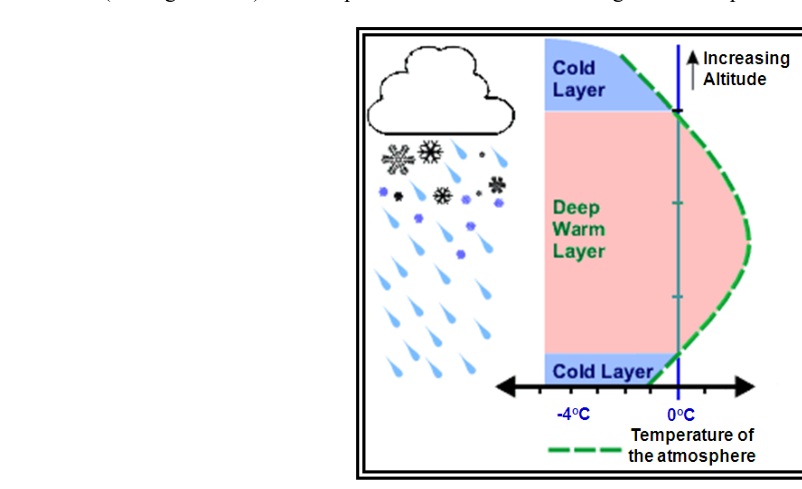
Freezing rain is a classic warm-layer phenomenon. Precipitation begins as snow or ice crystals aloft, falls into a layer of above-freezing air embedded within a temperature inversion, melts completely into liquid raindrops, and then descends into a shallow sub-freezing layer near the surface. The key diagnostic signature is a warm layer aloft—often visible as a pronounced inversion on a radiosonde sounding—sandwiched between a cold cloud layer above and a cold surface layer below. Droplets reaching an aircraft in this cold layer are supercooled liquid water, and because they originated as melted snowflakes or ice pellets, they are typically large: by meteorological convention, raindrops exceed 0.5 mm in median volume diameter (MVD).
Freezing drizzle has an entirely different genesis. It forms within shallow, low-level supercooled clouds—stratus, stratocumulus, or fog layers—where updrafts are too weak to grow droplets to raindrop size. Collision-coalescence within the supercooled cloud produces small drops in the 0.2 mm to 0.5 mm MVD range that fall only a short distance before reaching an aircraft or the surface. Critically, no warm layer aloft is required. A near-isothermal below-freezing airmass from cloud base to many thousands of feet can sustain freezing drizzle continuously, making vertical escape far more complex than it is in the classic FZRA scenario.
Ice Accretion Physics: How Drop Size Controls Ice Shape
The physics of impingement and freezing are governed by droplet inertia and surface tension—both functions of drop diameter. Large freezing rain drops carry substantial kinetic energy and spread laterally across the airfoil surface upon impact before their latent heat is fully extracted by the cold airframe. This produces clear glaze ice: dense, transparent, and smooth on the outer surface, conforming tightly to the leading edge contour. The critical danger is runback ice. Excess unfrozen water flows aft along the chord under aerodynamic pressure before freezing, depositing ice well behind the stagnation point and, importantly, well behind the coverage zone of pneumatic de-icing boots. This aft ice ridge alters the wing's camber without any obvious change in what the pilot sees on the leading edge. It can form and grow while boots are cycling normally, providing a false sense of protection.
Small freezing drizzle drops, by contrast, freeze almost on contact because their small volume loses heat to the cold surface very rapidly. The result is rough rime or mixed ice concentrated tightly around the leading-edge stagnation point. This rough texture is aerodynamically devastating: it disrupts the smooth boundary layer needed for attached airflow, dramatically increases profile drag, and—most critically—reduces the angle of attack at which the wing stalls. The Aviation Weather Handbook (FAA-H-8083-28) emphasizes that even a thin layer of rough ice at the leading edge can reduce maximum lift coefficient and stall angle of attack by amounts that render published performance data unreliable. FZDZ is therefore not "less serious" than FZRA simply because the drops are smaller; the aerodynamic penalty per unit of ice accreted can actually be worse because the roughness is concentrated where it disrupts flow earliest.
Supercooled Large Drops and Regulatory Certification
Both FZRA and FZDZ fall under the regulatory category of Supercooled Large Drop (SLD) icing conditions. Traditional icing certification under 14 CFR Part 25 Appendix C was built around a specific envelope of liquid water content, droplet size (up to approximately 40 microns MVD), and temperature. SLD conditions—defined by FZRA drops above 0.5 mm MVD and FZDZ drops in the 0.1–0.5 mm range—can produce ice shapes and accretion rates that fall entirely outside that Appendix C envelope. FAA rulemaking codified in 14 CFR Part 25 Appendix O established certification standards specifically for SLD icing, but this standard applies to newer aircraft type certification projects rather than as a blanket requirement for all aircraft. Most in-service transport and general aviation aircraft are certificated only under Appendix C, with no regulatory requirement that they hold Appendix O certification or that they avoid SLD conditions outright. Instead, FAA guidance (AC 91-74B) advises pilots of Appendix C-only aircraft to recognize SLD conditions and exit them as soon as practicable, since such conditions can produce ice accretion outside the aircraft's certificated ice-protection envelope even though encountering them is not itself prohibited.
Why Ice-Protection Systems Respond Differently
Pneumatic de-icing boots are sized and cycled on the assumption that ice builds to a certain thickness over a predictable interval before inflation cracks and sheds it. In rapid-accretion FZRA, ice may bond so firmly and accumulate so quickly that the boot cannot generate enough pressure differential to fracture the bond—a phenomenon sometimes called ice bridging, though the FAA notes the evidence on bridging from premature cycling is nuanced. More definitively, even fully functional boots do not address runback ice aft of their coverage zone. In FZDZ, the rough leading-edge deposit may be thin enough that boots shed it reasonably well, but any gap in cycling discipline allows the rough texture to rebuild and incrementally degrade performance. Thermal anti-ice and electrothermal systems that continuously heat the leading edge provide better protection against both runback (by preventing initial freezing of large drops) and the rough deposit of small drops—but even these systems have a finite heat output that can be overwhelmed by very high liquid water content.
Pilot Response Priorities
The overarching principle from the FAA's risk management guidance (FAA-H-8083-2) is that icing is not a condition to manage indefinitely; it is a condition to exit as rapidly as possible.
- Declare intentions early. Notify ATC as soon as icing begins accreting faster than ice-protection systems can handle, or anytime SLD conditions are suspected. Pilots are not required to wait until an emergency exists to request priority handling.
- FZRA escape—climb or descend strategically. Because FZRA requires a warm layer aloft, climbing through that inversion into above-freezing air is often the fastest escape. Alternatively, descending below the freezing level to above-zero surface temperatures removes the supercooling. Check the temperature sounding via ATC, PIREPs, or ACARS before committing to a direction.
- FZDZ escape—descend or divert laterally. With no warm layer aloft and a potentially deep supercooled stratus deck, climbing can worsen the encounter. Descending toward a warmer surface layer or tracking toward a different airmass is frequently more effective. Obtain PIREPs aggressively to map the vertical extent of the supercooled layer.
- Protect stall margins in FZDZ. Rough leading-edge ice raises effective stall speed. Use higher-than-normal approach and maneuvering speeds per the AFM/POH icing supplement, restrict bank angles to reduce load-factor stall speed penalties, and use flap settings recommended for known icing conditions—often a partial flap setting that preserves energy without introducing a flap-down stall speed surprise.
- Activate all ice protection proactively. FAA guidance consistently endorses early, proactive activation of boots, heat, and anti-ice systems rather than waiting for visible accumulation. This is especially critical in FZDZ where ice can form rapidly before it is visually apparent.
Key Numbers and Rules
- Raindrop MVD greater than 0.5 mm: defines FZRA; SLD category under Appendix O.
- Drizzle drop MVD 0.1–0.5 mm: defines FZDZ; also SLD under Appendix O.
- 14 CFR Part 25 Appendix C: traditional icing certification envelope, droplets up to ~40 microns—does not cover SLD.
- 14 CFR Part 25 Appendix O: SLD-specific certification standard applied to newer aircraft designs; most in-service aircraft remain Appendix C-only with no requirement to avoid SLD, though FAA guidance recommends exiting SLD conditions as soon as practicable.
- Rough leading-edge ice: even a thin layer (fractions of an inch) at the stagnation point can reduce stall angle of attack significantly—treat any roughness as a serious aerodynamic degradation.
Common Test Traps
- Assuming a climb always resolves icing. This is true in FZRA (warm layer aloft exists to climb through) but can be false or counterproductive in FZDZ where the supercooled layer may extend to high altitudes with no warm inversion above.
- Equating small drop size with low severity. FZDZ drops are smaller than FZRA drops, but the concentrated rough deposit at the leading edge can be aerodynamically more disruptive per unit mass of ice accreted.
- Believing cycling boots eliminates all icing risk. Runback refreezing aft of the boot coverage zone in FZRA can grow undetected. Boots are de-icing devices, not anti-icing barriers, and their coverage is finite.
- Overlooking the SLD guidance. Appendix C certification does not mean an aircraft is free of risk in SLD conditions; while Appendix C-only aircraft are not barred from encountering FZRA or FZDZ, FAA guidance directs pilots to recognize and exit SLD conditions promptly since accretion may exceed the aircraft's certificated ice-protection envelope.
- Confusing ice pellets (FZRA indicator) with FZRA itself. Ice pellets reaching the surface can indicate that a warm layer and a FZRA zone exist at some altitude above—a critical PIREP and METAR clue for pre-flight planning.
Memory aid
Use "Big drops run back; small drops stack rough." Large FZRA drops spread aft behind the boot as runback glaze ice; small FZDZ drops pile up concentrated rough ice right at the stagnation point. Both shapes are dangerous, but they threaten different parts of the airfoil and respond differently to escape tactics—so the escape direction must match the phenomenon.