Maintaining clear forward visibility through the windshield during rain is a fundamental safety requirement for aircraft operations. Unlike automobiles, which rely almost exclusively on rubber wiper blades, transport-category and many business aircraft use a combination of chemical rain repellent systems and electrically or pneumatically driven windshield wiper systems. For the AMT Airframe candidate, understanding how each system works, how to inspect and maintain it, and the critical operational limitations governing chemical application is essential both for the knowledge test and for real-world hangar practice.
Rain repellent and wiper systems fall within the broader category of ice and rain control systems, addressed in the FAA's Aviation Maintenance Handbook – Airframe (FAA-H-8083-31). While anti-ice and de-ice systems deal with frozen precipitation that can alter aerodynamic surfaces, rain control systems specifically address liquid water obscuring the crew's vision through transparencies. The two approaches — chemical and mechanical — are often used together for maximum effectiveness.
Chemical Rain Repellent Systems
Chemical rain repellent works on a straightforward physical principle: a hydrophobic (water-repelling) fluid is applied to the outer surface of the windshield, causing water to bead up and roll off rather than sheet across the glass. This beading effect dramatically reduces the amount of water clinging to the transparency surface, improving optical clarity even without wipers running.
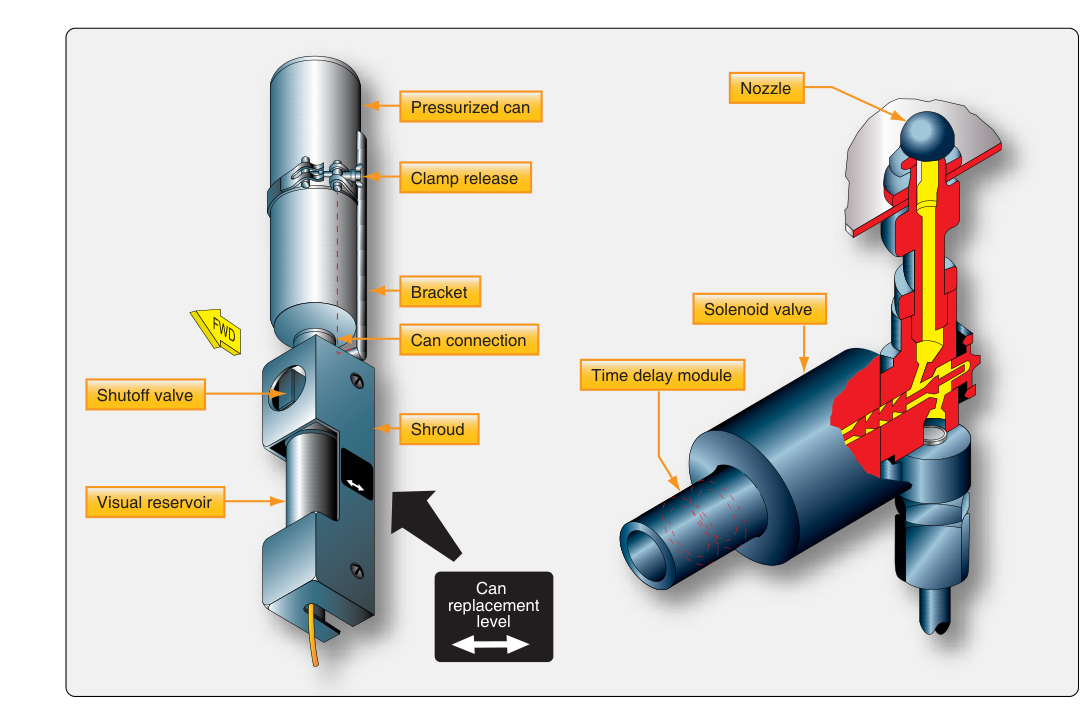
The repellent fluid itself is typically a silicone-based compound delivered under pressure from a reservoir through nozzles or spray bars positioned at the base of the windshield. When the flight crew activates the system, a measured dose of fluid is sprayed onto the windshield. On many transport-category aircraft the system is single-shot or metered-dose — meaning only a specific quantity is dispensed per activation — to prevent over-application, which can itself impair visibility by leaving a thick, smeared film.
Critical Operational Limitation: Dry Windshield Prohibition
The single most important rule governing chemical rain repellent — and the one most frequently tested on AMT written exams — is that the repellent must never be applied to a dry windshield. Applying repellent fluid without an adequate film of water already present causes the concentrated chemical to smear across the surface, creating an oily, prismatic haze that severely degrades visibility and is extremely difficult to remove in flight. Manufacturers universally specify that the system should be activated only when rain is heavy enough to wet the windshield thoroughly. This limitation is reinforced in aircraft flight manuals and maintenance manuals and is a common source of written-test questions.
Servicing the chemical repellent system involves checking the fluid reservoir level, inspecting the spray nozzles or spray bars for clogging or corrosion, and verifying that the metering valve or pump delivers the correct quantity per actuation. Some aircraft use a pressurized canister arrangement; others use an electrically driven pump. In either case, the technician must use only the specific fluid type approved in the aircraft maintenance manual for that airframe and system — substituting unapproved compounds can damage the windshield transparency or other affected components and may not perform as intended.
Windshield Wiper Systems
Windshield wipers on aircraft serve the same fundamental purpose as on ground vehicles but must be designed to operate reliably at high airspeeds where aerodynamic forces are enormous. A wiper blade that lifts away from the windshield at cruise speed provides no protection at all, so aircraft wiper systems are engineered with blade holders that generate a down-force sufficient to maintain contact with the transparency across the aircraft's normal operating airspeed range.
Types of Wiper Drive Systems
Two drive types are common in aviation:
- Electric wiper systems use a dedicated electric motor — often a permanent-magnet or series-wound DC motor — connected through a gear reduction mechanism to a crank or cam that converts rotary motor output into the back-and-forth arc of the wiper arm. Speed is typically selectable (slow/fast) from the cockpit. Most modern transport-category aircraft use electric systems because they are lighter, easier to maintain, and easier to integrate with flight deck controls.
- Pneumatic (air-driven) wiper systems use engine bleed air or a dedicated pneumatic pump source directed through a motor to drive the wiper. While robust, pneumatic systems require pneumatic ducting to the windshield area, adding complexity. They are found primarily on older transport aircraft and some turboprops.
Regardless of drive type, the wiper mechanism typically includes a pivot shaft, wiper arm, blade assembly, and a parking mechanism that stows the blade at the bottom of the windshield when the system is off, keeping it out of the pilot's primary field of view and reducing aerodynamic drag.
Wiper Blade Inspection and Replacement
Wiper blades are wear items that must be inspected at each scheduled maintenance interval. Technicians look for cracking, hardening, curling, or chunking of the rubber element — any of which causes streaking or chatter that degrades visibility. Aircraft wiper blades are not interchangeable with automotive blades; the blade must match the curvature of the specific windshield and the required contact pressure of the aircraft's wiper arm. Using an incorrect blade can cause excessive contact pressure, which scratches or crazes the windshield transparency, or insufficient pressure, which allows the blade to skip across the surface.
After replacement, technicians verify that the blade parks in the correct position, sweeps cleanly through its full arc without fouling the windshield frame or seal, and does not chatter or lift at the high-speed setting. On aircraft with electrically heated windshields, the technician must also confirm that wiper operation does not disturb the conductive heating elements embedded near the outer surface.
Interaction Between Wipers and Chemical Repellent
On aircraft equipped with both systems, operating wipers when repellent has been applied and is actively beading water works well. However, running wipers on a windshield that has received a heavy application of repellent without adequate water present can smear the chemical, compounding the dry-application problem described earlier. Conversely, using wipers in very light drizzle without activating repellent may leave the wiper dragging in a thin water film and creating optical distortion from the blade's squeegee action. Maintenance personnel should be familiar with the flight crew procedures for both systems so they can properly advise on correct combined use and troubleshoot complaints of poor visibility.
Why It Matters
Windshield visibility directly affects the flight crew's ability to see and avoid terrain, traffic, and runway incursions during approach and landing. A malfunctioning rain repellent nozzle that delivers repellent to the wrong area, or a wiper blade that lifts at approach speeds, can reduce forward visibility to nearly zero at the worst possible moment. From a maintenance standpoint, contamination of the windshield with incompatible repellent fluid can also damage the transparency itself — replacement of a transport-category windshield is a significant expense and requires careful removal and reinstallation procedures to preserve the window's structural contribution to the pressurized fuselage.
Key Numbers and Rules
- Never apply chemical repellent to a dry windshield — this is the cardinal rule and is specifically called out in aircraft flight manuals.
- Repellent fluid type must be the specific approved fluid identified in the aircraft maintenance manual for that airframe and system.
- Wiper blade inspection is a scheduled maintenance task; worn or deteriorated blades must be replaced with the approved part number.
- Wiper airspeed limits (Vwiper) are published in the AFM/POH or aircraft maintenance manual — operating wipers above the published limit can cause blade lift-off or structural damage to the wiper arm.
- Pneumatic wiper systems require bleed-air pressure within the specified range; low pressure results in slow, incomplete wiper strokes, while excessive pressure can cause wiper overspeed and blade damage.
- After any windshield seal or frame repair, wiper travel must be re-verified to ensure the blade does not contact seals or frames during operation.
Common Test Traps
- Applying repellent to a dry windshield: The exam frequently offers scenarios asking when repellent should be activated. The correct answer always requires the windshield to be wet with rain — applying on a dry surface causes severe smearing.
- Substituting automotive wiper blades: Aircraft wiper blades are specific to the aircraft model and windshield curvature; automotive blades are never an acceptable substitute regardless of apparent physical similarity.
- Ignoring wiper airspeed limitations: Students sometimes assume wipers can be run at any airspeed. Every aircraft has a published maximum wiper operating speed, and exceeding it risks mechanical failure and windshield damage.
- Confusing rain repellent with anti-icing fluid: Rain repellent is a hydrophobic coating agent applied during liquid precipitation. It is not an anti-icing or de-icing agent and must not be confused with windshield anti-icing systems that use isopropyl alcohol or heated panels.
- Neglecting nozzle inspection: Partially clogged repellent spray nozzles can direct fluid asymmetrically or deliver it in a heavy stream rather than a fine mist, causing uneven coverage — a detail the exam may probe through maintenance troubleshooting scenarios.