Before any aircraft departs in winter conditions, ground crews and pilots must ensure that all aerodynamically critical surfaces are completely free of ice, snow, and frost. A contaminated wing — even a thin, rough layer of frost — can dramatically alter the airfoil's lift characteristics and stall speed, potentially making a normal takeoff impossible. Ground deicing and anti-icing operations use specially formulated glycol-based fluids to remove existing contamination and to provide a protective coating that resists further accumulation during the time between treatment and takeoff. For Aviation Maintenance Technicians (AMTs), understanding the fluid types, their application, their limitations, and the regulatory framework surrounding them is essential knowledge — both for the FAA Airframe knowledge test and for safe real-world practice.
It is critical to understand the distinction between deicing and anti-icing from the outset. Deicing is the removal of existing frozen or freezing deposits from an aircraft surface. Anti-icing is the application of a protective fluid intended to prevent or retard the subsequent formation and accumulation of ice or frost. A full ground treatment often involves both steps: first a deicing application to clean the surface, then an anti-icing application to buy time — called holdover time — until the aircraft is airborne.
The Four Fluid Types
The Society of Automotive Engineers (SAE) and the FAA recognize four types of aircraft ground deicing and anti-icing fluids, commonly designated Type I, Type II, Type III, and Type IV. Each type has a distinct formulation, viscosity, and purpose, and they are not interchangeable.
Type I Fluid
Type I fluid is the most widely used and the simplest in formulation. It consists of a propylene glycol or ethylene glycol base diluted with water, typically heated to between 140°F and 180°F (60°C–82°C) for maximum deicing effectiveness. Because it is a low-viscosity, unthickened fluid, it flows freely off the aircraft surface after application. This means Type I provides relatively short holdover times — often 3 to 35 minutes depending on ambient temperature and precipitation intensity — but it is highly effective at quickly melting and removing ice, snow, and frost. Type I is dyed orange for identification. Because it is used hot, it rapidly penetrates and liquefies frozen deposits. However, its thin consistency means it does not cling to surfaces, so its protection against continued precipitation degrades quickly.
Type II Fluid
Type II fluid incorporates a thickening agent (typically a pseudoplastic polymer) that causes the fluid to adhere to surfaces at rest but to shear away and flow off once the aircraft accelerates down the runway. This behavior is called pseudoplastic or shear-thinning. Because Type II stays on the surface longer, it provides significantly greater holdover times than Type I — potentially ranging from 10 minutes to over an hour depending on conditions. Type II fluid is dyed light yellow (straw colored) and is typically applied at lower temperatures than Type I, often unheated or only slightly warmed. An important limitation: Type II fluid requires a minimum rotation speed (Vr) for it to shed cleanly from wing surfaces; aircraft that rotate at speeds below approximately 100 knots may not generate enough airflow to fully clear the fluid before liftoff. For this reason, Type II may not be approved for all aircraft types.
Type III Fluid
Type III fluid was developed specifically to address the gap created by Type II's minimum-speed requirement. It is a thickened fluid with intermediate viscosity — thicker than Type I but thinner than Type II — designed for aircraft that operate at lower rotation speeds, such as turboprops and regional jets. Type III fluid is dyed yellow-green and offers holdover times between those of Type I and Type II. Its thickening agent allows it to shed at lower airspeeds, making it appropriate for slower aircraft. While less commonly stocked at major airports than Types I and II, it is an important option for the AMT to recognize.
Type IV Fluid
Type IV fluid shares the same thickened, pseudoplastic chemistry as Type II but uses an improved polymer formulation that provides the longest holdover times of all four types. Under moderate precipitation conditions, Type IV can protect surfaces for up to 80 minutes or more, though actual holdover times always depend on weather severity. Type IV is dyed green and is the preferred anti-icing fluid at airports where extended ground delays between treatment and takeoff are possible. Like Type II, Type IV has minimum aircraft rotation speed requirements and is applied cold (unheated or lightly warmed).
Holdover Time: The Most Critical Concept
Holdover time (HOT) is the estimated time that a deicing or anti-icing fluid remains effective in protecting a treated surface from ice and snow accumulation under specific weather conditions. The FAA, Transport Canada, and SAE publish Holdover Time Guidelines tables that allow pilots and ground crews to estimate HOT based on outside air temperature (OAT) and the type and intensity of precipitation. These tables are updated periodically and are available in aircraft operations manuals and at airline dispatch stations.
Three critical facts about holdover time that every AMT and pilot must understand:
- HOT is an estimate, not a guarantee. The tables represent approximate values under controlled test conditions; real-world factors like wind, solar heating, heavy precipitation, or blowing snow can dramatically reduce actual holdover time.
- The clock starts when fluid application begins, not when it ends. If a complex, large aircraft takes 10 minutes to treat, the first surfaces sprayed have already been losing protection for 10 minutes by the time the crew finishes.
- If the HOT expires before takeoff, the aircraft must be re-treated. Operating beyond holdover time without re-inspection and re-treatment is a serious regulatory and safety violation.
Application Procedures and the Clean Aircraft Concept
The FAA's clean aircraft concept, supported by 14 CFR Part 121 and Part 135 operations specifications, establishes that no person may take off in an aircraft that has frost, ice, or snow adhering to any aerodynamically critical surface. This is the foundational regulatory principle driving all ground deicing operations.
A two-step procedure is the industry standard for contaminated conditions. In Step 1, hot Type I fluid (or a diluted glycol mixture) is applied to melt and flush away existing ice and snow. In Step 2, a thickened fluid (Type II, III, or IV) is applied unheated to the clean surface to provide anti-icing protection for the holdover period. The two-step process is superior to a single-step application because it ensures both a clean surface and maximum fluid efficiency: thickened fluids work best when applied to a surface already free of frozen contamination.
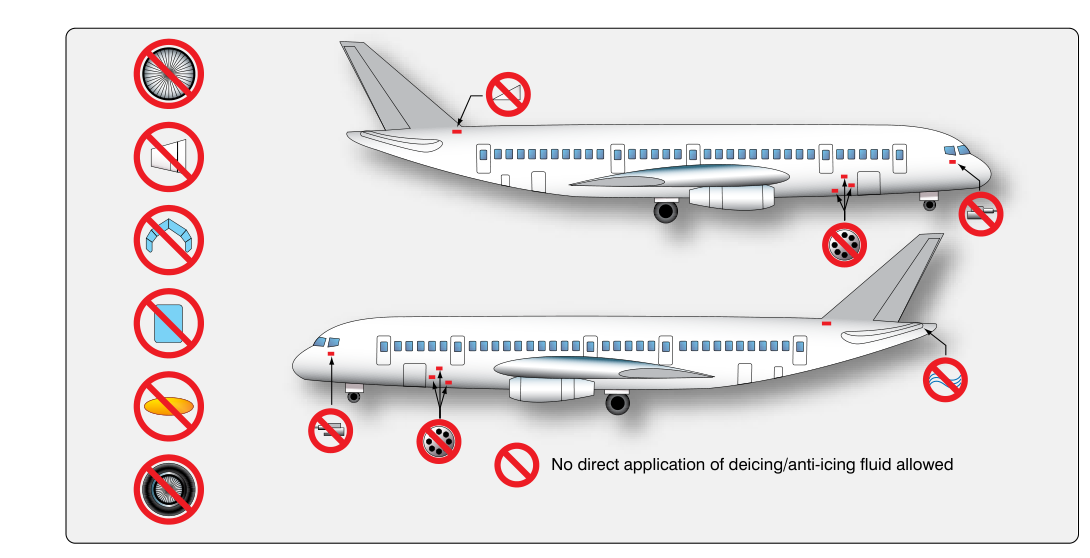
Application equipment typically consists of deicing trucks with articulating booms and heated fluid tanks. Fluid is sprayed at the correct concentration (mix ratio of glycol to water) appropriate for the ambient temperature. If OAT is very cold, a higher concentration of glycol (less water dilution) is required to lower the freezing point of the mixture sufficiently. Manufacturers and fluid suppliers publish temperature-versus-concentration guidance. Ground crews must also avoid spraying fluid directly into engine inlets, pitot tubes, static ports, and other openings — these must be protected or carefully avoided to prevent fluid contamination of critical systems.
Why It Matters: Safety and Airworthiness
The consequences of inadequate ground deicing are severe and well-documented in aviation accident history. Even a thin, rough layer of frost — comparable in texture to medium-grit sandpaper — can reduce lift by as much as 30% and increase drag significantly, potentially preventing an aircraft from achieving flying speed. Ice on control surfaces can jam or stiffen flight controls. Contamination on engine inlet sensors can produce erroneous readings. For the AMT, ensuring that the correct fluid type was used, that the holdover time has not been exceeded, and that the aircraft has been treated according to approved procedures is a direct airworthiness responsibility.
Additionally, most large transport category aircraft have an aircraft-specific approved deicing program described in the Aircraft Flight Manual (AFM) or Airplane Flight Manual supplement. The AMT must be familiar with these documents to confirm that the fluid type applied is approved for that aircraft and that no residual fluid contamination poses a risk to flight control surfaces or braking systems.
Key Numbers and Rules
- Type I: Orange; heated (140°F–180°F); low viscosity; short HOT (approx. 3–35 min); no rotation-speed restriction.
- Type II: Light yellow (straw); unheated or lightly warmed; thickened; longer HOT; requires minimum ~100-knot rotation speed.
- Type III: Yellow-green; thickened, intermediate viscosity; designed for low-rotation-speed aircraft; HOT between Type I and II.
- Type IV: Green; unheated; longest HOT of all types; same rotation-speed requirement as Type II.
- HOT clock starts at the beginning of the final (anti-icing) fluid application, not when that application ends.
- Clean aircraft concept: No takeoff permitted with frozen contamination on critical surfaces (14 CFR Parts 121, 135).
- Two-step procedures: Step 1 (deice with Type I), Step 2 (anti-ice with Type II/III/IV) is the industry standard for active precipitation.
- Fluid concentration must be appropriate for OAT — colder temperatures require higher glycol-to-water ratios.
Memory Aid
A simple color-sequence memory aid for the four fluid types: "Only Silly Youngsters Goof" — Orange (Type I), Straw/yellow (Type II), Yellow-green (Type III), Green (Type IV). Remembering the color sequence in order also helps you recall that holdover time generally increases from Type I through Type IV.
Common Test Traps
- HOT start time confusion: Many students incorrectly believe holdover time begins when the fluid application is finished. It begins when the final (anti-icing) fluid application starts, meaning a portion of the HOT is consumed during application itself.
- Confusing deicing with anti-icing: Deicing removes existing contamination; anti-icing prevents future accumulation. The test may describe a scenario and ask which process was performed — read carefully.
- Type I for anti-icing in heavy precipitation: Type I's very short holdover time makes it a poor choice as a sole anti-icing fluid when precipitation is ongoing. Using it alone in heavy snow can leave almost no margin before HOT expires.
- Type II/IV rotation speed requirement: Forgetting that thickened fluids require sufficient airspeed to shed from the wing is a classic error. Applying Type II to a slow-rotation aircraft without a Type II approval is a maintenance and airworthiness error.
- Spraying fluid into openings: The test may present a scenario where fluid is applied near pitot-static ports or engine inlets — the correct procedure always requires protecting or avoiding these openings to prevent system contamination.