Ice accumulation on an aircraft is one of the most insidious hazards in aviation. Even a thin, rough layer of ice on a wing's leading edge can disrupt airflow, dramatically increase stall speed, and reduce climb performance. For decades, the primary de-ice and anti-ice strategies on light and general aviation aircraft relied on pneumatic boots or heated surfaces. However, a third category — chemical fluid systems, most commonly called TKS weeping wing systems — has earned a well-established role in the general aviation fleet, particularly on turboprop and piston twins as well as high-performance singles. Understanding how TKS systems work, when they protect the aircraft, and where their limits lie is essential knowledge for any AMT working on airframe ice and rain control systems.
The abbreviation TKS comes from the original British company Tecalemit-Kilfrost-Sheepbridge Stokes, which developed the technology during the mid-20th century. Today, the system is manufactured and supported under the Aerospace Systems and Technologies (AST) brand, but the core operating principle has remained consistent for generations: deliver a freezing-point-depressant fluid continuously to critical surfaces so that ice cannot form — or if it has already formed, so that it is chemically broken down and shed by aerodynamic forces.
How the TKS System Works
A TKS system has four primary components: a fluid reservoir, an electrically driven metering pump, distribution plumbing, and the porous titanium panel assemblies installed on the leading edges of the wings, horizontal stabilizer, and vertical stabilizer. Some installations also protect propeller blade leading edges with slinger ring systems, though the wing panels are the heart of the airframe system.
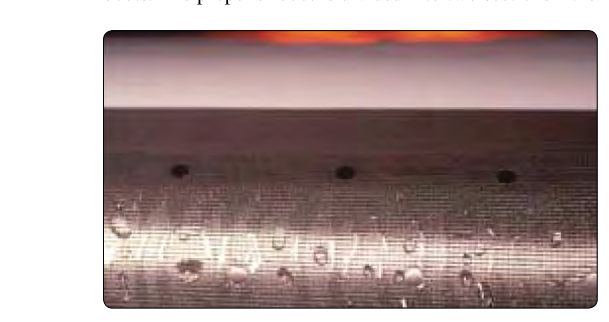
The panels themselves are the engineering marvel. Each panel is manufactured from two sheets of titanium bonded together. The outer sheet is perforated with thousands of precisely laser-drilled holes roughly 0.0025 inches (0.064 mm) in diameter, spaced approximately 0.04 inches apart. This microscopic perforation pattern allows fluid to weep uniformly across the panel's surface without creating high-velocity jets or uneven wet spots. The inner sheet contains an etched groove pattern that distributes incoming fluid evenly before it migrates through the holes. The result is a continuous, thin film of glycol solution across the critical aerodynamic surface.
The fluid itself is a propylene glycol-based solution (commonly identified by its specification, AL-5 / DTD 406B) blended with other additives to depress the freezing point of water well below the temperatures encountered in icing conditions. It is not monoethylene glycol (MEG), which is toxic and is not the standard base for certificated aircraft weeping-wing fluid. When the fluid contacts supercooled water droplets in the atmosphere or ice already on the surface, it lowers the local freezing point so that the water remains liquid. This liquid mixture, with greatly reduced surface tension between it and the airframe, is then swept away by aerodynamic forces. The surface is effectively kept wet with a substance that ice cannot adhere to strongly enough to accumulate.
The metering pump is electrically powered and draws fluid from a reservoir typically located in the fuselage or wing root area. The pilot or flight crew selects a flow rate — most systems offer at least two settings. The high flow rate is used when ice is already present (de-icing mode), and the low flow rate is used in anti-ice mode to prevent formation before ice accumulates. Some systems add a normal setting between these extremes. Consumption rates and reservoir capacity define the system's endurance, which the AMT must verify is within aircraft flight manual limits before any flight into known or forecast icing.
Anti-Ice Versus De-Ice Operation
This distinction is critically important. In anti-ice mode, the system is activated before encountering icing conditions, and the lower flow rate deposits enough fluid to prevent ice adhesion. This is the preferred operational mode because it maintains laminar flow and prevents structural ice loading from occurring at all. In de-ice mode, a higher flow rate is selected after ice has already formed; the fluid works its way under the ice layer, chemically breaking the bond between ice and metal, allowing aerodynamic forces to shed the ice in sheets or slabs. The de-icing process takes time and is less predictable than prevention — another reason pilots and AMTs alike should understand that the system works best proactively.
Because the TKS system addresses the wing leading edge and tail surfaces but may not protect every part of the airframe — windshields use separate alcohol or heated systems, pitot tubes use electric heat, and propellers use their own fluid or electric systems — the AMT must verify that the entire icing protection suite is functional. A weeping wing alone does not certify an aircraft for all icing conditions; the aircraft's approved flight manual and type certificate data sheet define what combination of systems meets the requirements for flight into known icing (FIKI) certification under 14 CFR Part 23 or Part 25 standards.
Maintenance Considerations for AMTs
TKS systems require diligent maintenance attention across several areas:
- Panel inspection: The porous titanium panels must be inspected for clogged holes, corrosion, impact damage, and delamination between the inner and outer sheets. Clogged holes reduce fluid distribution uniformity, creating dry spots where ice can accumulate. Inspection typically involves activating the system on the ground and visually confirming even fluid weeping across the entire panel surface.
- Fluid servicing: The correct FAA-approved TKS fluid must be used. Mixing fluids or using unapproved substitutes can alter the freezing-point depression characteristics or clog the microscopic holes with particulate matter. The reservoir fill cap and filler screen must be kept clean.
- Pump and valve checks: The metering pump must deliver the correct flow rates at each selected setting. If flow rates are out of tolerance, the system may not protect the aircraft in actual icing. The AMT should refer to the aircraft maintenance manual for specific pressure and flow rate specifications and test procedures.
- Plumbing integrity: Distribution lines, fittings, and check valves must be free of leaks. A leak upstream of the panels reduces total fluid flow and system endurance. A leak within the wing structure can introduce glycol fluid into unintended areas, potentially degrading sealants or interacting with other systems.
- Panel cleaning: Cleaning must use approved solvents only. Harsh chemicals can enlarge the laser-drilled holes, altering flow characteristics, or can damage the titanium bond. Never use wire brushes or abrasive pads on the panel surface.
- Fluid endurance documentation: After any maintenance that involved the TKS fluid circuit, the AMT must ensure the reservoir capacity and system flow rates conform to the values listed in the flight manual, so pilots can accurately calculate system endurance for a given flight.
Why It Matters
From a safety standpoint, TKS system failures are not immediately catastrophic the way an engine failure might be, but they can become so in icing conditions. An aircraft certified for flight into known icing with an inoperative TKS system is not legally or safely equipped for that mission. AMTs have a direct responsibility to ensure the system is airworthy before the aircraft departs into an icing environment. Furthermore, because the system is relatively simple compared to pneumatic boots or bleed-air systems — no high-pressure pneumatics, no complex valves — it tends to fail in subtle ways: gradual clogging, slow leaks, or reduced pump output. These failures may not be obvious until the aircraft is in the clouds and the crew notices ice forming despite the system being selected on.
Key Numbers and Rules
- Laser-drilled holes in titanium panels are approximately 0.0025 inches in diameter — smaller than a human hair in some dimensions, requiring only approved cleaning agents.
- TKS fluid is a propylene glycol-based mixture (AL-5 / DTD 406B); the specific approved fluid is listed in the aircraft's maintenance manual and must not be substituted.
- Systems typically offer at least two flow rates: high (de-icing) and low (anti-ice); some offer three settings.
- System endurance is determined by reservoir volume divided by selected flow rate — the AMT must verify this matches POH/AFM data after any servicing.
- Certification for flight into known icing requires the entire icing protection suite to be functional, not just the TKS panels; refer to the type certificate data sheet and applicable airworthiness directives.
- Maintenance is governed by the manufacturer's Component Maintenance Manual (CMM) and the aircraft maintenance manual; 14 CFR Part 43 requires that all maintenance be performed in accordance with manufacturer's instructions.
Common Test Traps
- TKS is not just a de-icer: A common mistake is thinking the weeping wing system is only used to remove existing ice. It is equally — and preferably — used as an anti-ice system activated before entering icing conditions.
- Fluid substitution: Test questions may imply that any glycol mixture is acceptable. Only the specific FAA-approved fluid listed in the maintenance documentation may be used. Using a non-approved fluid can void airworthiness and alter system performance.
- Clogged panels fail silently: A panel with partially clogged holes may appear to be working (fluid is flowing) while leaving dry patches. Ground checks must include visual inspection of the entire panel surface for uniform weeping.
- TKS alone does not equal FIKI: Students sometimes conclude that an operational TKS system means the aircraft is approved for known icing. FIKI certification requires all required ice protection systems — including pitot heat, heated windshield or alcohol windshield, prop protection, and stall warning heat — to be functional simultaneously.
- Panel material matters: TKS panels are titanium, not aluminum. Maintenance procedures, approved cleaners, and repair limits differ significantly from standard aluminum skin repairs. Applying aluminum-specific repair criteria to TKS panels is incorrect and potentially damaging.