High-performance aircraft equipped with constant-speed propellers and fuel-injected or carbureted reciprocating engines hand pilots three distinct levers of engine control: the throttle, which governs manifold pressure; the propeller control, which sets RPM through a governor; and the mixture control, which dials in the fuel-to-air ratio. When these three controls are coordinated correctly, they deliver efficient, reliable power across a wide range of flight conditions. When mismanaged—even briefly—the consequences range from fouled spark plugs and wasted fuel to catastrophic engine damage from detonation or mechanical overload. For the commercial pilot candidate, mastering this coordination is both a practical cockpit skill and a heavily tested knowledge area.
Understanding the Three Controls
Manifold Pressure (MP)
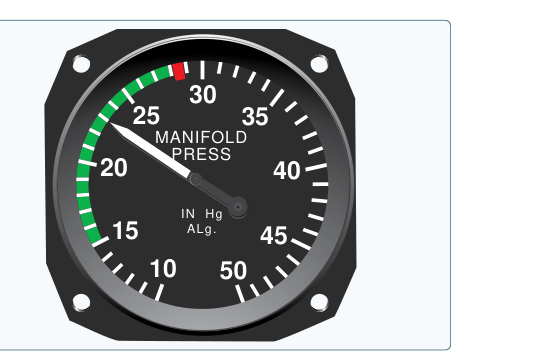
The manifold pressure gauge measures the absolute pressure of the air-fuel mixture in the engine's intake manifold, expressed in inches of mercury (in. Hg). With the engine not running, manifold pressure equalizes with ambient atmospheric pressure—approximately 29.92 in. Hg at sea level on a standard day. Once the engine starts and idles, the pistons pull against a partially closed throttle, creating a partial vacuum in the manifold; typical idle MP readings fall in the range of 12–15 in. Hg. As the throttle opens, that restriction is reduced and MP climbs. At full throttle on a normally aspirated engine at sea level, MP nearly (but not quite) equals ambient pressure because of minor airflow losses through the induction system. Understanding this baseline helps pilots immediately spot an anomalous MP reading—such as an unusually high idle MP—that can indicate a throttle rigging problem or an alternate-air door stuck open.
Propeller RPM and the Governor
A constant-speed propeller uses a governor to maintain a pilot-selected RPM regardless of airspeed and power changes. The governor senses crankshaft speed and hydraulically adjusts propeller blade pitch to keep RPM on target. When engine power increases and the propeller would speed up, the governor coarsens the blade angle (increases pitch) to absorb the extra torque. When power decreases, blade pitch decreases (finer angle) to maintain RPM. The pilot selects the desired RPM with the blue propeller control lever; the governor does the rest automatically. Because the governor has a response time, a sudden, large throttle movement can momentarily overwhelm it, allowing RPM to spike or drop before the governor catches up—another reason for smooth, deliberate power changes.
Mixture Control
The mixture control adjusts the ratio of fuel to air entering the cylinders. At sea level on a standard day, the stoichiometric (chemically ideal) ratio for aviation gasoline is approximately 15:1 by mass (air to fuel), though engines are often operated somewhat richer during high-power phases to provide additional cooling. As altitude increases, air density decreases. A mixture calibrated for sea level delivers progressively more fuel relative to available oxygen as the aircraft climbs, causing an over-rich condition that wastes fuel, roughens engine operation, raises exhaust gas temperatures from incomplete combustion products, and fouls spark plugs with lead deposits. As explained in the Pilot's Handbook of Aeronautical Knowledge (FAA-H-8083-25), leaning the mixture corrects this imbalance and is essential for efficient cruise flight above approximately 3,000 feet MSL—or at whatever altitude the Pilot's Operating Handbook (POH) specifies.
The Critical Sequencing Rule
The single most important coordination principle is this: when increasing power, raise RPM before advancing MP; when decreasing power, reduce MP before reducing RPM. This rule exists to prevent engine lugging—a condition in which the engine is forced to develop high cylinder pressures while turning slowly. High MP driving a low-RPM engine creates enormous mechanical stress on pistons, connecting rods, crankshaft journals, and bearings. More dangerously, it promotes detonation: uncontrolled, explosive ignition of the fuel-air charge rather than the smooth, progressive burn that normal combustion requires. Detonation generates intense, localized heat and shock waves that can destroy piston crowns, erode ring lands, and crack cylinder heads in seconds.
The Airplane Flying Handbook (FAA-H-8083-3) reinforces that operating with a manifold pressure numerically greater than the RPM setting allows—sometimes expressed informally as MP in. Hg exceeding the first two digits of RPM (for example, 25 in. Hg with 2,300 RPM is generally acceptable; 30 in. Hg with 2,000 RPM may not be)—must be avoided unless the specific aircraft's POH permits it. Always defer to the POH; some engines are built to tolerate a wider spread and some are far more restrictive.
Power-Up Sequence
- Advance the propeller control toward high RPM (fine pitch) first.
- Smoothly advance the throttle to the desired MP.
- Adjust mixture as appropriate for altitude and power setting.
Power-Down Sequence
- Reduce throttle to lower MP first.
- Reduce propeller control to desired RPM.
- Adjust mixture if transitioning to a significantly different power setting or altitude.
Mixture Management in Detail
Leaning technique varies by engine type and POH guidance, but two common reference methods are the exhaust gas temperature (EGT) method and the fuel-flow method. With the EGT method, the pilot slowly leans the mixture until EGT peaks (peak EGT), then enrichens slightly to the target percentage of peak EGT specified in the POH—commonly 50°F rich of peak for cruise power settings below 75 percent power, though some modern engines are approved to operate at peak or even lean of peak EGT. With the fuel-flow method, the pilot sets a specific fuel-flow rate in gallons per hour as published in the POH performance tables.
Before any high-power operation—especially takeoff—pilots must return the mixture to the position required by the POH. At airports near sea level, this is typically full rich. At high-density-altitude airports (generally above 3,000–5,000 feet MSL, depending on the POH), the correct mixture for maximum power output during takeoff may actually be a leaned position, because a full-rich mixture at high altitude floods the engine with excess fuel, reducing power and increasing the risk of stumbling or engine roughness during the takeoff roll. Failing to lean for a high-elevation takeoff is a real and tested hazard.
Turbocharged Engines: Elevated Stakes
Turbocharging adds a fourth variable. The turbocharger compresses induction air, allowing the engine to maintain sea-level (or near sea-level) manifold pressure up to its critical altitude. Below critical altitude, the throttle can actually produce more MP than the engine is certified to handle if advanced carelessly—a condition called over-boost. Over-boost can immediately exceed maximum cylinder pressure limits, risking catastrophic structural failure. Most turbocharged aircraft POHs specify a maximum MP (for example, 36 in. Hg or 40 in. Hg depending on the engine), a maximum throttle advancement rate, and a specific sequence for engaging turbocharger wastegate controls where applicable. Pilots of turbocharged aircraft must keep a vigilant eye on the MP gauge during all power additions and resist the temptation to make rapid, large throttle inputs.
Key Numbers and Rules
- Engine off MP: equals ambient atmospheric pressure (~29.92 in. Hg at sea level standard day).
- Idle MP: typically 12–15 in. Hg (partial vacuum below ambient).
- Leaning altitude: generally above 3,000 feet MSL for cruise, or per POH.
- Detonation trigger: high MP combined with low RPM, excessively lean mixture, or low-octane fuel.
- High-density-altitude takeoff mixture: lean per POH, not automatically full rich.
- Turbocharger over-boost: caused by advancing throttle too rapidly below critical altitude; always monitor MP gauge.
Common Test Traps
- Reversed sequence: Reducing RPM before reducing MP is wrong and potentially engine-damaging. The manifold pressure must come down first when pulling power back.
- MP reads zero at shutdown: False. The MP gauge reads ambient atmospheric pressure when the engine is not running, not zero. This is a classic distractor on the FAA Private and Commercial Pilot Knowledge Tests.
- Always use full rich for takeoff: Not universally true. High-elevation airports require leaning per the POH for maximum power and safe operation.
- Governor handles everything: The governor maintains RPM within its authority range, but it cannot respond instantaneously to abrupt throttle movements. Smooth inputs are always required.
- Leaning causes detonation: Detonation is typically caused by an excessively lean mixture at high power settings. For cruise at reduced power, leaning to POH specifications is safe and required for engine health. Always follow POH limits.
- Turbo over-boost: FAA knowledge test questions often ask what prevents a pilot from rapidly advancing the throttle in a turbocharged airplane. The answer centers on the risk of exceeding maximum published manifold pressure limits.
Memory Aid
For power sequencing, use "RPM up first, MP down first"—think of it as always protecting the engine from the dangerous high-MP/low-RPM combination. For mixture, the phrase "high and lean, low and rich" captures the fundamental rule: lean at altitude for efficiency, enrich before high-power operations at low elevations (and consult the POH for high-elevation exceptions).
Mastering this three-control coordination transforms a pilot from someone who simply moves levers to someone who genuinely manages engine health, efficiency, and longevity—exactly the standard the FAA expects of a commercial pilot certificate holder.