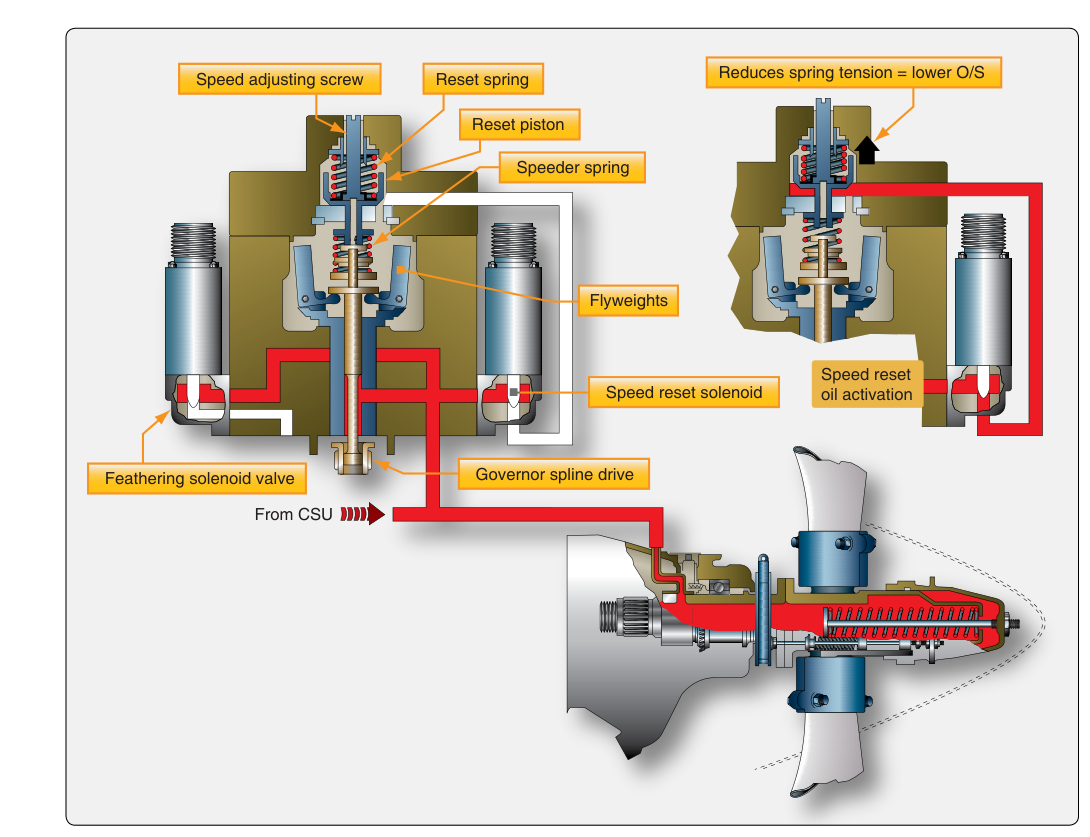
A controllable-pitch propeller is one of the defining features of a complex aircraft, and mastering it is central to the Commercial Pilot Airman Certification Standards (ACS). Unlike a fixed-pitch propeller, which forces the engine to operate across a wide and often inefficient RPM range as airspeed changes, a constant-speed system uses a flyweight governor to continuously meter engine oil pressure against a speeder spring, maintaining whatever RPM the pilot selects with the propeller control. The result is outstanding efficiency across cruise, climb, and approach configurations—but when the system malfunctions, the consequences can be catastrophic and develop in seconds. Understanding propeller overspeed: what causes it, how to prevent it, and how to respond, is not just a knowledge-test requirement; it is a genuine flight-safety imperative.
How the Constant-Speed Governor Works
The governor is driven by the engine at a speed proportional to crankshaft RPM. Inside, a set of rotating flyweights senses actual shaft speed. When RPM matches the selected value, the flyweights are in equilibrium, and oil flow to the propeller dome is neutral—blade pitch holds steady. If RPM rises above the selected value (an overspeed condition), centrifugal force throws the flyweights outward, which opens an oil port that directs high-pressure engine oil into the propeller hub to increase blade pitch (move blades toward a coarser, higher-drag angle), loading the engine and pulling RPM back down. If RPM falls below the selected value (an underspeed condition), the flyweights move inward, oil pressure is relieved from the dome, and a counterweight or feathering spring drives blades toward lower pitch (finer angle), reducing load so RPM can recover.
This elegant feedback loop works flawlessly under normal conditions. But notice the critical detail: low oil pressure—whether from a governor failure, a cracked oil line, or system contamination—removes the one force that drives blades toward high (coarse) pitch. With oil pressure absent, counterweights and springs drive the blades toward flat pitch, and the engine accelerates. This is the physics behind almost every propeller overspeed event.
Causes of Propeller Overspeed
Governor and Oil System Failures
The most dangerous cause of overspeed is a governor failure in which internal wear, contamination, or a stuck valve allows blades to migrate toward flat pitch uncontrollably. Because oil pressure is what holds blades at a coarser angle, any interruption—a broken line, low engine oil quantity, or severe oil foaming—can produce the same result. The FAA's Airplane Flying Handbook (FAA-H-8083-3) notes that pilots must understand that most constant-speed systems are designed so that a loss of governor oil pressure causes the blades to move toward the low-pitch (high-RPM) position, not toward feather. This is a deliberate design compromise: in the event of an in-flight failure, a low-pitch default allows the engine to continue producing some power for continued flight, whereas an uncontrolled feather would cause an immediate power loss. However, this default also means an oil-pressure failure is an overspeed event by nature.
Aerodynamic and Pilot-Induced Causes
Overspeed does not always result from a mechanical failure. A steep, uncoordinated dive at high power can temporarily overwhelm the governor's ability to coarsen pitch fast enough to match the rapidly increasing airspeed. In this scenario, aerodynamic forces on the blades act in the low-pitch direction, adding to the governor's workload. Similarly, improper power-change sequencing is a common pilot-induced cause. When increasing power, the correct sequence is to set RPM first (propeller control forward) and then advance the throttle to increase manifold pressure. Reversing this—pushing the throttle first—can cause a momentary RPM spike because the engine receives more fuel-air mixture than the propeller pitch can absorb at the current setting. On descent, the mirror error applies: reducing RPM before reducing manifold pressure leaves the engine loaded with high MP and insufficient propeller drag, which can spike RPM above the selected value.
Why Overspeed Is So Dangerous
Reciprocating engines and their propellers are engineered to precise RPM limits. The red-line tachometer marking represents the maximum RPM for continuous operation, and exceeding it—even briefly—subjects the system to stresses it was not designed to sustain. At excessive RPM, centrifugal loading on propeller blades increases as the square of rotational speed, meaning even a 10% RPM exceedance produces roughly 21% more centrifugal stress on blade roots and hub components. The crankshaft, which must transmit all of this rotational energy, is also vulnerable to torsional fatigue. In extreme cases, blade deformation, hub cracking, or propeller separation can occur. Beyond the propeller itself, over-revving a direct-drive engine can cause valve float, in which intake or exhaust valves are held open by their own inertia, causing severe power loss or backfire. For turbocharged engines, an overspeed event that simultaneously drives the engine toward over-boost compounds the emergency significantly.
Even a brief overspeed that the pilot corrects quickly is not necessarily harmless. Most manufacturer Pilot Operating Handbooks (POHs) and FAA guidance recommend that any RPM exceedance beyond red-line be reported to and evaluated by a certificated mechanic before further flight. Failing to do so is both a safety hazard and potentially a regulatory issue, since operating an aircraft in an unairworthy condition violates 14 CFR Part 91.
Recognition and Immediate Response
The first indication of an overspeed is a tachometer reading above the selected RPM, often accompanied by an unexpected increase in engine noise. The pilot's immediate actions should follow the specific emergency checklist in the aircraft's POH, but the general sequence recognized across most aircraft types is:
- Reduce throttle — Lowering manifold pressure immediately reduces the power driving the propeller overspeed. This is the fastest way to reduce RPM from the engine side.
- Move the propeller control toward increased pitch (high-pitch/low-RPM) — If the governor is still partially functional, commanding a higher pitch setting may help. Exercise caution: a sudden large pitch increase on a severely over-revving engine can cause engine shock loading, so the movement should be deliberate, not slammed.
- Reduce airspeed — Raising the nose or, if available, deploying speed brakes reduces the aerodynamic force driving blades toward low pitch, relieving some of the governor's workload.
- Declare an emergency and land as soon as practical — Once an overspeed has occurred and cannot be reliably controlled, continued flight risks progressive structural damage.
Prevention: Power Management Discipline
The cornerstone of overspeed prevention in normal operations is strict adherence to power-change sequence. For a normally-aspirated engine, the governing principle is straightforward: when adding power, RPM leads MP; when reducing power, MP leads RPM. This ensures the propeller always has sufficient blade-angle authority to absorb the incoming fuel-air charge before it arrives, and that the engine is never left with excess manifold pressure and insufficient RPM.
Pilots should also monitor the tachometer continuously during high-power maneuvers, steep descents, and any configuration change. An RPM reading above the selected value is never normal during steady flight—it is always an indication that the governor is working beyond its capacity or has lost regulation. Recognizing this early, before RPM climbs to red-line, is what separates a managed abnormality from a full emergency.
Key Numbers, Rules, and Edge Cases
- Red-line RPM is the published maximum for continuous operation; any exceedance requires maintenance evaluation per most POHs and FAA guidance.
- Oil pressure loss defaults blades to low pitch (high RPM) in most constant-speed systems—not to feather.
- At low power settings, the governor may already be at its high-pitch mechanical stop, so moving the prop control forward has no effect; RPM reading below the selected value in this condition is normal, not an underspeed malfunction.
- Turbocharged engines face compounded risk: overspeed and over-boost can co-occur if power management is poor during descent.
- Feathering systems use an accumulator or an additional high-pressure oil source specifically because the engine must already be at very low RPM (or stopped) to feather, and governor oil pressure alone may be insufficient.
Common Knowledge-Test Traps
- Governor failure causes overspeed, not underspeed. Because oil pressure maintains high pitch, losing it removes the coarsening force and blades flatten—RPM rises.
- A momentary overspeed is not automatically harmless. Even a brief exceedance may require inspection; do not assume the engine is fine simply because RPM returned to normal.
- The prop control sets a target, not a hard RPM ceiling. If aerodynamic or mechanical forces overwhelm the governor, the actual RPM can exceed the selected value regardless of prop-control position.
- Increasing manifold pressure before RPM is the classic pilot-induced overspeed trigger on power additions—always set RPM first.
- Overspeed on a piston engine is not the same as a turbine runaway. Emergency procedures differ entirely; confusing them on the knowledge test or in the cockpit is a critical error.
Memory Aid
For all power changes in a complex aircraft, use: "Up: RPM then MP. Down: MP then RPM." A useful way to remember the logic is to think of it as always protecting the engine—give the prop its load before you give the engine its fuel, and remove the fuel before you unload the prop.