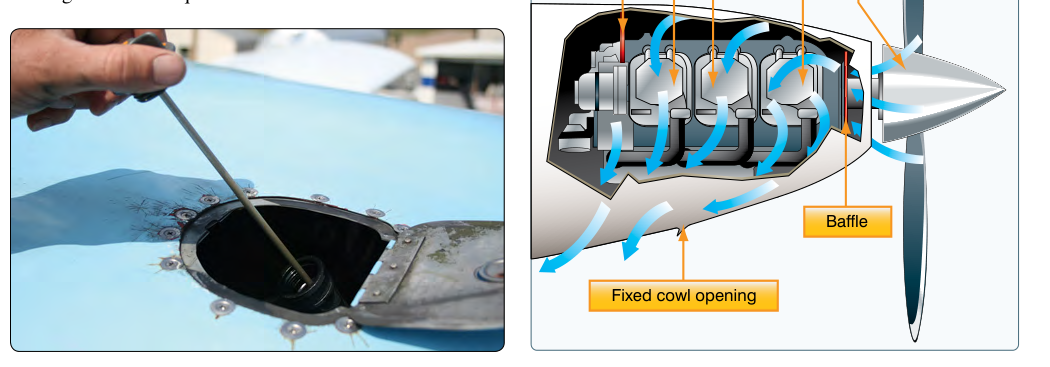
High-performance piston engines are thermal machines operating near their design limits during every takeoff and climb. For the commercial pilot candidate, understanding cowl flap operation goes far beyond knowing which direction to move a lever. It requires integrating knowledge of heat transfer physics, engine metallurgy, aerodynamic drag trade-offs, and phase-of-flight risk management — all topics addressed throughout the FAA Airplane Flying Handbook (FAA-H-8083-3) and the Pilot's Handbook of Aeronautical Knowledge (FAA-H-8083-25). This article explains not just what cowl flaps do, but how and why they must be managed precisely if you want to protect the engine and ace the commercial pilot knowledge test.
What Cowl Flaps Are and How They Work
Cowl flaps are hinged panels, typically located at the aft lower edge of the engine cowling. Their fundamental job is to control the exit area for cooling air that has flowed over the cylinders and oil cooler. Air-cooled reciprocating engines rely on ram air — the forward momentum of the aircraft forcing outside air through intake openings at the front of the cowl — to carry heat away from the cylinder fins and into the slipstream. The efficiency of this heat exchange depends on two things: the temperature differential between the cylinder metal and the incoming air, and the volume and velocity of air moving through the cowling.
When cowl flaps are opened, the exit area at the rear of the cowl enlarges. This lowers back-pressure inside the cowling, which draws more air through from the front, increasing the cooling airflow rate. The trade-off is that the open panels create additional parasite drag — a direct performance penalty. When cowl flaps are closed, drag is minimized and the cowling acts as a more aerodynamically clean surface, but cooling airflow is restricted. Pilots must continuously balance these competing demands based on engine load, airspeed, and ambient temperature conditions.
Phase-of-Flight Analysis
Takeoff and Initial Climb
During takeoff, the engine is producing maximum or near-maximum power. Fuel combustion is at its peak rate, generating enormous quantities of heat. Simultaneously, airspeed is low — particularly during the ground roll and initial climb — which means ram airflow through the cowl is at its minimum. This combination of maximum heat generation and minimum cooling airflow creates the highest overheating risk in any normal flight profile. The correct procedure, consistent with FAA guidance and virtually every high-performance aircraft POH, is to have cowl flaps fully open before applying takeoff power. There is no aerodynamic argument for closing them at this phase; the drag penalty is trivially small compared to the engine protection benefit.
Climb
As the aircraft accelerates through initial climb, ram airflow increases, but engine power settings remain high — typically 75% or above for a normal climb profile. Cylinder Head Temperature (CHT) should be monitored continuously. If CHT approaches the yellow arc or the manufacturer's recommended limit, the pilot should verify cowl flaps are fully open and consider reducing the climb angle to increase airspeed, which increases ram cooling. In some high-power or high-temperature situations, manufacturers note that mixture enrichment can provide additional internal cooling through evaporative fuel charge, though this is not a universal POH climb recommendation and should be applied only per the specific aircraft's guidance; lean-of-peak operations are generally not appropriate at high-power settings unless the engine is specifically designed for it.
Cruise
Once established at cruise altitude and power, ram airflow is at its highest efficiency. At typical cruise power settings of 55–75% and cruise airspeeds, the engine is producing less heat than at climb power and receiving more cooling airflow. This is the phase where cowl flaps can be partially or fully closed to recover the drag penalty and improve cruise efficiency. The transition should be made gradually, with the pilot monitoring CHT and oil temperature to confirm they stabilize within normal range — typically the green arc — after closing the flaps. Do not close cowl flaps and then stop scanning the temperature gauges; temperature equilibrium takes time to establish.
Descent
Descent introduces the hazard of shock cooling — a phenomenon that is heavily tested on the commercial pilot knowledge examination. When a pilot abruptly reduces power for a rapid descent, fuel combustion drops sharply, reducing the engine's internal heat source. At the same time, forward airspeed (and thus ram airflow) may remain high. The result is an extremely rapid drop in Cylinder Head Temperature. The danger lies not in the lower temperature itself, but in the rate of change. Aluminum cylinder heads and cast iron or steel cylinder barrels have different coefficients of thermal expansion. A rapid, uneven temperature drop causes uneven thermal contraction, which over time can produce cylinder head cracks, damaged valve seats, and distorted piston ring lands.
FAA handbooks discuss shock cooling as a real hazard, though they do not prescribe a single specific numeric CHT rate limit; engine and airframe manufacturers are the source for such guidance. Some manufacturers, such as Lycoming and Continental, cite guideline figures like limiting CHT drops to approximately 50°F per minute, while other sources cite different thresholds — the authoritative figure for any specific aircraft is always found in its POH or engine manufacturer's documentation, not in FAA handbooks. Practical techniques to prevent shock cooling include reducing power gradually rather than all at once, maintaining a shallower descent angle to keep some power on, and leaving cowl flaps in the open position longer than instinct might suggest. Once CHT has stabilized at a lower but acceptable value, cowl flaps can be transitioned toward the closed position for the remainder of the descent.
Landing and Go-Around
On final approach, airspeeds are low and power settings are reduced, but the engine may still be warm from the preceding flight. Many POHs call for cowl flaps open during landing to ensure adequate airflow during the slow-speed phase. This is especially important for the go-around scenario: if a go-around is initiated, the engine must immediately accept full power, and an already-warm engine with closed cowl flaps faces a sudden spike in thermal load. Having cowl flaps open during the approach ensures the engine is not heat-soaked at the moment maximum power is demanded.
Key Temperatures and Limits
- CHT normal range: Typically displayed as a green arc on the gauge; maximum CHT limits for common air-cooled training engines (such as the Lycoming O-320/O-360 series) are commonly around 500°F (red line), but always verify in the specific aircraft POH or engine manufacturer's documentation.
- Oil temperature: A secondary but important indicator; oil serves as both a lubricant and a supplementary coolant in many engines. Sustained high oil temperatures indicate inadequate cooling and can accelerate oxidation and breakdown of lubricating properties.
- Shock cooling rate: No single FAA-mandated numeric limit exists; some engine manufacturers cite guideline figures such as approximately 50°F per minute — the specific aircraft's POH or engine manufacturer's documentation governs.
- Cowl flap position at takeoff: Fully open — non-negotiable for most high-performance aircraft.
- Cruise cowl flap position: Varies by aircraft and ambient conditions; determined by CHT stabilization, not convenience.
Common Test Traps
- Open cowl flaps increase drag, not reduce it. Open = more cooling AND more drag. This is a frequently reversed concept on the knowledge test.
- Shock cooling is a descent/power-reduction hazard. Overheating is the primary climb risk; shock cooling is the primary descent risk. Know which risk applies to which phase.
- CHT is the most direct indicator of shock cooling risk, not oil temperature. Oil temperature lags behind CHT changes significantly.
- Closing cowl flaps too early in cruise can allow CHT to creep upward if the pilot stops monitoring. Temperature equilibrium must be confirmed, not assumed.
- Go-around demands cowl flaps open on final — many pilots incorrectly believe cowl flaps can be closed during a stabilized approach because power is low.
- The POH is always the final authority. FAA handbooks establish principles; the aircraft's flight manual establishes the specific numbers and procedures for that airframe and engine combination.
Memory Aid
A reliable way to remember cowl flap logic: Hot and slow = wide open; cool and fast = close it up. During takeoff and climb you are running the engine hard at low airspeed — maximum heat, minimum ram air — so open wide. During cruise you have abundant ram air doing the cooling work — close up for efficiency. During descent, remember that a rapid power reduction is a thermal shock risk — keep them open and cool gradually.
Mastering cowl flap management demonstrates the kind of systems-level thinking the FAA expects of commercial pilot certificate holders. It is not a single-answer checklist item; it is a continuous decision process that integrates power setting, airspeed, ambient temperature, phase of flight, and real-time temperature gauge interpretation. Study it that way, and both the knowledge test and the practical test will reflect that depth of understanding.