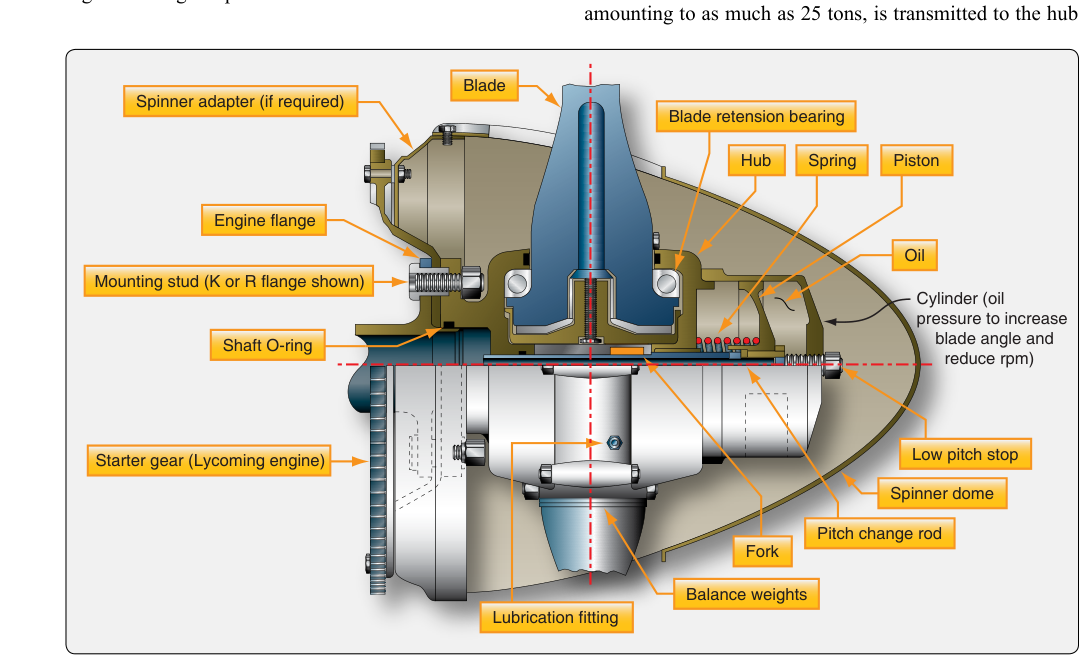
What Is a Constant-Speed Propeller?
A constant-speed propeller is a variable-pitch propeller whose blade angle is automatically adjusted by a governor to maintain a pilot-selected rotational speed (RPM), regardless of changing airspeed, altitude, or power setting. Unlike a fixed-pitch propeller — which operates at only one ideal blade angle — a constant-speed system continuously seeks the most aerodynamically efficient angle for any given flight condition. This is why constant-speed propellers are standard equipment on high-performance and complex aircraft, and why mastery of their operation is a core commercial pilot competency.
How It Works: The Governor and Pitch Change Mechanism
The heart of the system is the propeller governor, an engine-driven device that senses propeller RPM through flyweights and compares it to the RPM selected by the pilot via the propeller control (blue lever) in the cockpit. The governor acts like a precision speed regulator with three possible states:
- On-speed: Actual RPM equals selected RPM. Flyweights are in a neutral position, oil pressure to the propeller hub is balanced, and blade pitch holds steady.
- Overspeed: Actual RPM exceeds selected RPM (e.g., after a dive or an increase in airspeed). Flyweights fly outward, opening a port that directs high-pressure engine oil into the propeller hub, driving the blades toward high pitch (coarse) — increasing the load on the engine and slowing the propeller back to the selected RPM.
- Underspeed: Actual RPM is below selected RPM (e.g., after power is reduced or during a climb). Flyweights move inward, oil is ported away from the hub, and a spring plus centrifugal twisting moment drives the blades toward low pitch (fine) — reducing blade load and allowing the engine to speed back up.
In most single-engine aircraft using this system, oil pressure increases pitch (moves blades toward coarse/high pitch). A failure of the oil supply therefore causes the propeller to default toward low pitch / high RPM — an important safety consideration discussed further below.
Feathering Propellers
Many multi-engine aircraft use feathering propellers, where the blades can rotate to approximately 90° — essentially parallel to the relative wind — to minimize drag after an engine failure. In feathering systems, a counterweight and spring arrangement works opposite to the single-engine design: oil pressure keeps the blades in low pitch, and when oil pressure is lost (engine failure), the counterweights and springs drive the blades toward feather. This is why, on a multi-engine aircraft, pulling the propeller control to the feather detent removes oil pressure, allowing the blades to feather and dramatically reducing drag on the windmilling engine.
The Three Controls and Their Interaction
In an aircraft with a constant-speed propeller, the pilot manages power through two levers (plus mixture): the throttle and the propeller control. Understanding how these interact is critical for avoiding engine damage.
- Throttle (manifold pressure — MP): Controls the amount of fuel-air mixture entering the engine cylinders, directly setting power output. Measured in inches of mercury (in. Hg). More throttle = higher manifold pressure = more power.
- Propeller Control (RPM): Sets the governor's target RPM by adjusting spring tension on the flyweights. Higher RPM setting = finer pitch = higher engine speed.
- Mixture: Controls the fuel-to-air ratio, adjusted for altitude to maintain efficiency and prevent over-rich or over-lean conditions.
Power Setting Order: Avoiding Overboosting
A critical rule when operating a constant-speed propeller is the order of power changes. Because manifold pressure and RPM interact directly, an incorrect sequence can cause internal engine stress:
- When adding power: Increase RPM first (propeller control forward), then increase manifold pressure (throttle forward). This ensures the engine is turning fast enough to handle the increased cylinder pressure.
- When reducing power: Reduce manifold pressure first (throttle back), then reduce RPM (propeller control back). This prevents a condition where high manifold pressure is pushing against slow-turning pistons — an overboost situation that stresses cylinder heads and connecting rods.
A common memory aid taught for this sequence is «RPM before MP on the way up; MP before RPM on the way down» — or more simply, keep the numbers in order: high RPM supports high MP. Never allow manifold pressure to significantly exceed the RPM in a way that places excessive load on the engine. Specific manifold pressure limits for a given RPM setting are published in the Pilot's Operating Handbook (POH) for each aircraft.
Blade Angle, Efficiency, and Aerodynamic Principles
Every propeller blade is an airfoil, and like a wing, it generates lift (thrust) based on its angle of attack. Blade angle is the angle between the blade chord line and the plane of rotation. Pitch is often used interchangeably, but technically refers to the theoretical forward travel per revolution. The angle of attack of a blade section depends on both blade angle and the helix angle — determined by the aircraft's forward speed and propeller RPM.
At low airspeeds (takeoff and climb), a low pitch (fine) blade angle is most efficient. The blade takes a smaller bite of air per revolution, keeping angle of attack moderate and allowing the engine to turn at high RPM for maximum power. At high airspeeds (cruise), a high pitch (coarse) blade angle is more efficient — the blade takes a larger bite, moving the aircraft farther per revolution while keeping engine RPM within a fuel-efficient range. This is analogous to shifting to a higher gear in a car: more work per cycle, less engine spinning.
Blade Twist and Geometric Pitch
Propeller blades are twisted from root to tip to compensate for the fact that the blade tip travels much faster than the root. The twist ensures a more uniform angle of attack along the entire blade length, preventing the root from stalling while the tip is at too shallow an angle — maximizing overall efficiency.
Practical Cockpit Procedures
The following procedures reflect standard commercial pilot practice and should always be verified against the specific aircraft's POH:
- Before takeoff: Propeller control is set to full forward (maximum RPM / fine pitch). This provides maximum thrust for the takeoff roll and ensures the engine is at its most responsive.
- Climb: After reaching a safe altitude, reduce to the climb power setting specified in the POH (e.g., 25 inches MP / 2,500 RPM). Reduce manifold pressure first, then RPM.
- Cruise: Set cruise power per POH. A typical light high-performance aircraft might use 23 inches / 2,300 RPM for a 65% power cruise. Verify the setting does not exceed manufacturer limits for that combination.
- Descent: Gradual power reduction. Avoid shock-cooling by reducing power slowly — no more than 1 inch of manifold pressure per minute is a commonly cited conservative guideline.
- Before landing: Propeller control full forward to ensure maximum RPM availability for a go-around. This is a critical checklist item.
Failure Modes and Safety Considerations
Understanding what happens when the governor fails is essential for commercial pilot decision-making:
- Oil pressure loss (single-engine aircraft): With no oil to increase pitch, the propeller defaults to low pitch and high RPM. This is generally manageable but requires careful monitoring to avoid engine overspeed.
- Governor failure in overspeed: Propeller RPM climbs above redline. Reduce throttle immediately to reduce power and lower RPM. Land as soon as practical.
- Propeller control disconnect: If the control cable fails, the governor may hold the last set RPM or may trend toward a limit. Follow POH emergency procedures.
- On multi-engine aircraft: Always verify the correct propeller on the correct engine before feathering. The DECIDE checklist (Dead foot, Dead engine, Identify, Confirm, Execute) prevents feathering the good engine.
Common Test Traps
- Oil pressure and pitch direction: On most single-engine aircraft, oil pressure INCREASES pitch (moves toward coarse/high pitch). A governor failure defaults to LOW pitch and HIGH RPM — not feathered.
- Order of power changes: Always increase RPM before increasing MP; reduce MP before reducing RPM. Reversing this order risks overboosting or excessive engine stress.
- Propeller control before landing: Many students forget to move the prop control to full forward before landing. The FAA expects this as a standard checklist item — it ensures a go-around is immediately available.
- Low pitch vs. high RPM: Low pitch (fine/flat) = high RPM; high pitch (coarse) = low RPM. Students frequently confuse these. Think of it as a bicycle: a low gear (fine pitch) lets you pedal fast with less resistance; a high gear (coarse pitch) takes bigger bites with each revolution.
- Feathering vs. flat pitch default: Multi-engine feathering propellers default TOWARD feather on oil pressure loss; single-engine constant-speed propellers default toward flat/low pitch. The difference in design purpose explains the difference in failure behavior.