Retractable landing gear is the hallmark of a complex aircraft under 14 CFR Part 61—an airplane with a retractable undercarriage, flaps, and a controllable-pitch propeller. For commercial pilot candidates, mastery of these systems goes far beyond memorizing two V-speeds. You must understand the mechanical architecture, the logic behind warning systems, how to troubleshoot ambiguous indications in the cockpit, and how to execute emergency extension procedures with calm precision. Gear-up landings remain one of the most preventable and costly accidents in general aviation; the knowledge required to prevent them is equally foundational to passing the FAA Commercial Pilot Airplane Knowledge Test.
How Retractable Gear Systems Work
Retractable landing gear systems eliminate a substantial source of parasite drag—the type of drag that increases with the square of airspeed and has nothing to do with lift production. By stowing the wheels in the fuselage or wings, designers can achieve cruise speeds and fuel efficiencies impossible on comparably powered fixed-gear aircraft. The tradeoff is mechanical complexity and the very real possibility of a gear-up landing if the pilot does not manage the system correctly.
Hydraulic Systems
Many light retractable-gear aircraft use hydraulic actuation. An engine-driven or electrically driven hydraulic pump pressurizes fluid that flows through selector valves to actuating cylinders attached to each gear leg. When the pilot selects gear up, the valve routes high-pressure fluid to the retract side of each cylinder; selecting gear down reverses the flow. Critically, mechanical uplocks and downlocks—not continuous hydraulic pressure—hold the gear firmly in position once the gear reaches its travel limits. This means a hydraulic pressure loss in cruise does not cause the gear to fall on its own; the uplock must first be released. However, it also means that without a functioning primary system, the pilot must release those locks manually to allow gravity extension.
Electric Systems
Electrically actuated systems replace fluid with a reversible electric motor driving a jackscrew, torque tube, or cable-and-pulley arrangement. The motor drives the gear through its full range of travel, and limit switches cut power when the gear reaches the up or down position. Mechanical locks again secure the gear at both endpoints. Electric systems are lighter and simpler in small aircraft, but they depend on the aircraft's electrical bus—a significant consideration during an electrical failure. Some aircraft use a combination design: electric motor driving a hydraulic pump (an electrohydraulic system), which blends the controllability of hydraulics with the simplicity of a single power source.
Gear Doors
Most retractable-gear aircraft also have gear doors that open before the gear moves and close after retraction to create a smooth aerodynamic surface. The door actuation sequence—doors open, gear moves, doors close—is managed automatically by the selector valve or by door-operated mechanical triggers. During this sequence the doors experience peak aerodynamic loads while in motion and partially open, which is why VLO (landing gear operating speed) can be a more restrictive limit than VLE (landing gear extended speed) in many designs; however, the relationship between the two speeds varies by aircraft, and some POHs publish the same value for both or list separate retraction and extension speeds. Always consult the specific aircraft's Pilot's Operating Handbook (POH) for exact values.
V-Speed Rules Every Retractable-Gear Pilot Must Know
- VLO — Landing Gear Operating Speed: The maximum speed at which the gear may be extended or retracted. Exceeding this speed while the gear is in transit risks structural damage to doors and actuating linkages.
- VLE — Landing Gear Extended Speed: The maximum speed at which the aircraft may be flown with the gear in the down-and-locked position.
- Practical rule: When conducting an emergency extension or any abnormal gear operation, slow below VLO first—then perform the procedure. After extension, do not exceed VLE. Because the relationship between VLO and VLE varies by aircraft, always verify the published values in the specific POH rather than assuming one is always lower than the other.
Gear Warning and Indication Systems
Because the consequences of forgetting to extend the gear are severe, aircraft designers layer multiple redundant warning cues. Understanding each one—and its limitations—is essential for both the knowledge test and real cockpit decision-making.
The Gear Warning Horn
The gear warning horn activates when the throttle is reduced below a manufacturer-specified power setting (typically approach power) and the gear is not in the down-and-locked position. This protects against the classic distraction scenario: a pilot pulls power on final and forgets the gear. The critical limitation is equally important: a silent horn does not confirm that the gear is down. At cruise power settings, the horn is intentionally suppressed. A pilot flying downwind at high power who is distracted will not hear a warning even if the gear is up. The horn's silence is only meaningful when power has been reduced to the trigger threshold.
Visual Position Indicators
Most aircraft provide a green light for each gear (or a single green for the complete gear system) to indicate down-and-locked. An amber or red light—or a light that remains illuminated during transit—signals an unsafe condition. A dark (no-light) indication typically means the gear is up and locked, but this varies by aircraft. Some designs use red lights for up-and-locked and no lights for an intermediate unsafe state. There is no substitute for reading the specific POH indicator legend before flying an unfamiliar type. Many aircraft also include a small mirror or an inspection port on the wing or nacelle through which the pilot can visually verify the main gear position.
Squat Switches and Throttle Switches
Many systems incorporate a squat switch (also called a weight-on-wheels switch) on the main gear that prevents the gear from being accidentally retracted while on the ground—at least when the gear is bearing weight. Throttle-mounted microswitches connect the warning horn to power setting. Understanding these interlocks explains several knowledge-test scenarios: for example, why the gear may retract on the ground if the aircraft becomes airborne briefly during a rough landing before the squat switch opens.
Emergency Extension Procedures
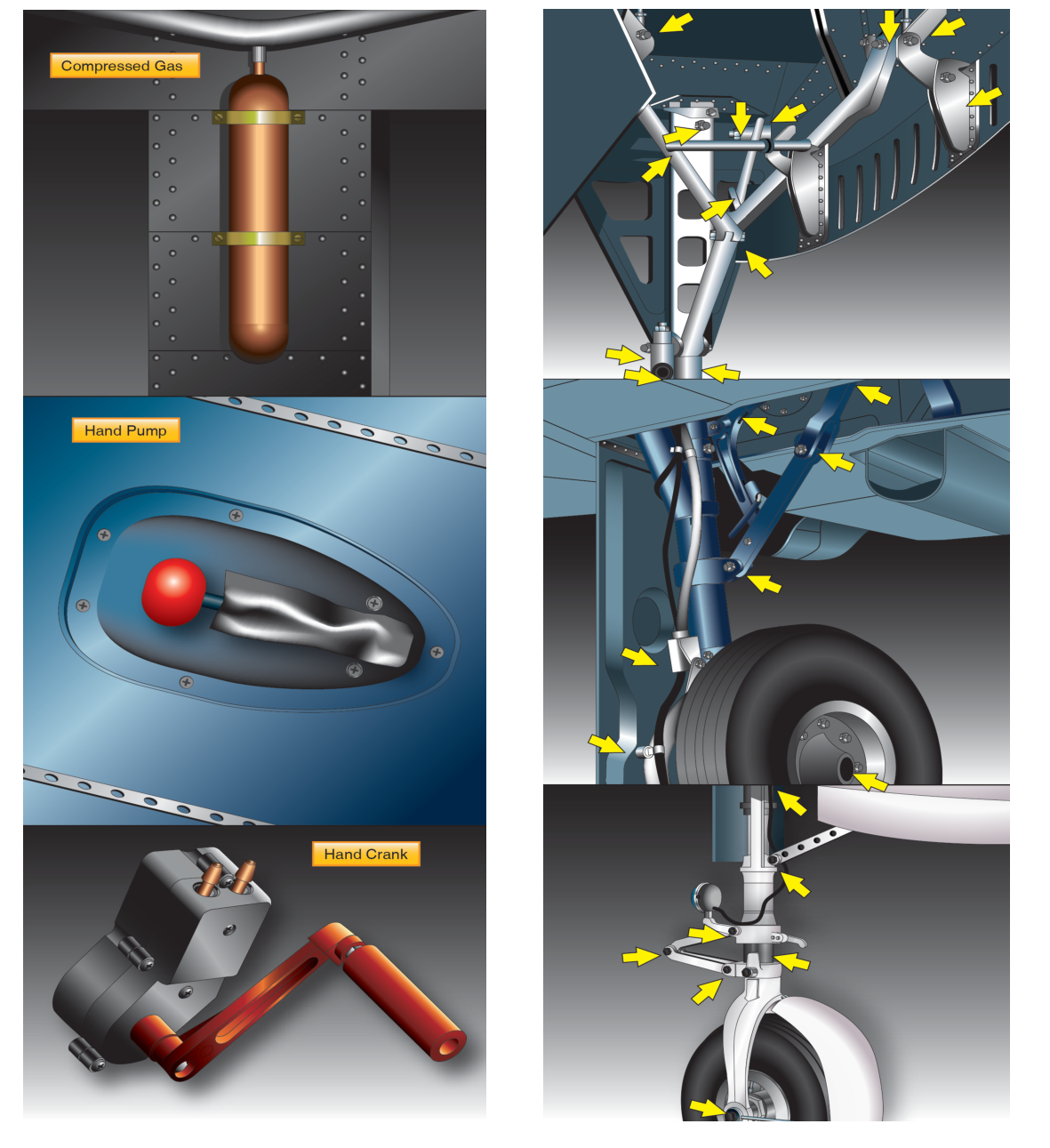
Many aircraft certificated under 14 CFR Part 23 incorporate a means of extending the landing gear that is independent of the primary system, though the specific certification basis and design determine whether such a system is required (see 14 CFR 23.729, Retracting mechanism). The POH is always the governing authority for the aircraft you are flying—but the common approaches are:
- Manual hydraulic hand pump: The pilot uses a cockpit-mounted pump handle to build hydraulic pressure in the system, forcing the gear down. This method often requires dozens of pump strokes and is physically demanding. Pressure must exceed the uplock force to release the gear.
- Mechanical free-fall (gravity drop): The pilot pulls a mechanical release (cable, handle, or knob) that disengages the uplocks, allowing gravity and aerodynamic drag to swing the gear to the extended position. The free-fall method works best at lower airspeeds and may require gentle aircraft maneuvering—such as a coordinated bank—to help seat the downlocks.
- Pneumatic or CO₂ bottle: Some aircraft store a compressed-gas cylinder that, when activated, blows gear doors open and forces the gear to the down-and-locked position. This is a one-shot system; once used, the bottle is spent and the gear cannot be retracted.
Regardless of method, the procedural logic is consistent: (1) slow below VLO, (2) select gear down on the primary system, (3) execute the emergency extension per the POH checklist, (4) verify down-and-locked indications. If indicators remain unreliable, a low pass over the tower (where trained eyes can observe gear position) or using the in-flight mirror provides a cross-check. After any emergency extension, assume the gear cannot be retracted. Declare the situation to ATC, configure for a normal approach speed, and plan a full-stop landing. Brief any passengers, secure loose objects, and consider an emergency declaration if runway length or other factors warrant it.
Key Rules and Limits
- Always reduce airspeed below VLO before any gear operation—normal or emergency.
- Never exceed VLE with gear extended; structural certification limits are real limits, not suggestions.
- A single missing green light may indicate a burned-out bulb—check the POH troubleshooting steps before assuming the gear is not down.
- Gear warning horn silence at high power settings provides no confirmation of gear position.
- After emergency extension via backup system, treat the gear as non-retractable for the remainder of the flight.
- Emergency hand-pump extension may require significant physical effort; allow adequate time and altitude.
Common Test Traps
- VLO vs. VLE confusion: The FAA Commercial Pilot Airplane Knowledge Test frequently tests whether students know that VLO is for moving the gear and VLE is the limit while the gear is stationary and down. The relationship between the two values varies by aircraft, so do not assume VLO is always the lower number—always check the specific POH.
- Horn silence on downwind: A common scenario presents a pilot maintaining cruise power on the downwind leg. The question tests whether the student knows the horn will not activate at high power settings—gear position cannot be inferred from horn silence alone.
- Single green light out: Do not automatically declare an emergency. Verify the bulb by testing it (many aircraft have a press-to-test feature) and follow POH troubleshooting before concluding the gear is not locked.
- Free-fall gear after emergency extension: Test questions may ask what limitation applies after an emergency extension. The correct answer is that the gear cannot be retracted and a full-stop landing is required.
- Squat-switch scenarios: A scenario describing gear retraction on touchdown (bounced landing) tests knowledge of the squat-switch interlock and when it may fail to prevent inadvertent retraction.
Memory Aid
Use the GUMPS flow on every approach in a complex aircraft: Gas (fuel selector on proper tank), Undercarriage (gear down and three green), Mixture (rich or per POH), Propeller (high RPM / forward), Switches and Seatbelts. Running GUMPS at a consistent point on every approach pattern—such as abeam the numbers on downwind—creates the habit that prevents gear-up landings regardless of cockpit distractions.