Introduction: Two Models, One Wing
When student pilots first ask "how does a wing produce lift?" most instructors reach immediately for Bernoulli's principle — and that explanation is valid and FAA-endorsed. But the FAA's Pilot's Handbook of Aeronautical Knowledge (PHAK, FAA-H-8083-25) is equally clear that lift can also be explained through Newton's Third Law: for every action there is an equal and opposite reaction. The PHAK presents this as one valid, complementary model rather than a complete explanation that stands alone or supersedes Bernoulli's principle. Understanding both models, and how they complement each other, is the mark of a complete aerodynamics instructor. This article gives you a thorough, CFI-level treatment of the Newtonian perspective on lift so you can teach it confidently and accurately.
Newton's Three Laws — A Quick Grounding
Before focusing on the Third Law, recall the complete framework:
- First Law (Inertia): An object at rest or in uniform motion stays that way unless acted upon by a net force. Air ahead of the wing is initially undisturbed; the wing must exert a force on it to change that.
- Second Law (F = ma): A net force applied to a mass produces acceleration proportional to that force. When a wing deflects a large mass of air downward, the rate of change of momentum equals the lift force. Expressed mathematically: F = Δ(mv)/Δt, where m is the mass of air deflected per unit time and v is the velocity change imparted to it.
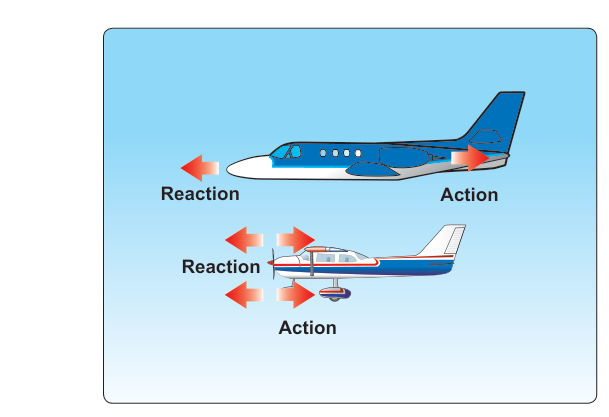
- Third Law (Action-Reaction): For every action force there is an equal and opposite reaction force. The wing pushes air downward; the air pushes the wing upward. That upward push is lift.
The PHAK Chapter 5 presents all three laws as the foundational framework for understanding aerodynamic forces, and a CFI must be comfortable moving fluently among them.
The Core Mechanism: Downwash and Momentum Exchange
The Newtonian model of lift centers on the concept of downwash — the mass of air that a wing deflects downward as it passes through. Here is the step-by-step physical story:
- Airflow approaches the wing. Relative to the wing, a large continuous stream of air is moving horizontally. This air has momentum in the horizontal direction only.
- The wing changes the direction of the airflow. Both the upper and lower camber surfaces, together with the wing's angle of attack, redirect a substantial mass of air so that it leaves the trailing edge with a downward component. This is downwash.
- Change in momentum requires a force (Second Law). Because the air's velocity vector has been altered — specifically, because a downward component has been added — its momentum has changed. A change in momentum per unit time equals a force. The wing exerted that force on the air.
- The reaction force is lift (Third Law). By Newton's Third Law, if the wing pushes the air downward, the air pushes the wing upward with exactly the same magnitude of force. That upward force is aerodynamic lift.
The key insight for instructors is that lift is not a mysterious suction — it is the measurable reaction to momentum that the wing imparts to the air mass passing over and under it.
Angle of Attack: The Pilot's Control Over the Newtonian Mechanism
Angle of attack (AOA) is the angle between the chord line of the wing and the relative wind. In Newtonian terms, increasing AOA increases the amount of downward deflection imparted to the passing air mass, thereby increasing the rate of change of downward momentum, and therefore increasing lift — up to a point.
The PHAK defines the critical angle of attack as the AOA at which the airflow can no longer remain attached to the upper surface of the wing and separates, causing a dramatic loss of lift known as a stall. For most general aviation airfoils this is approximately 16° to 20°, though the exact value varies by airfoil design. A stall is always a function of AOA, not airspeed — a concept that the Newtonian model makes vivid: if the wing is pitched too steeply, the air cannot follow the sharp upper-surface turn and the organized downwash collapses. With no downwash, there is no action, and therefore no reaction (lift).
How the Newtonian and Bernoulli Models Relate
Students sometimes believe the two explanations contradict each other. They do not. The PHAK presents them as complementary descriptions of the same physical phenomenon:
- Bernoulli's principle describes the pressure distribution around the wing: accelerated flow over the curved upper surface produces lower static pressure above the wing; higher pressure below pushes the wing upward. This is a valid, measurable explanation grounded in energy conservation.
- The Newtonian momentum model describes the force balance in terms of mass flow: the wing imparts downward momentum to the air and receives an equal upward reaction. This is equally valid and grounded in momentum conservation.
Both are correct because they are both consequences of the same underlying fluid dynamics. For a CFI, the practical teaching point is this: Bernoulli's principle is excellent for explaining where the pressure differences arise (upper vs. lower surface); Newton's Third Law is excellent for explaining why a net upward force must exist whenever the wing deflects air downward. Together they give students a robust, multi-angle understanding that is far harder to confuse on a test or in a real cockpit situation.
Practical Factors That Affect the Newtonian Lift Equation
Because lift equals the rate of change of downward momentum of the air (F = Δ(mv)/Δt), anything that changes the mass flow rate or the velocity change will change lift. This leads directly to the standard lift factors:
- Airspeed: Higher airspeed means more air mass encounters the wing per second AND each parcel is deflected more rapidly. Per the standard lift equation (L = CL × ½ρV²S), lift increases with the square of airspeed at a constant angle of attack — doubling speed quadruples lift (all else equal).
- Air density: Denser air means more mass per unit volume, so the same wing deflects more mass per second. High altitude, high temperature, and high humidity all reduce density and therefore reduce lift — a critical density altitude consideration.
- Wing area: A larger wing intercepts more air per second, increasing mass flow rate and therefore lift. This is why high-lift devices like flaps increase effective wing area (and camber).
- Angle of attack: Greater AOA deflects each parcel of air further downward, increasing the velocity change component and therefore the momentum transfer — until the critical AOA is reached and flow separation destroys the organized downwash.
- Wing camber and shape: A more cambered airfoil naturally deflects air downward more efficiently at a given AOA, increasing lift for a given speed and air mass.
Teaching This Concept: CFI Strategies
The FAA's Aviation Instructor's Handbook (AIH, FAA-H-8083-9) emphasizes building on what students already know — a technique called building blocks. Most students have felt Newton's Third Law directly: the recoil of a garden hose, the kick of a firearm, the push felt when blowing air from their mouth against a hand. Start there.
A powerful classroom demonstration: ask the student to hold a piece of notebook paper at one end and blow across the top surface — the paper rises, illustrating Bernoulli. Then ask them to hold the paper flat and tilt it slightly into a gentle stream of air from a fan — it rises again, illustrating the Newtonian deflection mechanism. The AIH calls this the use of concrete analogies to bridge from the known to the unknown.
When teaching stalls, the Newtonian model is particularly vivid: "At the critical angle of attack, the wing can no longer organize that downwash. With no air being pushed down, nothing is pushing the wing up. The action-reaction loop breaks." This language often produces a genuine "aha" moment.
Memory Aid
Use the phrase "Push Down, Fly Up" to anchor the Third Law application: the wing's job is to push air down (action), and the reward is that the air pushes the wing up (reaction). Every variable that helps the wing push more air down — more speed, more density, more area, more angle of attack (within limits) — produces more lift. If you can visualize the downwash, you can reason about the lift.
Common Test Traps
- "Lift is caused only by Bernoulli's principle." Wrong — the FAA presents both Bernoulli and Newtonian momentum exchange as valid, complementary explanations. Neither is complete without the other.
- "A stall occurs when airspeed drops below a fixed value." Wrong — a stall is always caused by exceeding the critical angle of attack, regardless of airspeed. The Newtonian model makes this clear: if the wing cannot organize downwash, there is no reaction force, at any speed.
- "Doubling airspeed doubles lift." Wrong — per the standard lift equation, lift varies with the square of velocity at a constant angle of attack, so doubling airspeed quadruples lift (all else equal).
- "Downwash is only relevant to induced drag." Partially true but incomplete — downwash is the very mechanism by which lift is generated in the Newtonian model. The trailing vortex system that causes induced drag is a byproduct of the same spanwise pressure and downwash distribution that produces lift.
- "Newton's Third Law pairs act on the same object." A classic misconception — action-reaction pairs always act on different objects. The wing acts on the air (pushing it down); the air acts on the wing (pushing it up). They are equal in magnitude, opposite in direction, and act on different bodies.