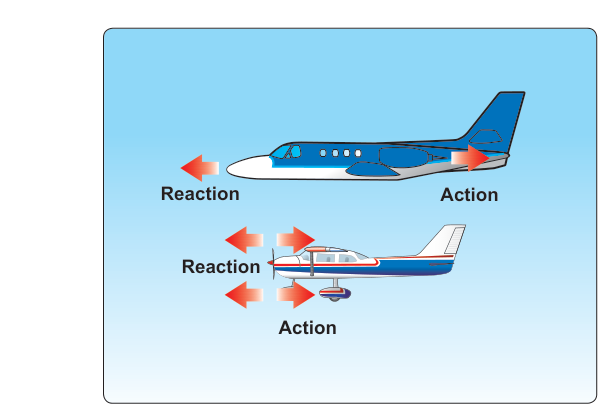
When most student pilots first encounter the concept of lift, they hear about Bernoulli's principle and the idea that air moving faster over a curved upper wing surface creates lower pressure. That explanation is valid and useful, but it tells only part of the story. Newton's Third Law of Motion — for every action there is an equal and opposite reaction — provides a complementary and equally important explanation of how a wing generates the upward force that keeps an aircraft aloft. Understanding both perspectives not only helps you pass the FAA Private Pilot knowledge test, but gives you a much deeper intuition for why aircraft behave the way they do in the real atmosphere.
Newton's Third Law is deceptively simple: whenever one object exerts a force on a second object, the second object exerts an equal force in exactly the opposite direction on the first. Applied to aerodynamics, the "first object" is the wing, and the "second object" is the air mass through which the aircraft moves. The wing continuously deflects air downward — that downward motion of air is called downwash — and the equal and opposite reaction is an upward force on the wing. That upward force is lift.
How Newton's Third Law Produces Lift
To visualize the mechanism, picture a wing slicing through still air at cruise speed. The wing's shape — its camber — and its angle of attack together determine how much the wing bends the oncoming airflow. The leading edge divides incoming air into two streams. Both streams are redirected: the upper stream curves over the cambered top surface and then angles downward behind the trailing edge, while the lower stream is deflected downward more directly by the flat or slightly curved lower surface. The net result is that the wing imparts a downward momentum to a large mass of air with every second of flight.
Here is where Newton's Third Law becomes quantitative. Momentum = mass × velocity. The wing is continuously accelerating a very large mass of air in the downward direction. By Newton's Second Law, a force is required to do that — and by Newton's Third Law, that same force acts back on the wing in the upward direction. The faster the aircraft flies, the more air mass the wing processes per second, and the more downward momentum it imparts — which is why lift increases with airspeed. The steeper the angle of attack (up to a point), the more aggressively the wing bends that air downward, again increasing lift.
You can watch this same principle in action on a much smaller scale. Hold your hand out of a car window with your palm flat and tilted slightly upward into the airflow — your hand is pushed upward. Tilt it more steeply and the upward push increases. Tilt it too steeply and the flow separates from the back of your hand and the smooth lift disappears, replaced by buffeting drag. That is exactly what happens when a wing exceeds its critical angle of attack and stalls.
The Relationship Between Angle of Attack and Downwash
Angle of attack (AOA) is the angle between the wing's chord line and the relative wind — the direction the air is actually coming from relative to the moving aircraft. As AOA increases, the wing deflects air more steeply downward, increasing downwash and therefore increasing lift. This relationship is nearly linear up to a point. The FAA Pilot's Handbook of Aeronautical Knowledge (PHAK) explains that lift increases proportionally with AOA until the critical angle of attack is reached — an airfoil-specific value commonly approximated at around 16–20 degrees for most general aviation wings, though the exact figure depends on the airfoil and aircraft design.
Beyond the critical AOA, the smooth downward deflection of air breaks down. Airflow separates from the upper wing surface, the wing can no longer effectively redirect the air, downwash collapses, and lift drops dramatically. This is an aerodynamic stall, and it is purely an AOA event — it can happen at any airspeed and any attitude, a fact the FAA knowledge test is very likely to probe. Understanding the Newtonian model makes this crystal clear: if the wing cannot redirect air smoothly downward, there is no reaction force pushing the wing up.
Bernoulli and Newton — Two Sides of the Same Coin
It is worth emphasizing that Bernoulli's principle and Newton's Third Law are not competing explanations for lift — they are complementary descriptions of the same physical reality. Bernoulli's principle describes the pressure difference that arises when air accelerates over the curved upper surface; Newton's Third Law describes the momentum exchange between the wing and the air. Both are correct, and both are incomplete on their own. The FAA handbooks present both views precisely because understanding either one in isolation can lead to misconceptions.
One common misconception worth correcting: the old "equal transit time" story — the idea that air molecules split at the leading edge must somehow meet again at the trailing edge, requiring the upper air to move faster — is physically inaccurate. In practice, the upper-surface air generally reaches the trailing edge before the corresponding lower-surface air does, a subtlety not spelled out in detail in the PHAK. The actual reason for the pressure differential is the curvature of the streamlines over the wing (which is correctly explained by both Bernoulli and Newton taken together, not by equal transit time).
Why This Matters for Safe Flight
Grasping the Newtonian model of lift has direct, practical safety implications:
- Stall recognition and prevention: Because a stall is an AOA event and not a speed event, a pilot who understands that lift comes from deflecting air downward immediately grasps why pulling back harder when already slow is dangerous — increasing AOA beyond the critical angle destroys the very mechanism producing lift.
- Load factor and maneuvering: In a banked turn, the wing must produce more total lift to maintain altitude because only the vertical component of lift opposes gravity. To do that, the pilot must increase AOA (or speed). This increases the load factor — the ratio of lift to the aircraft's weight — which is why steep turns can lead to accelerated stalls if back-pressure is applied too aggressively.
- Ground effect: When landing close to the runway, the downwash from the wing is physically constrained by the ground surface beneath the aircraft. The ground prevents the air from flowing as far downward as it normally would, which changes the pressure distribution and allows the wing to generate the same lift at a slightly lower AOA or airspeed. This is why aircraft tend to "float" in ground effect — useful to understand when judging landing flare distance.
- Wake turbulence: The powerful downwash produced by a large, heavy aircraft is the root cause of wingtip vortices and wake turbulence. Those vortices represent the rotating column of air left behind after the wing has pushed enormous masses of air downward. Lighter aircraft following heavy aircraft can be violently upset by these residual momentum fields — which is why FAA wake turbulence avoidance procedures exist.
Key Numbers and Rules
- Lift equation factors: Lift is proportional to the square of airspeed, the coefficient of lift (which reflects AOA and airfoil shape), air density, and wing area. Doubling airspeed quadruples lift — a critical relationship for understanding stall speeds and maneuvering speed.
- Critical AOA: Commonly approximated around 16–20 degrees for general aviation airfoils; the exact figure is aircraft- and airfoil-specific. A stall always occurs at the critical AOA, regardless of airspeed, bank angle, or aircraft attitude.
- Load factor in turns: In a 60-degree banked level turn, load factor doubles to 2 Gs. Stall speed increases proportionally with the square root of the load factor — at 2 Gs, stall speed increases by approximately 41 percent above wings-level stall speed.
- Ground effect height: Ground effect becomes significant when the aircraft is within approximately one wingspan of the ground surface, with the effect increasing markedly as the aircraft gets closer and becoming most pronounced at very low heights, on the order of one-tenth of a wingspan.
Memory Aid
A reliable memory anchor for Newton's Third Law applied to lift is the phrase: "Push air down, wing goes up." Every word carries meaning: Push reminds you that the wing actively does work on the air (it imparts force and momentum). Air down is the downwash — the action. Wing goes up is the equal and opposite reaction — the lift. When you feel the controls in the aircraft and notice the buffet before a stall, you can recall that the wing is losing its ability to "push air down," and the solution is always to reduce angle of attack.
Common Test Traps
- Stall is not just about low airspeed. The FAA knowledge test frequently presents stall scenarios at high speed or unusual attitudes. Remember: a stall occurs when the critical angle of attack is exceeded, period. Airspeed alone does not cause or prevent a stall.
- Confusing angle of attack with pitch attitude. Pitch attitude is the angle of the aircraft's nose relative to the horizon; angle of attack is the angle between the chord line and the relative wind. In a nose-high but descending aircraft, AOA can still be low. In a nose-low, high-speed pull-up, AOA can be very high. These are not the same thing.
- Thinking Bernoulli and Newton are mutually exclusive. Some test questions present both as explanations for lift; both are accepted and correct by FAA standards. Do not dismiss either.
- Forgetting that lift acts perpendicular to the relative wind, not perpendicular to the ground. In a banked turn, the lift vector tilts with the wing, and only its vertical component counters gravity — which is why you need increased total lift (and thus increased AOA or speed) to maintain altitude in a turn.
- Underestimating wake turbulence from the Newtonian perspective. Heavy jets create enormous downwash. The resulting vortices sink and move with the wind. FAA rules require specific spacing and avoidance procedures; knowing why the vortices exist (massive downward momentum transfer) helps you remember those rules intuitively.