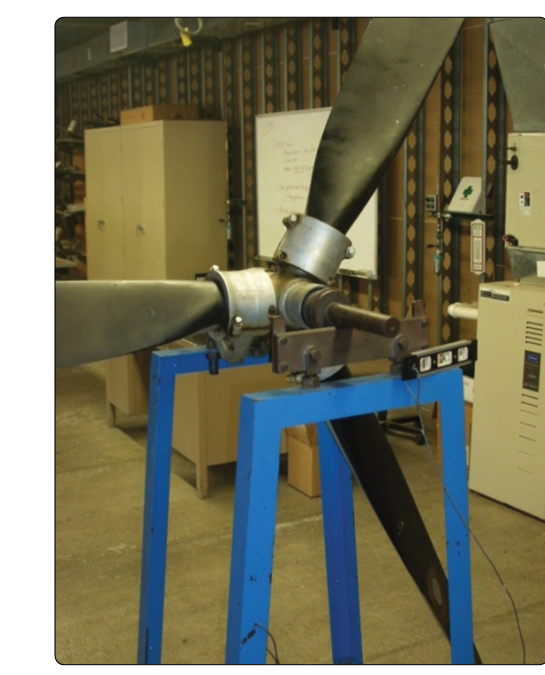
A propeller that is even slightly out of balance generates vibration that ripples through the engine mounts, airframe, and flight instruments with every revolution. At cruise RPM, a small imbalance becomes a relentless cyclic force that accelerates fatigue in crankshaft bearings, engine mounts, and the propeller itself. For AMT candidates and working powerplant technicians, understanding the difference between static and dynamic balancing — and knowing when each is required — is a core competency tested on the FAA Airframe and Powerplant knowledge exams and demanded on the shop floor.
Propeller balancing is not optional maintenance. It is a fundamental part of ensuring airworthiness after any propeller removal, repair, or blade replacement. The FAA's guidelines and accepted industry practice draw a clear distinction between two methods: static balancing, which checks mass distribution while the propeller is at rest, and dynamic balancing, which measures and corrects imbalance while the propeller actually turns at operating speed.
Understanding Propeller Imbalance
Imbalance occurs whenever the center of mass of the rotating assembly does not coincide perfectly with the axis of rotation. Two categories describe the problem. Static imbalance — also called force imbalance — exists when the mass is unequally distributed around the rotational axis in a single plane. If you were to support the propeller horizontally on a frictionless spindle and let it rotate freely, it would rotate until the heavy side came to rest at the bottom. That tendency to find the heavy side is the direct measure of static imbalance.
Dynamic imbalance is fundamentally different and more complex. It arises from unequal mass distribution in more than one plane along the axis of rotation. A propeller can pass a perfect static balance check yet still produce significant vibration during operation because its mass is skewed across its thickness or chord in opposing planes. This type of imbalance creates a couple — a pair of equal and opposite forces that try to tilt the spinning assembly — and it can only be detected and corrected while the propeller is spinning.
Static Balancing: How It Works
Static balancing is performed with the propeller removed from the aircraft and mounted on a mandrel — a precision arbor that fits through the propeller hub bore — placed on a horizontal balancing stand. The stand itself uses knife-edge rails or frictionless ball bearings to allow the propeller to rotate freely with minimal friction. The mandrel must be absolutely level and the rails perfectly horizontal; even a slight tilt will give a false reading.
Once the propeller is placed on the stand, the technician gently rotates it to several positions and observes where it comes to rest. A perfectly balanced propeller has no preferred resting position — it stays wherever it is placed. If one blade consistently rotates to the bottom, that blade assembly is heavier and must be corrected.
Correction of static imbalance is accomplished by adding or removing weight. On wood propellers, small amounts of material may be carefully removed from the heavy blade tip or a small solder or lead plug may be added to a pre-drilled recess in the light blade tip. On metal and composite propellers, most manufacturers specify approved methods such as adding balance weights to the blade tip or hub area, or removing small amounts of material from specific locations as defined in the manufacturer's instructions. No repair or weight addition may exceed the limits defined in the manufacturer's maintenance manual or applicable Airworthiness Directive.
The static balance check is considered satisfactory when the propeller remains stationary in any position after being released from rest. This is sometimes described as the propeller being in a state of indifferent equilibrium. For a two-blade propeller, this check is straightforward. For three- and four-blade propellers, the technician must verify balance in multiple blade combinations to ensure each individual blade is within limits as well as the assembly as a whole.
Dynamic Balancing: How It Works
Dynamic balancing is performed with the propeller installed on the aircraft and the engine running. It requires specialized electronic equipment — commonly a vibration analyzer paired with an accelerometer and a once-per-revolution (1/rev) phase reference sensor, though the FAA handbook does not mandate a specific sensor technology and equipment varies by manufacturer. The accelerometer measures vibration amplitude at the propeller's rotational frequency, while the 1/rev sensor provides a phase reference that tells the analyzer where in the rotation the heavy spot is located relative to a fixed point on the propeller.
The process begins with a baseline run at a stabilized RPM — often a value specified in the balancing equipment's instructions or the aircraft maintenance manual. The analyzer displays vibration magnitude (typically in units of inches per second, or IPS) and phase angle. The technician then adds a test weight to a known location on the propeller hub or spinner backplate and performs another run. By comparing the changes in magnitude and phase between runs, the analyzer calculates the exact mass and angular position required to cancel the imbalance. The technician installs the correction weight, runs the engine again to verify, and repeats the adjustment cycle until vibration falls below the acceptable threshold.
Acceptable dynamic balance vibration thresholds vary significantly by aircraft, engine, and propeller combination and by the balancing equipment manufacturer's guidance — some accept readings up to 0.3–0.5 IPS or specify limits in different units, so there is no single FAA-mandated universal figure. The technician must always apply the specific limit called out in the applicable aircraft, engine, or balancing equipment manufacturer's instructions. After balancing is complete, all added weights must be secured against loosening, and their installation must be documented in the aircraft maintenance records.
Why Both Methods Matter
Static balancing alone cannot correct dynamic imbalance. A propeller that passes a perfect knife-edge static test can still produce significant vibration in flight if its mass is asymmetrically distributed across its planes. This is why dynamic balancing has become the preferred method for final airworthiness verification, particularly after propeller overhaul, blade replacement, or any repair that alters the mass distribution of the assembly.
Conversely, static balancing remains an important first step. Performing a static balance check before a dynamic balance run ensures gross imbalances are corrected inexpensively and quickly, reducing the number of dynamic balance correction cycles needed.
Chronic propeller imbalance has serious consequences: accelerated bearing wear, crankshaft seal failure, fatigue cracking of engine mount structures, instrument damage from vibration, and pilot fatigue from sustained cockpit vibration. Pilots and owners often notice these symptoms — excessive vibration that worsens with RPM, oil leaks that appear after propeller work, or instruments that fail prematurely — before a technician identifies the source.
Key Numbers and Rules
- Static balance standard: Propeller must remain stationary in any position when placed on a frictionless horizontal mandrel and stand — no preferred resting position.
- Dynamic balance target: Varies by aircraft/engine/propeller and balancing equipment manufacturer guidance; there is no single FAA-mandated universal IPS threshold, and the technician must use the applicable manufacturer's specified limit.
- Equipment required for dynamic balancing: A vibration analyzer/calculator paired with an accelerometer and a phase reference sensor; specific sensor technology varies by equipment manufacturer.
- Reference RPM for dynamic runs: As specified by the balancing equipment manufacturer or the aircraft/engine manufacturer — typically a stabilized cruise or high-power setting.
- Weight additions: Must not exceed the limits in the propeller manufacturer's maintenance manual; must be secured against in-flight loosening.
- Applicable FAA reference: FAA-H-8083-32 (Aviation Maintenance Technician Handbook — Powerplant), Chapter 7 covers propeller maintenance and balancing procedures.
- Records requirement: All balancing work, correction weights added, and final vibration readings must be entered in the aircraft maintenance records per 14 CFR Part 43.
Common Test Traps
- Confusing static and dynamic imbalance definitions: Static imbalance is a single-plane mass distribution problem; dynamic imbalance involves multiple planes and can exist even when static balance is perfect. Know both definitions precisely.
- Assuming static balance is sufficient: A propeller can be statically balanced and still vibrate severely in operation due to dynamic imbalance. The exam often tests whether candidates know that dynamic balancing is the definitive check.
- Knife-edge stand must be level: If the balancing stand is not perfectly horizontal, the results are meaningless. The exam may present scenarios where tilted equipment produces a false heavy-blade indication.
- Phase angle matters in dynamic balancing: Adding the correction weight in the wrong angular position can make vibration worse, not better. The vibration analyzer provides both the magnitude of correction needed and the precise angular location — both must be applied correctly.
- Weight limits and approval: Any weight added to a propeller for balance must be within the manufacturer's approved limits. Exceeding these limits, even to achieve perfect balance, is not airworthy and violates 14 CFR Part 43 workmanship standards.