A propeller is far more than a spinning fan bolted to an engine — it is a precisely engineered rotating airfoil whose performance depends critically on the relationship between its blades and the oncoming airflow. Before any technician can intelligently inspect, adjust, or troubleshoot a propeller system, they must command the vocabulary that describes blade geometry. Terms like blade angle, pitch, geometric pitch, effective pitch, and slip appear throughout the FAA knowledge test and, more importantly, throughout the practical work of propeller maintenance. This article builds that vocabulary from the ground up, explaining not just what each term means but why each concept matters for both efficiency and safety.
Understanding these terms also illuminates why variable-pitch propeller systems were developed and why a fixed-pitch propeller is always a compromise. Every concept here is rooted in the Aviation Maintenance Technician Handbook — Powerplant (FAA-H-8083-32) and the Pilot's Handbook of Aeronautical Knowledge (FAA-H-8083-25).
The Propeller Blade as an Airfoil
Each propeller blade is an airfoil, just like a wing, generating lift — but in this case the lift acts forward and is called thrust. The blade has a leading edge, a trailing edge, a cambered face, and a flat or slightly cambered back. Because different sections of the blade travel at different speeds (the tip moves much faster than the root), the blade is twisted along its length. This twist ensures that each section of the blade meets the relative wind at an efficient angle of attack rather than stalling at the tip or being uselessly flat at the root. Understanding the geometry of a single blade cross-section is the key to all pitch and angle terminology.
Blade Angle: The Core Measurement
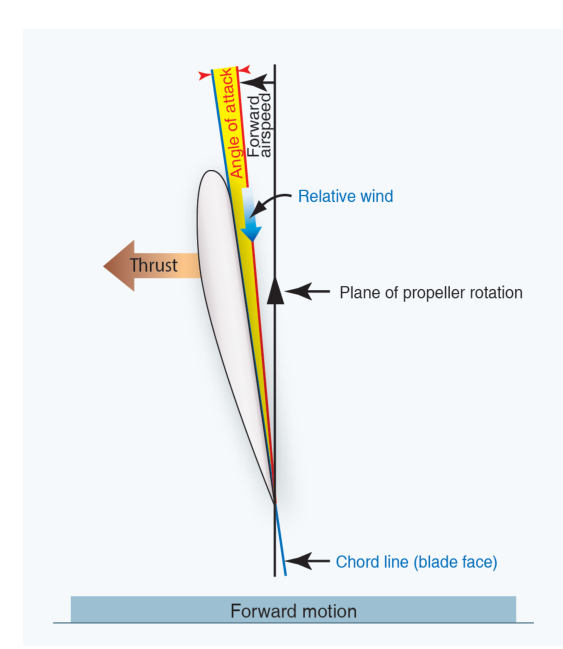
Blade angle (also called the blade pitch angle) is the angle between the chord line of the blade at a given cross-section and the plane of propeller rotation. The plane of rotation is simply an imaginary flat disk perpendicular to the crankshaft axis — the path that the blade tips trace as the propeller spins. Blade angle is always measured in degrees and is stated at a specific reference station along the blade, typically 75% of the propeller radius from the hub. The FAA uses this 75% station as the standard reference point because it represents the location where the blade is doing the greatest share of useful work.
A small blade angle (a flat or low-pitch setting) means the chord line is nearly parallel to the plane of rotation. A large blade angle (a high-pitch or coarse setting) means the chord line is angled more steeply away from that plane. These two extremes correspond to the low-pitch and high-pitch settings of a controllable-pitch propeller.
Pitch Terminology Explained
Geometric Pitch
Geometric pitch is the theoretical distance a propeller would advance forward in one complete revolution if it were screwing through a solid medium — like a wood screw advancing into wood. It is calculated from the blade angle and the circumference swept by the reference station. If the blade angle at the 75% station is known, geometric pitch can be calculated as:
Geometric pitch = 2π × r × tan(blade angle), where r is the radius at the reference station. In practice, technicians rarely calculate this by hand, but understanding that geometric pitch is a purely mathematical, theoretical value — assuming zero slippage — is critical. A blade set at a larger angle has a greater geometric pitch.
Effective Pitch
Effective pitch is the actual distance the aircraft advances forward in one complete propeller revolution. Because air is not a solid, the propeller does not grip it perfectly. The propeller always slips backward relative to its theoretical advance. Effective pitch is therefore always less than geometric pitch under normal powered flight conditions. Effective pitch changes with aircraft speed and flight conditions; it is a real-world, measured quantity rather than a theoretical one.
Propeller Slip
Slip is the difference between geometric pitch and effective pitch, and it represents the inefficiency inherent in moving a propeller through a fluid rather than a solid. Slip is expressed either as a distance or, more usefully, as a percentage:
Slip (%) = [(Geometric pitch − Effective pitch) / Geometric pitch] × 100
A well-designed propeller operating near its design speed might have slip in the range of 10–30%. Slip is not pure waste — some slip is always necessary to generate thrust, just as a wing must generate a downwash to generate lift. Zero slip would mean zero thrust. However, excessive slip indicates poor blade angle selection for the operating condition, propeller damage, or other inefficiencies.
Angle of Attack of the Blade
The blade's angle of attack is the angle between the blade chord line and the relative wind that the blade actually experiences. This relative wind is the vector combination of the rotational velocity of the blade section and the aircraft's forward velocity. Because the propeller is rotating and the aircraft is moving forward, the relative wind approaches the blade from an angle that changes with airspeed and RPM. The blade angle of attack is therefore not the same as blade angle — blade angle is measured from the plane of rotation, while angle of attack is measured from the actual relative wind. This distinction is crucial and frequently tested.
Fixed-Pitch vs. Variable-Pitch Propellers
A fixed-pitch propeller has its blade angle set at the factory and cannot be changed by the pilot or ground crew during normal operations. The manufacturer selects a blade angle that is a compromise between climb performance (which benefits from low pitch) and cruise performance (which benefits from high pitch). A propeller optimized for climb — called a climb propeller — has a relatively small blade angle, allowing the engine to reach higher RPM and develop more power at low airspeeds. A cruise propeller has a larger blade angle, reducing RPM and allowing efficient operation at higher forward speeds but sacrificing initial climb performance.
A variable-pitch (controllable-pitch) propeller allows the blade angle to be changed in flight (or on the ground, depending on the system). The pilot or an automatic governor selects the appropriate blade angle for each phase of flight. Low pitch for takeoff and climb; high pitch for cruise. A constant-speed propeller — the most common type on higher-performance aircraft — uses a governor to automatically vary blade angle to maintain a selected RPM regardless of airspeed or power changes. When more load is placed on the engine (such as during a climb), the governor reduces blade angle slightly to maintain RPM. During a descent or power reduction, it increases blade angle.
High Pitch, Low Pitch, and Feathering
Low pitch (small blade angle) allows higher RPM at a given power setting. The blade bites less air per revolution but spins faster, which is useful for takeoff and initial climb where high thrust at low speed is needed. High pitch (large blade angle) causes lower RPM at a given power setting because each revolution bites more air. This is efficient in cruise flight where forward speed provides a larger contribution to the relative wind angle.
Feathering is a special blade angle position, used only on multi-engine aircraft, where the blade angle is rotated to approximately 90° — nearly parallel to the direction of flight. A feathered blade presents minimum drag to the airstream, which is essential when an engine has failed and the propeller would otherwise windmill and create enormous drag. Feathering is the highest possible blade angle a propeller can reach.
At the opposite extreme, some propellers can move to a reverse pitch position, where the blade angle is negative (past flat pitch in the opposite direction), creating rearward thrust for ground braking on turboprop aircraft.
Key Numbers and Rules
- Reference station for blade angle measurement: 75% of propeller radius from the hub centerline.
- Blade angle is measured from the plane of propeller rotation to the chord line.
- Geometric pitch is always greater than effective pitch (in normal forward flight).
- Slip = Geometric pitch − Effective pitch; expressed as a percentage of geometric pitch.
- Low pitch = high RPM; used for takeoff and climb.
- High pitch = low RPM; used for cruise.
- Feather angle ≈ 90° to the plane of rotation; used to stop windmilling after engine failure on multi-engine aircraft.
- The blade angle of attack changes with both RPM and forward airspeed — a distinction from the fixed blade angle itself.
Common Test Traps
- Confusing blade angle with angle of attack: Blade angle is fixed relative to the plane of rotation; angle of attack is the angle to the actual relative wind and changes constantly with airspeed and RPM.
- Assuming geometric pitch equals effective pitch: They are never equal in real flight. Effective pitch is always less than geometric pitch whenever the propeller is generating thrust.
- Mixing up high pitch and high RPM: High pitch (large blade angle) produces lower RPM, not higher. Low pitch produces higher RPM. This is one of the most common reversals on the knowledge test.
- Thinking slip is always bad: Some slip is unavoidable and even necessary to generate thrust. Zero slip would imply no thrust production.
- Forgetting the 75% station: The FAA specifically uses 75% of propeller radius as the standard blade angle measurement reference. Answers citing the tip or hub are incorrect.