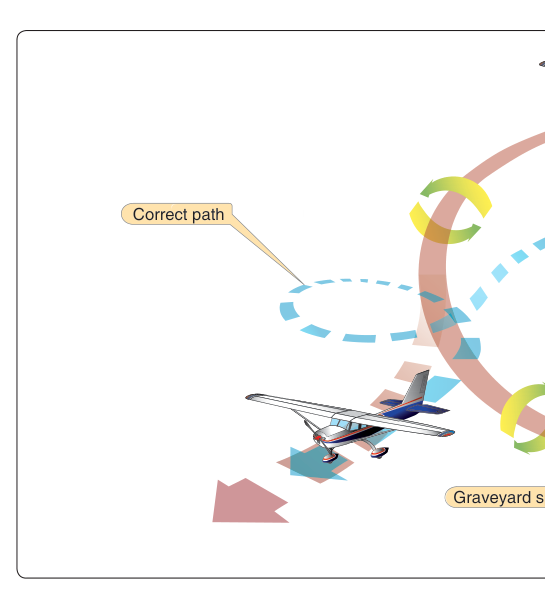
Every year, spatial disorientation contributes to some of the most tragic accidents in general aviation. A pilot flies into clouds, trusts their body's sense of motion rather than the instruments, and within seconds is in a diving, turning spiral they never intended. Two of the most insidious illusions driving these accidents are the somatogravic illusion and the graveyard spiral. Both stem from the same root cause: the vestibular system in your inner ear was never designed to reliably detect the sustained, smooth motions of flight. Understanding exactly how and why these illusions occur gives you the cognitive armor to resist them when your life depends on it.
The FAA's Pilot's Handbook of Aeronautical Knowledge (PHAK) dedicates significant attention to spatial disorientation precisely because it is so common and so lethal. The key insight is this — your body's sense of motion is built to detect changes in acceleration, not steady-state movement. Once a motion becomes constant, your inner ear adapts and the sensation fades, leaving your brain to fill in the blanks with a faulty picture of reality.
How the Vestibular System Works — and Fails
Inside each of your inner ears sits a structure called the vestibular labyrinth, which contains two main sensing systems. The semicircular canals detect rotational acceleration — rolling, pitching, and yawing. The otolith organs (the utricle and saccule) detect linear acceleration and the pull of gravity. Both systems depend on fluid movement and the deflection of tiny hair cells, and both share a critical limitation: they only respond to changes in motion. If acceleration becomes constant — or ceases — the fluid settles, the hair cells return to their neutral position, and the sensation of movement disappears.
This adaptation happens remarkably fast. Sustained turns at a constant bank angle typically cause the sensation of turning to fade away within about 15 to 20 seconds, leaving the pilot feeling straight-and-level even while in a significant bank. When the pilot or autopilot then rolls back to wings-level, the resumption of motion is perceived as a turn in the opposite direction — a completely false sensation called the leans in mild form, or the foundation of the graveyard spiral in more severe form.
The Somatogravic Illusion
The somatogravic illusion involves the otolith organs rather than the semicircular canals. It is triggered by rapid linear acceleration — most classically, a sudden surge of thrust during a go-around, missed approach, or departure in low-visibility conditions.
Here is the mechanism: your otolith organs are designed to sense the downward pull of gravity. When you accelerate forward rapidly, the inertial force pushing you back into your seat adds to the gravitational force pulling you down. The combined resultant force vector tilts backward relative to your body. Your brain interprets this tilted force vector as meaning you are pitched nose-up — sometimes dramatically so, even though you may actually be in a perfectly level or even slightly nose-low attitude.
The instinctive and lethal response is to push forward on the controls to correct the falsely perceived nose-high pitch. In IMC on a missed approach, for example, a pilot who shoves the nose down in response to this illusion — while actually already close to the ground — has almost no margin for recovery. The opposite also occurs: rapid deceleration creates the illusion of pitching nose-down, which can cause a pilot to pull back unnecessarily.
The somatogravic illusion is particularly acute in high-performance aircraft capable of rapid acceleration, but it can affect any pilot in any aircraft during a go-around in instrument meteorological conditions. Recognition and immediate transition to instrument scan are the only reliable defenses.
The Graveyard Spiral
The graveyard spiral is among the most well-documented fatal accident patterns in aviation. It develops through a predictable sequence that the FAA describes in detail in the PHAK.
First, the pilot enters a gradual, undetected bank — often because attention drifted, or because turbulence tilted the aircraft slightly in IMC. Because the bank develops slowly and gradually, below the threshold at which the semicircular canals can reliably sense the rotation, no sensation of turning is felt. The pilot now believes they are wings-level when they are not.
Second, in a bank, lift tilts away from vertical. The aircraft begins to descend. The pilot, sensing the descent on the altimeter or by sound (increasing airspeed), does what any pilot would naturally do — pulls back on the stick or yoke to arrest the descent. But because the wings are banked, pulling back does not recover altitude; it only tightens the turn and increases the load factor. Airspeed continues to build. The spiral steepens.
Third, the pilot may now sense — correctly, though too late without instrument reference — that the aircraft is turning. But because their semicircular canals have adapted to the prolonged bank, rolling to wings-level feels wrong. Rolling to what the instruments show is wings-level feels like entering a turn in the other direction. The powerful, gut-level urge is to roll back into the bank. Pilots who succumb to this urge complete the spiral into the ground.
Structurally, the graveyard spiral involves steadily increasing aerodynamic load — in a 60-degree bank a pilot experiences 2.0 Gs, and in a 75-degree bank nearly 3.86 Gs. As the bank steepens and the pilot continues to pull, airspeed builds rapidly. The aircraft may ultimately exceed its structural limits or simply impact terrain before the pilot can interpret what is happening.
Why These Illusions Matter: The Fatal Chain
Spatial disorientation is consistently cited by the NTSB and FAA as a contributing factor in a significant proportion of fatal general aviation accidents, particularly those involving VFR-into-IMC flight. The graveyard spiral and somatogravic illusion are dangerous precisely because they are not rare corner cases — they lurk in any situation where a pilot loses outside visual reference. The FAA Risk Management Handbook emphasizes that physiological hazards like spatial disorientation must be addressed through both aeronautical knowledge and disciplined cockpit behavior. Knowing the illusion exists is necessary but not sufficient; the pilot must also be trained to override the instinct to trust body feel over instruments.
Key Numbers and Rules
- Detection threshold for rotation: The semicircular canals cannot reliably detect slow, gradual bank changes developing at low rates, such as those produced by turbulence or inattention. The PHAK and IFH do not specify a single precise numeric threshold, but describe this inability as a well-established limitation of the vestibular system.
- Adaptation time: Within about 15 to 20 seconds of constant-rate turning, most pilots lose the sensation of turning entirely.
- Load factor in a 60° bank: 2.0 G — double normal weight; adds to pilot workload and structural stress.
- Leans: The mildest form of vestibular illusion; pilot feels tilted even after returning to wings-level flight — often the first warning sign that the vestibular system is being fooled.
- Instrument proficiency: 14 CFR 61.57 requires instrument currency (6 approaches, holds, intercepting and tracking courses within 6 calendar months) for legal IFR flight — but any pilot flying in reduced visibility needs a solid instrument scan even under VFR rules.
- Somatogravic trigger: Rapid forward acceleration (e.g., go-around power application) creates false pitch-up sensation; rapid deceleration creates false pitch-down sensation.
Defending Yourself: Practical Cockpit Strategies
The FAA's guidance is clear: trust your instruments, not your body. This is easier said than done because the vestibular illusion feels completely real and compelling. Here is how to build the habits that save lives:
Maintain a continuous instrument scan. In any reduced-visibility condition — even patchy clouds or nighttime flight over dark terrain — treat yourself as an instrument pilot. Scan attitude, heading, airspeed, altitude, and vertical speed in a systematic pattern. The earlier you catch a developing bank on the attitude indicator, the less adaptation the semicircular canals have time to complete.
On a go-around or missed approach, resist the urge to push forward. When you apply full power, consciously remind yourself that the pitch-up sensation is likely the somatogravic illusion. Fix your eyes on the attitude indicator and fly the numbers.
If you feel the leans, do not chase them. Set the wings level by reference to the attitude indicator and hold them there. The false sensation will eventually fade as your vestibular system re-adapts — but it may take a minute or more, during which you must intellectually override the urge to roll.
Memory Aid
UNOS — a simple reminder for recovering from suspected spatial disorientation: Unload (reduce back pressure to break the spiral and reduce G-load), Needle (center the turn coordinator or set wings-level on the attitude indicator), Outside reference lost (accept you cannot trust body feel), Scan (return to and trust the instrument panel). While this is not a universal FAA-published mnemonic, the underlying principle — check and trust your instruments before acting on body sensations — is the FAA's primary recommendation throughout the PHAK aeromedical chapter.
Common Test Traps
- Confusing the two illusions: The somatogravic illusion involves linear acceleration and the otolith organs (false pitch sensation); the graveyard spiral involves rotational adaptation in the semicircular canals (false bank/level sensation). Know which organ drives which illusion.
- Thinking the graveyard spiral only affects IFR pilots: Any pilot who loses visual reference — including a VFR pilot inadvertently entering a cloud — is at risk. The FAA tests this broader context.
- Assuming pulling back recovers altitude in a spiral: In a banked spiral, pulling back increases G-load and tightens the turn without recovering altitude. The correct first step is to level the wings, then apply back pressure.
- Underestimating the leans: The leans are not just uncomfortable — they are a warning sign that the vestibular system is unreliable. Many pilots try to