Imagine you're cruising on a dark night with no visible horizon. You enter a gradual bank so slowly that your inner ear never notices the turn beginning. After a minute in the bank, you level the wings — and suddenly your body insists the airplane is banking the other way. You feel a powerful urge to roll back into the original turn just to feel "level" again. That sensation is the leans, one of the most common and insidious forms of spatial disorientation in aviation. Understanding exactly why it happens — and what to do when it does — is essential for every pilot who will ever fly in reduced visibility or at night.
The leans belong to a family of vestibular illusions that emerge from the way our balance organs evolved. Those organs were built for walking and running on a planet's surface, not for maneuvering a three-dimensional vehicle at altitude. When the environment removes the visual cues that normally dominate our orientation, the inner ear takes over — and it can be dangerously wrong.
How the Inner Ear Works (and Why It Fails Pilots)
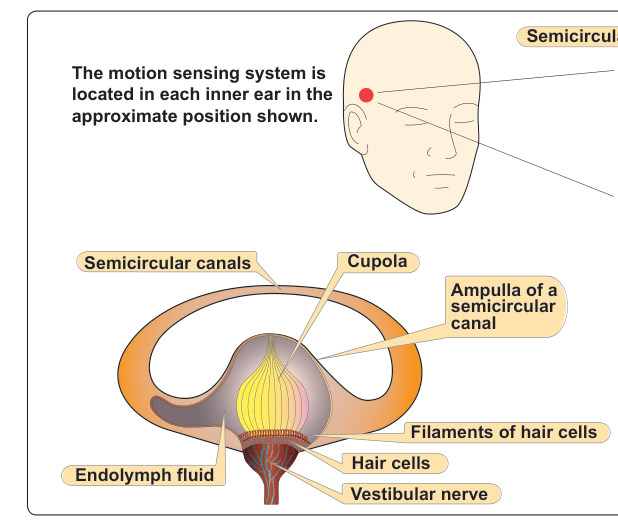
Deep inside each ear lies a structure called the vestibular labyrinth, which contains two main sensor types. The otolith organs (the utricle and saccule) detect linear acceleration and gravity. The semicircular canals — three fluid-filled loops arranged roughly at right angles to one another — detect rotational movement. When you tilt or roll, the fluid (endolymph) inside the canals lags behind the canal walls due to inertia, bending a set of hair cells and signaling the brain: "we are rotating."
Here is the critical flaw for pilots: the semicircular canals only detect change in rotation. Once a rotation has been sustained for roughly 10 to 20 seconds, the endolymph catches up with the canal walls, the hair cells return toward their neutral position, and the sensation of turning fades — even though the turn is still happening. The brain concludes: "We have stopped turning. This is straight and level." This fading-sensation phenomenon is a form of vestibular (canal) adaptation, and its most common flight manifestation is the leans. It is a distinct mechanism from the somatogravic illusion, which arises from the otolith organs responding to linear acceleration rather than from canal adaptation.
How the Leans Actually Happen — Step by Step
The classic sequence unfolds like this:
- Subthreshold entry: The pilot enters a bank at a rate below approximately 2 degrees per second — slow enough that the semicircular canal fluid never generates a detectable signal. The brain registers no turn.
- Canal adaptation: Even in a slightly faster bank, if the bank is sustained beyond 10–20 seconds, the fluid catches up and the turning sensation fades. The brain re-registers the banked attitude as "wings level."
- Sudden correction: ATC calls, an instrument scan shows a 30-degree bank, or the pilot notices attitude indicator disagreement. The pilot rolls the wings back to level flight.
- False rotation signal: Rolling from the banked attitude back to true wings-level generates a definite rotational signal — but the brain interprets it as rolling in the opposite direction from the original bank. The pilot now feels as though the airplane is banking hard the other way.
- The leans: The pilot knows intellectually (instruments say) the airplane is level. But every fiber of their body insists it is banked. To relieve the sensation, the pilot may lean their torso in the direction of the original (false) "level" attitude — hence the name. Some pilots even unconsciously apply control inputs toward the original bank to resolve the conflict.
The Pilot's Handbook of Aeronautical Knowledge (FAA-H-8083-25) identifies the leans as the most common form of spatial disorientation in instrument meteorological conditions and recognizes it as a significant contributor to loss-of-control accidents.
Related Vestibular Illusions
The leans rarely exists in isolation. Pilots should know the related illusions that can compound it:
- Graveyard spiral: A sustained, undetected bank leads to a nose-low spiral. When the pilot pulls back to recover altitude without first leveling the wings, the bank tightens and the descent rate accelerates. This is a leading cause of IMC loss-of-control fatalities.
- Coriolis illusion: If a pilot turns their head rapidly while in a prolonged turn, the sudden movement stimulates multiple semicircular canals simultaneously, producing a tumbling or rolling sensation. It can be severely disorienting and even nausea-inducing.
- Graveyard spin: Analogous to the graveyard spiral but in autorotation — the pilot stops sensing a spin after adaptation and, upon recovery, feels a spin in the opposite direction, potentially re-entering the spin.
- Somatogravic illusion: Rapid acceleration (common at takeoff) stimulates the otolith organs in the same way that a nose-high pitch attitude would, creating a false sense of pitching up. The pilot may push forward on the controls — a deadly hazard at low altitude.
Why the Leans Matter: Safety and Statistics
Spatial disorientation is not a minor inconvenience. The FAA and NTSB consistently cite it as a factor in a disproportionate number of fatal general aviation accidents. The majority of disorientation accidents occur at night or in IMC — exactly the conditions that strip away the outside visual references the brain normally depends on to override inner-ear signals. A fully instrument-rated, experienced pilot is not immune; because the leans stems from basic physiology, no amount of experience eliminates the sensation. Experience only teaches you to distrust it.
The critical danger of the leans is not the lean itself — it is the pilot's behavioral response. A pilot who unconsciously banks back toward the "comfortable" attitude, or who focuses attention on the disorienting sensation rather than the flight instruments, can rapidly lose situational awareness and aircraft control.
Key Numbers and Rules
- ~2°/second — approximate threshold below which the semicircular canals may not detect a roll rate entry (subthreshold stimulation).
- 10–20 seconds — approximate time for endolymph to reach equilibrium with the canal walls in a sustained turn, causing rotation sensation to fade.
- Visual dominance — under normal daylight VFR conditions, visual cues override vestibular signals. This protection disappears in IMC or night conditions with no visible horizon.
- Trust the instruments — FAA-H-8083-25 explicitly states that when spatial disorientation occurs, the pilot must rely on flight instruments rather than body senses.
- Instrument currency (14 CFR 61.57(c)) — to act as PIC under IFR or in IMC, a pilot must have performed, within the preceding 6 calendar months, at least 6 instrument approaches, holding procedures and tasks, and intercepting and tracking courses through the use of navigation systems. This requirement exists partly because instrument scan skills erode rapidly, leaving pilots more vulnerable to disorientation.
Memory Aid
Many instructors use the phrase "Trust the gauges, not your feelings" as a quick reminder. A more structured mnemonic for spatial disorientation survival is the "3 Ds":
- Detect — Recognize that disorientation may be occurring. If an instrument shows one thing and your body says another, believe the instrument.
- Diagnose — Identify which illusion is likely at work (the leans, somatogravic, Coriolis, etc.).
- Defeat — Apply the correct recovery: level the wings using the attitude indicator, maintain a disciplined instrument scan, and resist the urge to move controls in response to bodily sensations.
Practical Cockpit Strategies
The antidote to the leans is disciplined, prioritized instrument flying. The FAA recommends the following practical measures:
- Establish and maintain an instrument scan before entering any conditions that reduce outside visibility. Waiting until you're already disoriented to start instrument flying is too late.
- Resist the urge to "feel" level. When the leans strike, acknowledge the sensation (fighting it mentally exhausts attention) but consciously refuse to act on it. Many pilots find it helps to verbalize: "The instruments show wings level. I accept that." The sensation usually fades within seconds to a minute as the canals re-adapt.
- Avoid unnecessary head movements in IMC. Turning the head sharply while already in a bank dramatically increases the risk of triggering the Coriolis illusion on top of the leans.
- Use the autopilot if available and legal. Engaging the autopilot can stabilize the aircraft while the pilot resolves disorientation, provided the autopilot is functioning correctly and the pilot monitors it.
- Declare an emergency if necessary. Spatial disorientation is a genuine emergency. ATC can provide radar vectors, and admitting the situation is always better than pressing on while impaired.
Common Test Traps
- "The leans are caused by the eyes." Wrong — the leans are a vestibular (inner ear) illusion caused by the semicircular canals, not by visual misinformation. Visual illusions are a separate category.
- "An experienced pilot won't experience the leans." Wrong — the physiology is universal. Experience changes the pilot's response, not the sensation itself.
- "The correct response is to push through the sensation by using aggressive control inputs." Wrong — aggressive inputs can over-correct or induce other upsets. Smooth, instrument-referenced corrections are correct.
- "Spatial disorientation only happens in IMC." Wrong — it can occur in haze, rain, darkness, featureless terrain (white-out, blue-out), or any condition that degrades outside visual reference.
- Confusing the leans with the somatogravic illusion. The somatogravic illusion involves a false pitch-up sensation from linear acceleration, not a false bank from rotational canal adaptation. Both are vestibular illusions, but the mechanisms and scenarios differ.