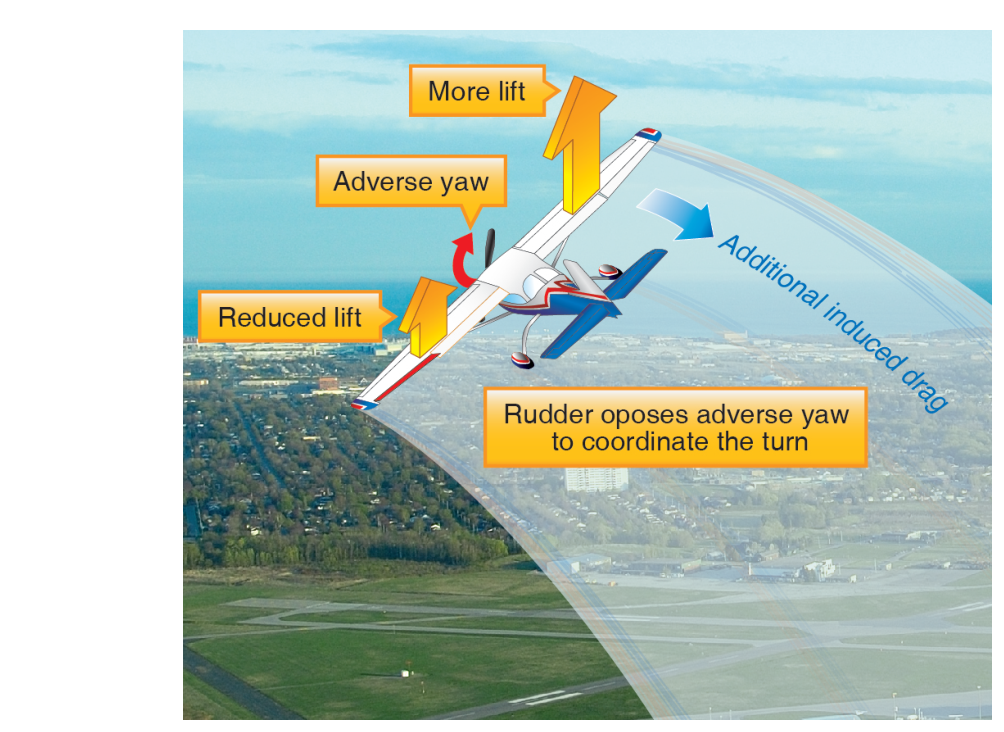
Every time you deflect the ailerons to begin a bank, something counterintuitive happens: the aircraft momentarily wants to yaw in the wrong direction. This phenomenon is called adverse yaw, and understanding it is essential for any pilot—but especially for those flying light-sport and recreational aircraft at lower airspeeds, where the effect is more pronounced and the consequences of ignoring it are more serious.
Here is what is happening aerodynamically. When you roll right, the left aileron goes down and the right aileron goes up. The downward-deflected aileron on the left wing increases that wing's camber and lift—but it also significantly increases drag on that same wing. The right wing, with its aileron raised, produces less lift and less drag. The result is a drag imbalance: the left wing is dragging more than the right, pulling the nose to the left even as you are trying to turn right. That leftward pull is adverse yaw. The fix is coordinated rudder input—in this case, right rudder—applied simultaneously with aileron deflection to counteract that drag imbalance and keep the nose tracking smoothly through the turn.
Why it matters
Adverse yaw is always present during aileron input, but its significance grows dramatically at low airspeeds. At slow speeds, control surfaces are less effective, the relative wind is reduced, and any yawing tendency requires a larger rudder correction to overcome. In light-sport aircraft, which are often lighter and have longer wingspans relative to their weight, adverse yaw can be quite noticeable even during gentle aileron inputs.
The most dangerous scenario occurs when a pilot allows adverse yaw to go uncorrected in a skidding turn. A skid means the aircraft is yawing faster than it is banking—the ball in the inclinometer slides to the outside of the turn. In a skidding turn at low altitude and slow airspeed, such as during a base-to-final turn, the outside wing can stall first. This asymmetrical stall creates a rapid, uncommanded roll toward the stalled wing—the classic skidding stall/spin entry. This is one of the leading causes of fatal accidents in the traffic pattern. Proper rudder coordination is literally a life-saving skill.
Conversely, a slipping turn occurs when the aircraft is banked more than the rate of turn warrants—the ball slides to the inside of the turn. While a slip is generally less dangerous than a skid, it still represents uncoordinated flight and degrades efficiency. The goal is always to keep the ball centered: coordinated flight means the lift vector is aligned properly, drag is minimized, and the aircraft responds predictably.
The standard instrument for monitoring coordination is the slip/skid indicator (commonly called "the ball"). A simple rule governs its correction: step on the ball. If the ball is displaced to the right, apply right rudder pressure to bring it back to center. This muscle memory must become second nature.
Memory aid
"Step on the ball" — Whatever direction the ball slides, apply rudder pressure on that same side to re-center it. This is one of the most time-honored memory aids in aviation and directly reflects the physical correction needed.
For remembering why adverse yaw occurs, think: "Down aileron = more drag = nose goes that way." The wing generating more lift also generates more drag, and that drag pulls the nose opposite your intended turn.
Common test traps
- Adverse yaw direction: Adverse yaw pulls the nose toward the rising wing (the wing with the aileron going down is the high-lift, high-drag wing). Students often confuse which way the nose yaws. Remember: the nose yaws toward the wing with the raised aileron (the rising wing), not the wing with the down-going aileron.
- Skid vs. slip: A skid (ball to the outside, too much rudder or insufficient bank) is more dangerous at slow speeds than a slip because it can lead to a spin entry. Do not confuse the two on the test.
- "Step on the ball" direction: You apply rudder on the same side as the ball's displacement—not the opposite side. Applying opposite rudder makes the coordination worse.
- Low speed amplifies the effect: Test questions may ask when adverse yaw is most significant. The answer is at low airspeeds, where aerodynamic forces are reduced and yawing tendencies are harder to overcome with less-effective control surfaces.