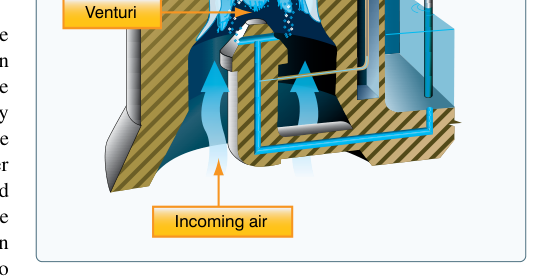
How a Float-Type Carburetor Works
Nearly every Light-Sport Aircraft (LSA) certified under 14 CFR Part 21 and flown under Sport Pilot privileges uses a horizontally-opposed, air-cooled reciprocating engine fed by a float-type carburetor. Understanding how this system works is the foundation for understanding why carburetor ice is such a persistent danger.
The float-type carburetor has two primary jobs: measure the correct amount of air entering the engine and mix that air with the right quantity of fuel. Air enters through the air intake and passes through a narrow section called the venturi. According to Bernoulli's principle, as air speeds up through the venturi, its pressure drops. This low-pressure zone sits just above a small orifice called the main metering jet, which connects to the float chamber below. Because atmospheric pressure acts on the fuel in the float chamber while low pressure exists at the jet, fuel is pushed upward into the airstream, where it atomizes and mixes with the incoming air before being delivered to the intake manifold and cylinders.
The float itself is a hollow pontoon that rides on the surface of the fuel in the bowl. As fuel is consumed and the level drops, the float falls, opening a needle valve that allows more fuel in from the fuel supply line. When the level is restored, the float rises and closes the valve. This elegant mechanical feedback loop keeps fuel level — and therefore the fuel-to-air ratio — remarkably stable across a range of engine demands.
The throttle plate (also called the throttle valve or butterfly valve) sits downstream of the venturi and controls the volume of the air-fuel charge reaching the cylinders. Pushing the throttle forward opens the plate; pulling it back restricts airflow, reducing power. In LSA engines, this single plate is your primary power control during flight.
The Idle Circuit and Mixture Control
At low power settings, the pressure drop across the main venturi is too small to draw adequate fuel from the main jet. The carburetor therefore has a separate idle circuit with its own jet, positioned just downstream of the throttle plate where low pressure still exists at idle. This is why the engine can run smoothly at idle even though the main metering system is barely active.
Most LSA carburetors also feature a mixture control, a needle valve that can lean (reduce) or enrich (increase) the fuel supplied to the main jet. As altitude increases, air becomes less dense, so the same volume of air weighs less. Without leaning, the engine receives too much fuel relative to available oxygen and runs rich, losing power and wasting fuel. Leaning the mixture by pulling the mixture control aft restores the proper ratio. The FAA Pilot's Handbook of Aeronautical Knowledge (PHAK) generally references leaning during cruise at altitudes above approximately 5,000 feet density altitude, rather than a fixed MSL threshold (always check the Pilot's Operating Handbook or aircraft flight manual, since manufacturers may specify different thresholds).
How and Why Carburetor Ice Forms
Carburetor ice is one of the most insidious hazards in aviation precisely because it can form in weather that feels benign — even on a clear, warm day. There are two physical mechanisms at work simultaneously inside the carburetor throat.
1. Refrigeration effect (fuel vaporization cooling): When liquid fuel is sprayed into the airstream and vaporizes, it absorbs a significant amount of heat energy from the surrounding air — the same principle that makes a swamp cooler work. This can reduce local air temperature in the venturi by as much as 30°F (about 17°C).
2. Pressure drop cooling: The venturi itself causes a pressure drop. As pressure drops, temperature also drops (as described by the relationship between pressure and temperature in gas laws). This effect can contribute an additional temperature reduction, compounding the cooling from fuel vaporization.
Together, these two effects can drop the temperature inside the carburetor far enough to freeze water vapor out of the incoming air, even when the outside air temperature (OAT) is well above freezing. According to the PHAK, carburetor ice can form with OAT as high as 70°F (21°C) and relative humidity as low as 50%. The ice deposits on the throttle plate, the venturi walls, and especially around the low-pressure zones. As ice accumulates, it restricts airflow, richens the mixture, and progressively robs the engine of power — often without any dramatic warning sign.
The Danger Zone: Power Setting and Humidity
Carburetor ice is most likely to form at low to mid power settings — precisely the power range used during cruise, descents, and the traffic pattern. At lower throttle settings, the throttle plate is nearly closed, meaning the pressure drop behind it is especially pronounced, and the engine's reduced heat output means less warmth is available to prevent or melt ice. High humidity and temperatures between roughly 20°F and 70°F OAT create the classic risk window, but pilots should remember that any temperature and humidity combination that puts the carburetor throat temperature below 32°F (0°C) is dangerous.
Recognizing Carburetor Ice in Flight
In an aircraft with a fixed-pitch propeller (the most common configuration in LSA), the first and most reliable sign of carburetor ice is an unexplained drop in engine RPM with no change in throttle position. The engine will sound rougher as the mixture is disrupted, and if ice continues to build, RPM will continue to fall. In an aircraft with a constant-speed propeller, ice is indicated by a loss of manifold pressure rather than RPM, since the propeller governor compensates to maintain RPM. Most LSA use fixed-pitch propellers, so watch the tachometer.
Severe carburetor ice can ultimately cause complete engine failure. Because the symptoms are gradual, pilots who are unfamiliar with the hazard may not react until the situation is critical. This is why preventive application of carburetor heat is strongly preferred over reactive use.
Carburetor Heat: How It Works and How to Use It
Every certificated carburetor-equipped aircraft must have a carburetor air heat system. A valve in the air intake box selects between ambient air (the normal, filtered intake) and a alternate air source that passes through a heat muff — a shroud wrapped around the exhaust pipe. The exhaust pipe is extremely hot, and this heat muff transfers heat to the incoming air before it enters the carburetor throat. The heated air raises the temperature inside the carburetor above the freezing point, preventing ice formation or melting ice that has already formed.
When carburetor heat is applied to an engine that is not iced, the pilot will notice a slight RPM drop. This is normal and expected: the heated air is less dense than ambient air, so the engine receives a slightly leaner, less dense charge, producing marginally less power. When carburetor heat is applied to an engine that is iced, the initial response is a further RPM drop (as ice melts and temporarily passes through as water, momentarily disrupting combustion) followed by a recovery and rise in RPM above the iced level — a clear sign that ice was present and has been cleared.
The POH or AFM for each LSA specifies when to apply carburetor heat. Common practice includes applying full carburetor heat during descent, during slow flight, in the traffic pattern, before landing, and anytime icing conditions are suspected. Do not use partial carburetor heat as standard practice — partial heat can raise carburetor temperature into the prime icing range without being warm enough to melt ice that forms. Use full carburetor heat as directed by the manufacturer.
Memory Aid
To remember when to reach for the carb heat knob, use the phrase "DISC" — Descent, Icing conditions, Slow flight, Circuit (traffic pattern)". Each of these represents a phase of flight where power is reduced and ice risk is elevated. In each phase, confirm carb heat is applied per the POH before reducing power significantly.
Carburetor Heat and Engine Leaning
Applying carburetor heat enriches the mixture because the less-dense hot air effectively increases the fuel-to-air ratio. If you apply carb heat during cruise while already leaned, the mixture can become excessively rich, causing rough running. The FAA recommends that when applying carburetor heat at cruise altitude, pilots enrich the mixture slightly or return the mixture to full rich to compensate. Always follow the specific guidance in the POH.
Common Test Traps
- "Carb ice only forms in cold weather." FALSE — OAT can be as warm as 70°F (21°C) and ice can still form. Temperature inside the carburetor depends on vaporization cooling and the venturi pressure drop, not just outside air temperature.
- "A slight RPM drop when carb heat is applied means something is wrong." FALSE — A small RPM drop with carb heat on a non-iced engine is completely normal because the heated air is less dense.
- "If RPM drops and then rises after applying carb heat, that means it's not working." FALSE — The drop-then-rise pattern is actually the correct indication that ice was present and has been melted. It confirms carb heat is working properly.
- "Use partial carb heat to be safe." FALSE — Partial heat is potentially more dangerous because it can elevate carburetor temperature into the prime icing range without being hot enough to melt ice. Use full carb heat as directed.
- "Carb ice is most likely at full power." FALSE — Low to mid power settings create the greatest risk because the throttle plate is nearly closed, maximizing the pressure drop and reducing engine heat available to warm the induction system.