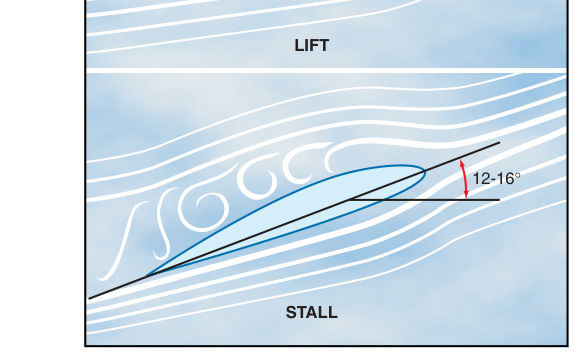
Every flight in a light-sport aircraft (LSA) is governed by one deceptively simple variable: angle of attack (AOA). Whether you are climbing out of a grass strip, maneuvering in the traffic pattern, or recovering from turbulence, the wing's attitude relative to the oncoming air determines whether it keeps flying or abruptly stops producing lift. Understanding AOA at a deep, operational level is one of the most important things a Sport Pilot certificate candidate can do—not just for the knowledge test, but for a lifetime of safe flying.
Defining Angle of Attack
AOA is the angle between the wing's chord line—an imaginary straight line drawn from the leading edge to the trailing edge—and the relative wind, which is the airflow moving opposite to the aircraft's actual path of travel through the air mass. It is absolutely not the same as pitch attitude. Pitch attitude is measured relative to the horizon; AOA is measured relative to where the aircraft is actually going. These two quantities can diverge dramatically.
Consider a pilot pulling abruptly out of a steep dive: the nose may still be pointed below the horizon, yet the relative wind is now angled even further downward because of the dive trajectory. The difference between chord line and relative wind—the AOA—can spike high enough to trigger a stall even though the attitude looks nose-low. The same phenomenon occurs in the base-to-final turn when a pilot over-banks and hauls back on the stick: attitude looks survivable, but AOA is at or beyond the critical angle. This is the classic accelerated stall that kills pilots near the ground.
How Wings Generate Lift
Lift is not produced by one mechanism alone; it is the result of two complementary physical principles working in concert. First, Bernoulli's principle: the curved (cambered) upper surface of a wing forces air to travel a longer path than the flatter lower surface, accelerating the upper airflow and reducing its static pressure. The pressure difference between the lower (higher pressure) and upper (lower pressure) surfaces produces a net upward force. Second, Newton's third law: the wing deflects air downward as it passes; the air pushes back upward on the wing with equal force. Both effects are real and both contribute to lift. As the FAA's Pilot's Handbook of Aeronautical Knowledge (PHAK, FAA-H-8083-25) explains, practical lift generation relies on this combined action of pressure differential and air mass deflection.
The lift equation formalizes the relationship: Lift = CL × ½ρV² × S, where CL is the coefficient of lift, ρ is air density, V is airspeed, and S is wing area. AOA directly controls CL. As AOA increases from zero, CL climbs in a nearly linear fashion. Eventually, CL reaches its maximum—at the critical angle of attack—and then falls sharply. That sudden drop in CL is the aerodynamic stall.
The Critical Angle of Attack and the Stall
The critical angle of attack for most general aviation airfoils falls roughly in the range of 15 to 20 degrees above the chord line, depending on airfoil design and camber. Beyond that point, the smooth, attached airflow separating around the upper surface can no longer follow the wing's contour. It separates from the upper surface, becoming turbulent and detached. The low-pressure region collapses, and lift drops dramatically while drag spikes. The aircraft is stalled.
The single most important thing to memorize: a stall can occur at any airspeed, any altitude, and any pitch attitude whenever the critical angle of attack is exceeded. This is stated plainly in the PHAK. An aggressive pull at cruise speed—an accelerated stall—exceeds the critical AOA just as effectively as flying too slowly in level flight. The stall speed published in the Pilot's Operating Handbook (POH) represents the minimum calibrated airspeed at which the aircraft can maintain level flight at maximum gross weight, wings level, in the landing configuration. Any deviation from those conditions changes the actual stall speed.
LSA-Specific Limits and Why They Matter
Light-sport aircraft certified under ASTM International consensus standards (with LSA definitions found in 14 CFR Part 1 and the Sport Pilot certificate governed by 14 CFR Part 61, Subpart J, and operating rules in Part 91) are subject to specific design limits that make AOA awareness especially critical. Part 103 governs ultralight vehicles, which are a separate category from light-sport aircraft. Key regulatory parameters include:
- Maximum gross weight: 1,320 lb (600 kg) for land-based LSAs; 1,430 lb (650 kg) for seaplanes.
- Maximum stall speed: 45 knots calibrated airspeed (KCAS) in the landing configuration. This is a certification ceiling—many LSAs stall well below it.
- Maximum airspeed (VH): 120 knots calibrated airspeed in level flight at maximum continuous power.
Because LSAs are light, many have relatively modest wing areas and simple airfoils. Small changes in weight, configuration, or bank angle produce proportionally larger changes in effective stall speed than they might in a heavier aircraft with a larger wing. The pilot flying an LSA near maximum gross weight on a hot day at a high-elevation airport is dealing with reduced air density (lower ρ, meaning V must increase to maintain the same dynamic pressure and lift), a higher actual stall speed, and reduced climb performance—all simultaneously.
Load Factor, Bank Angle, and Accelerated Stalls
Load factor (expressed in Gs) has a direct, mathematically precise relationship with stall speed. In a coordinated, level turn, the wing must produce enough vertical lift to support the aircraft's weight and enough horizontal component to change direction. The resulting load factor equals 1 divided by the cosine of the bank angle. At 60 degrees of bank, load factor reaches 2.0 Gs. The accelerated stall speed equals the unaccelerated stall speed multiplied by the square root of the load factor. At 2 Gs, that multiplier is approximately 1.41—meaning stall speed rises about 41 percent above the wings-level value.
For an LSA with a wings-level stall speed of 40 KCAS, a 60-degree banked level turn raises the effective stall speed to roughly 56 KCAS. If that same pilot is also slow and distracted in the traffic pattern—a tragically common scenario—there may be almost no margin between current airspeed and the accelerated stall speed. The PHAK devotes significant attention to this exact situation because it is one of the leading causes of fatal general aviation accidents.
Flaps, CG, and Their Effect on AOA
Extending flaps increases the wing's camber, which raises the CL achievable at a given AOA. The practical result is that the aircraft can maintain level flight at a lower airspeed for the same AOA—or at a lower AOA for the same airspeed. This is why deploying flaps reduces stall speed, enabling slower, safer approach speeds. However, flaps also increase drag substantially, and at full deflection the dominant effect shifts toward drag rather than lift. Full flaps are optimized for steep, slow approaches—not for maximizing lift coefficient.
Center of gravity (CG) position has a subtler but equally important effect. An aft CG reduces the nose-down pitching moment, requiring less up-elevator to hold a given AOA. This makes the aircraft pitch-sensitive and degrades the natural nose-drop stall warning that a more forward CG provides. An LSA loaded at the aft CG limit may enter a stall with less aerodynamic warning than the pilot expects—and may exhibit a flatter, harder-to-recover stall attitude. Always verify CG is within limits before flight.
Key Numbers and Rules
- Critical AOA: approximately 15–20 degrees for most light-aircraft airfoils; the specific value for a given LSA is determined by its airfoil design.
- LSA maximum stall speed (landing configuration): 45 KCAS per ASTM standards.
- Load factor in a 60° banked level turn: 2.0 Gs; stall speed increase: approximately 41%.
- Stall speed scales with the square root of load factor—double the Gs, multiply stall speed by about 1.41.
- Density altitude reduces lift: as density altitude rises, indicated/calibrated stall speed remains essentially the same, but the true airspeed at which the stall occurs increases—so on a hot, high-elevation day the aircraft is actually moving faster through the air at the moment of stall even though the airspeed indicator reads about the same.
- A stall can occur at ANY airspeed if the critical AOA is exceeded.
Common Test Traps
- "Stalls only happen at slow speed." False. AOA determines stall, not airspeed. An abrupt pull at cruise speed—an accelerated stall—exceeds the critical AOA just as surely as flying too slowly.
- "The POH stall speed is always the stall speed." False. Published stall speeds are for a specific weight, configuration, and wings-level flight. Any bank angle, extra weight, or out-of-limit CG changes the actual stall speed.
- "Angle of attack is the same as pitch attitude." False. Pitch is measured relative to the horizon; AOA is measured relative to the relative wind. They can differ by many degrees depending on flight path.
- "More flaps always produce more lift." Partially false. Flaps increase the lift coefficient at a given AOA and lower stall speed, but at full deflection the dominant aerodynamic effect is increased drag. The maximum lift produced may actually be less than at a partial-flap setting in some airfoils.
- "A nose-high attitude guarantees a high AOA." False. If the flight path is also angled steeply upward (e.g., a vertical zoom), the relative wind follows the flight path and AOA may actually be low despite an extreme pitch attitude.