Ask any group of student pilots how a wing generates lift and the majority will answer, "faster air on top creates lower pressure." That answer is not wrong, but it is dangerously incomplete. Modern aerodynamics, as presented in the FAA Pilot's Handbook of Aeronautical Knowledge (PHAK, FAA-H-8083-25), recognizes that both Bernoulli's Principle and Newton's Third Law work together to produce lift. For the sport pilot and recreational pilot operating light-sport aircraft (LSA) at low speeds with simple airfoils, grasping both mechanisms is not academic trivia—it is the foundation for understanding stalls, angle of attack, and the limits of your aircraft.
Bernoulli's Principle: The Pressure-Difference Story
Daniel Bernoulli demonstrated that within a steady, streamlined flow of an incompressible fluid (air behaves approximately as one at low speeds), an increase in flow velocity corresponds to a decrease in static pressure. The PHAK explains this relationship in the context of airfoil geometry: a wing's upper surface is curved—cambered—while the lower surface is comparatively flat. As air approaches the leading edge and divides, the air traveling over the curved upper surface must negotiate a longer, more arched path. To maintain continuity of flow, that air accelerates. Faster-moving air exerts less static pressure on the upper wing surface. The air beneath, traveling a shorter, less curved path, moves more slowly and therefore exerts greater static pressure. This pressure differential—higher below, lower above—acts over the entire wing planform area and produces an upward net force: lift.
The magnitude of this pressure-based lift depends heavily on airfoil camber (the curvature of the mean line between upper and lower surfaces), wing area, air density, and the square of the true airspeed. Because lift varies with the square of airspeed, cutting airspeed in half reduces the pressure-based lift component to one quarter of its original value—an important reason why LSA operations at low approach speeds demand careful angle-of-attack management.
Newton's Third Law: The Reaction Force Story
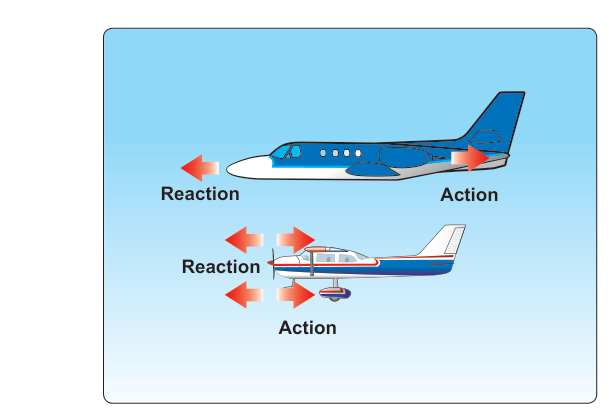
Sir Isaac Newton's Third Law states that for every action there is an equal and opposite reaction. Applied to aerodynamics, the wing is not merely a passive shape deflecting pressure—it is actively redirecting a large mass of air downward. This downward deflection of air, called downwash, is the "action." The reaction is an upward force on the wing. The greater the mass of air deflected and the greater the downward velocity imparted to it, the larger the reactive lift force.
This Newtonian mechanism depends primarily on the wing's angle of attack (AOA)—the angle between the wing's chord line and the relative wind. Even a perfectly flat, uncambered board will generate lift at a positive angle of attack because it physically scoops air downward. This is why a symmetrical airfoil (identical upper and lower surface curvature) flying at zero angle of attack produces essentially no lift, yet produces significant lift when pitched to a positive AOA: the geometry is symmetrical, so Bernoulli's pressure differential is negligible, but the downwash reaction is not. Similarly, it explains why a classic light-sport aircraft with a simple, nearly flat-bottomed airfoil can still climb effectively—the wing is flown at a sufficient angle of attack to ensure strong reactive lift even when the Bernoulli component is modest.
How the Two Mechanisms Work Together
Neither explanation stands alone. Bernoulli's Principle accounts well for the lift generated by camber at low angles of attack, where the pressure differential between upper and lower surfaces dominates. As angle of attack increases, the Newtonian deflection of air becomes a progressively larger share of total lift. Research cited in the PHAK and aviation weather and aerodynamics literature consistently shows that in normal cruise flight, both contributions are simultaneously present and significant. Removing either from the analysis produces an incomplete—and potentially misleading—picture of wing behavior.
Consider a concrete scenario: a sport pilot flying a light-sport aircraft reduces power on final approach. Airspeed drops, reducing the Bernoulli pressure differential (recall: lift ∝ V²). To compensate and maintain altitude, the pilot applies back pressure, increasing angle of attack. This amplifies the Newtonian reactive component. The two mechanisms adjust dynamically in concert throughout every phase of flight.
Angle of Attack: The Central Variable
Understanding both mechanisms makes it clear why angle of attack is the single most operationally critical variable in aerodynamics. The PHAK defines the critical angle of attack as the AOA at which the airflow over the upper wing surface separates from the surface rather than following it smoothly. For most general aviation and light-sport aircraft airfoils, the critical angle of attack is approximately 16 to 18 degrees, though the exact value is airfoil-specific. When this angle is exceeded:
- The smooth, accelerated airflow over the upper surface breaks down into turbulent, separated flow—eliminating the Bernoulli pressure differential.
- The wing can no longer redirect air smoothly downward in a controlled manner—reducing the Newtonian reactive lift as well.
- Total lift collapses dramatically: the wing stalls.
This is why the PHAK is explicit: a stall is caused by exceeding the critical angle of attack, not by low airspeed alone. A sport pilot can stall at cruise airspeed by abruptly pulling back hard on the controls (accelerated stall), or can stall while banked steeply because the horizontal component of lift requires a higher AOA to maintain altitude at the same airspeed. The stall speed increases with the square root of the load factor—in a 60-degree banked level turn, load factor is 2G, and the load factor multiplier on stall speed is the square root of 2, or approximately 1.41 times the wings-level stall speed.
Why This Matters Specifically for Light-Sport Aircraft
LSA airfoils are frequently high-lift designs optimized for slow flight: generous camber, sometimes with fixed leading-edge slats or large flap systems, and relatively low wing loading. These design choices amplify both lift mechanisms at low speed. High camber maximizes the Bernoulli pressure differential at low airspeeds. Large flap deflections increase effective camber further and also increase the AOA of the flapped section, strengthening the Newtonian downwash component. This is why extending full flaps on an LSA can dramatically lower approach speed while still generating adequate lift—both mechanisms are being leveraged simultaneously.
The practical in-cockpit takeaway: when flying an LSA slowly—on approach, in the pattern, or during a soft-field takeoff—you must manage angle of attack actively. Airspeed is an indirect indicator of AOA, not a direct one. A gust that changes the direction of the relative wind can momentarily spike your AOA toward critical values even if the airspeed indicator reads normally. This is the aerodynamic basis for the FAA's emphasis on maintaining proper approach airspeeds and avoiding abrupt control inputs at low altitude.
Key Numbers and Rules
- Lift equation: L = CL × ½ρV² × S, where CL is the lift coefficient (AOA-dependent), ρ is air density, V is true airspeed, and S is wing area. Both Bernoulli and Newton effects are captured inside CL.
- Critical AOA: typically 16–18° for common light-sport airfoils; stall occurs at this angle regardless of airspeed or aircraft attitude.
- Load factor and stall speed: stall speed increases with the square root of load factor; at 2G (60° bank), stall speed is ~1.41 times the unaccelerated stall speed.
- Lift varies with V²: halving airspeed reduces the velocity-dependent portion of lift to 25% of its original value.
- Symmetrical airfoil at zero AOA: produces essentially zero lift—demonstrating that camber (Bernoulli) and AOA (Newton) must both be considered.
Common Test Traps
- "The shape of the airfoil is the only cause of lift." Incorrect. Angle of attack and the reactive force from downwash are equally real contributors. Flat boards and symmetrical airfoils generate lift at positive AOA.
- Confusing pitch attitude with angle of attack. AOA is measured between the chord line and the relative wind, not the horizon. A nose-high attitude in a descent can coexist with a low or even negative AOA.
- Believing stalls only happen at low airspeeds. Stalls are purely an AOA event. An abrupt pull-up, a steep banked turn, or a gust can push AOA past critical at any airspeed and any attitude.
- Assuming Bernoulli alone explains lift in all conditions. At high angles of attack, in turbulent conditions, or with simple flat-bottomed LSA airfoils, the Newtonian downwash reaction carries a substantial and sometimes dominant share of total lift.
- Forgetting density altitude. Lower air density (high elevation, high temperature) reduces ρ in the lift equation, requiring higher true airspeed or higher AOA—or both—to generate the same lift. This is critical for LSA operations at mountain airports.